
GRASP: Awakening Latent Spatial Reasoning in LVLMs via Training-free Geometric Rectification
Abstract
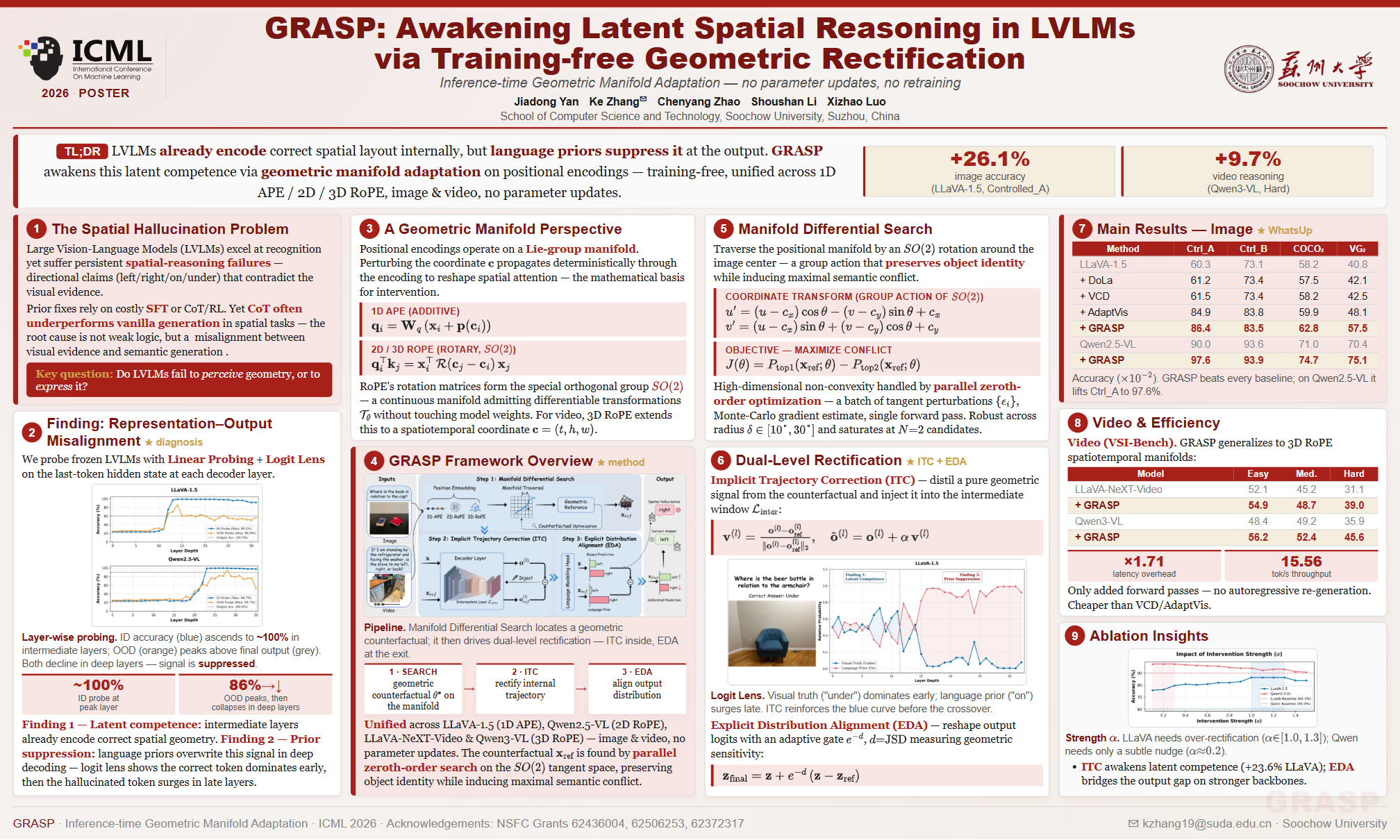
Large Vision-Language Models (LVLMs) exhibit remarkable general capabilities but struggle significantly with spatial reasoning tasks. In this paper, we uncover a critical representation-output misalignment via linear probing: LVLMs correctly encode spatial features internally, but generate incorrect results in the final text. To address this, we pioneer the Inference-time Geometric Manifold Adaptation paradigm and propose GRASP (Geometric Rectification for Active Spatial Perception), a training-free framework to awaken these latent capabilities. GRASP employs Manifold Differential Search to identify optimal geometric counterfactuals, which then drive a dual-level rectification mechanism: Implicit Trajectory Correction to rectify attenuated intrinsic geometric features in intermediate decoder layers, and Explicit Distribution Alignment to break the dominance of language priors at the output layer. Extensive experiments spanning diverse architectures (LLaVA, Qwen 2.5/3-VL) and positional encoding paradigms (1D APE, 2D/3D RoPE) across image and video benchmarks (WhatsUp, VSR, VSI-Bench) demonstrate that GRASP significantly mitigates spatial hallucinations without parameter updates, achieving accuracy gains of up to 26.1% on image benchmarks and 9.7% on video reasoning tasks, consistently outperforming baseline methods.
Lay Summary
Today's advanced AI models can analyze complex images and write brilliant descriptions, but they frequently struggle with simple spatial reasoning, like telling "left" from "right" or "front" from "behind." In this paper, we made a surprising discovery: these AI models actually do perceive the correct spatial relationships internally, but they get overruled by their own "language habits" before producing the final answer. To solve this, we introduce GRASP, a training-free framework for active spatial perception. Instead of expensively retraining the entire model, GRASP intervenes directly during the AI's generation process. Before the model's accurate geometric understanding can be overpowered by its language biases, GRASP actively rectifies the internal spatial features. This intervention ensures that the AI's final answer is driven by actual visual evidence rather than statistical text assumptions. Our approach significantly boosts the spatial accuracy of popular AI models without incurring any extra training costs. This brings us one step closer to building reliable AI systems for real-world tasks where precise spatial awareness is critical, such as robotics and autonomous driving.