
SWE-rebench V2: Language-Agnostic SWE Task Collection at Scale
Abstract
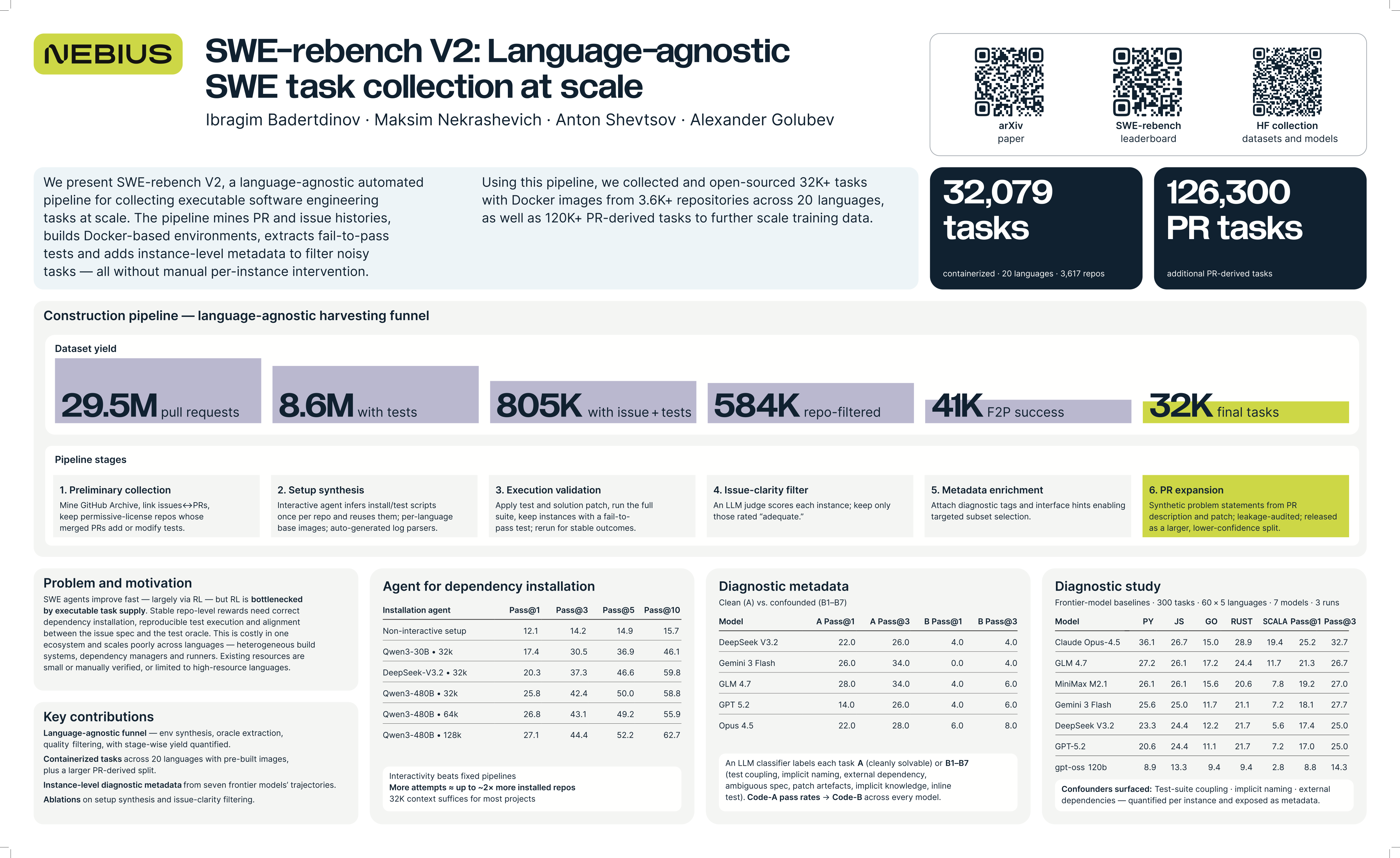
Software engineering agents (SWE) are improving rapidly, with recent gains largely driven by reinforcement learning (RL). However, RL training is constrained by the scarcity of large-scale task collections with reproducible execution environments and reliable test suites. Although a growing number of benchmarks have emerged, datasets suitable for training remain limited in scale and diversity or often target a limited set of high-resource language ecosystems. We introduce SWE-rebench V2, a language-agnostic automated pipeline for harvesting executable real-world SWE tasks and constructing RL training environments at scale. The pipeline synthesizes repository-specific installation and test procedures via an interactive setup agent, and filters unsound instances using an ensemble of LLM judges, validated against human-verified SWE-bench annotations. Using this pipeline, we construct a dataset of 32,079 tasks spanning 20 languages and 3,617 repositories, with pre-built images for reproducible execution. To further scale training data, we additionally release 120,000+ tasks with installation instructions, fail-to-pass tests and rich metadata, where the problem statement is generated based on the original pull request description. We validate the collected instances through a diagnostic study that covers a subset of tasks in five programming languages across seven popular models, and provide instance-level metadata that flags common confounders such as overly restrictive tests and underspecified descriptions. We release the datasets, the collection and execution code, and associated artifacts to enable large-scale training of SWE agents across diverse languages and repositories.
Lay Summary
Modern AI coding assistants are becoming better at fixing real software bugs, but training them requires many realistic programming tasks where solutions can be checked automatically. Today, such tasks are scarce, especially outside a few popular programming languages, because each software project has its own build tools, dependencies, and test setup. We introduce SWE-rebench V2, an automated system for collecting real software engineering tasks from open-source repositories and turning them into reproducible training environments. Our pipeline finds pull requests that fix issues, reconstructs how to install and test each project, and keeps tasks where the original tests can confirm that a fix works. Using this approach, we collect 32,079 executable tasks across 20 programming languages and 3,617 repositories, plus more than 120,000 additional tasks with installation and testing metadata. The dataset also includes labels that help researchers identify tasks that may be ambiguous, fragile, or dependent on external information. This makes it easier to train and evaluate AI agents on realistic software work, not just small coding exercises. By releasing the data, environments, and collection pipeline, we aim to support more reliable and broadly capable AI tools for software development.