
Lightweight and Interpretable Transformer via Unrolling of Mixed Graph Algorithms for Traffic Forecast
Abstract
Lay Summary
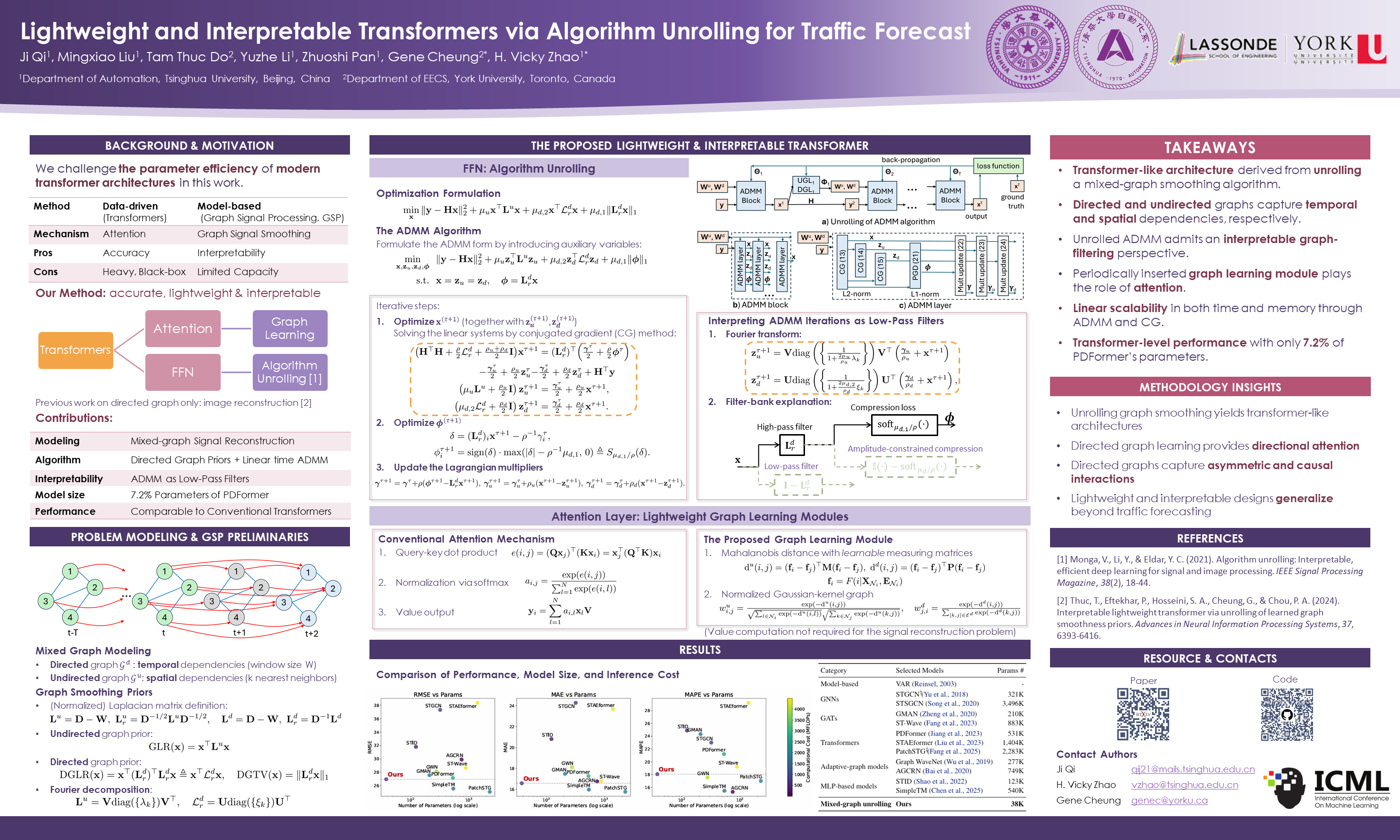
We challenge the parameter efficiency of modern transformer architectures in this work. Conventional transformers rely on dense self-attention mechanisms and large black-box feed-forward networks (FFNs), which often result in high computational cost and limited interpretability. Using city-scale traffic forecasting as a case study, we develop a lightweight and interpretable transformer-like neural network by unrolling a mixed-graph smoothing algorithm. Despite using only 7.2% of the parameters of the transformer-based PDFormer model, our approach achieves competitive performance against a wide range of strong baselines. Our method models traffic data using a mixed graph composed of two parts: an undirected graph that captures spatial relationships between road sensors, and a directed graph that models how traffic evolves over time. Building on ideas from graph signal processing, we design smoothing priors for both graph types — including a new prior for directed graphs — and formulate traffic forecasting as a graph signal recovery problem. We solve this optimization problem using an iterative ADMM algorithm, whose operations can be interpreted as a sequence of low-pass graph filters over the learned mixed graph. By unrolling these iterative steps into neural network layers and learning only a small number of filter parameters, we obtain an interpretable and parameter-efficient alternative to conventional transformer FFNs. We further show that transformer attention learning is closely related to Gaussian-kernel graph learning, allowing us to implement local attention structures at dramatically lower parameter cost. Our results suggest that many parameter-heavy transformer components can be replaced by structured graph-based operations with strong mathematical interpretations. Although we evaluate our approach on traffic forecasting, the broader goal of this work is to study how directed relationships — analogous to directional attention scores — can be modeled using graph learning and graph signal processing techniques. We believe these lightweight and interpretable transformer designs may generalize to a much broader range of applications beyond traffic systems.