
Physically-Guided Data-Space Rectified Flow for Precipitation Nowcasting
Abstract
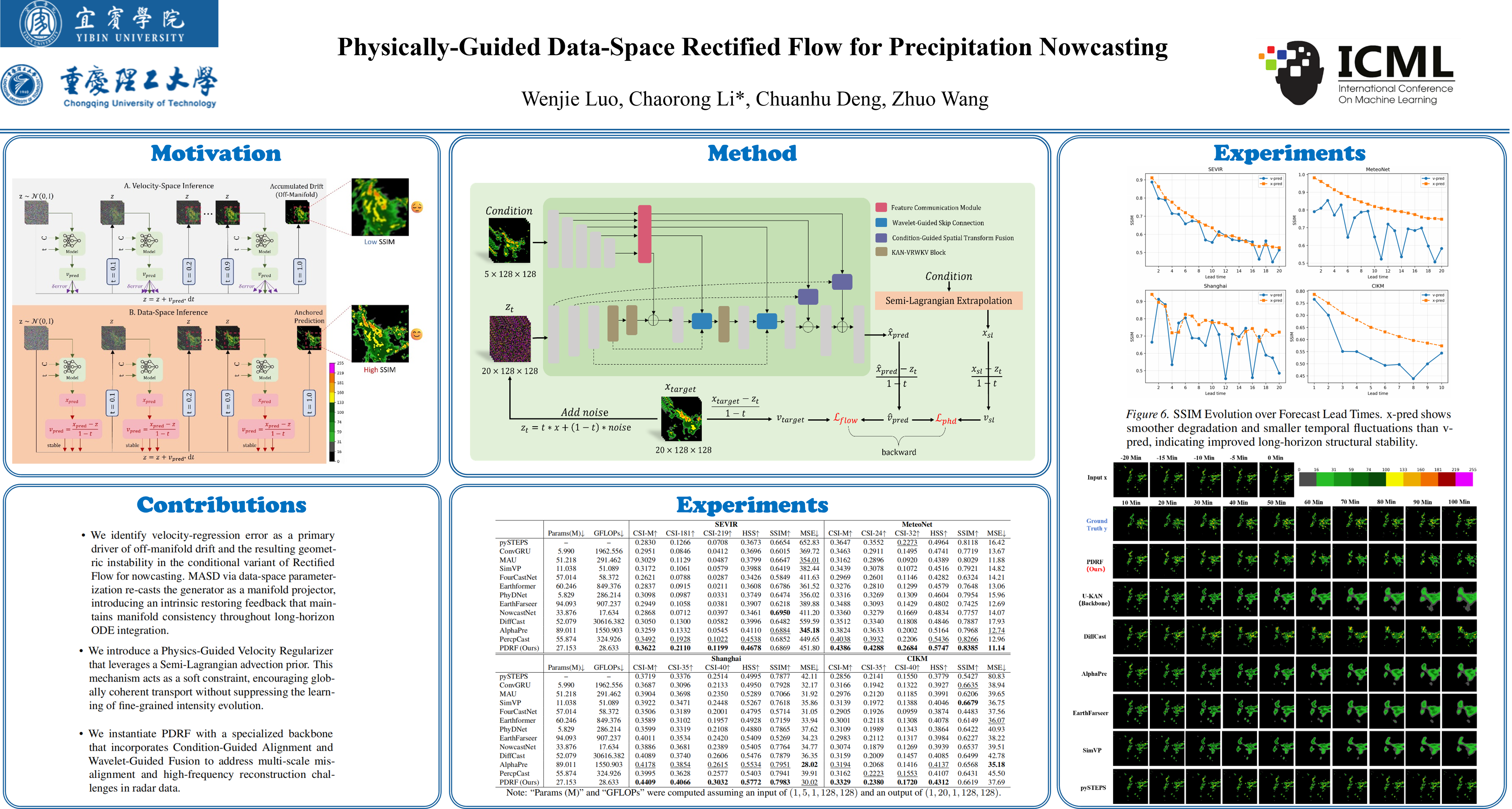
Reliable long-horizon precipitation nowcasting requires preserving fine-scale echo structures while maintaining coherent transport. Although Rectified Flow (RF) can generate detail-preserving future sequences, numerical ODE integration compounds velocity estimation errors and induces progressive off-manifold drift, causing morphological distortions at extended lead times. We propose Physically-guided Data-space Rectified Flow (PDRF), which re-parameterizes the generative ODE in data space: the network predicts the clean future sequence, analytically inducing a coupled vector field with an implicit restoring effect that suppresses drift. We also introduce a soft Semi-Lagrangian teacher based on an advection prior to regularize large-scale transport, while allowing local growth/decay/deformation to be learned from data. Experiments on four public benchmarks demonstrate consistent improvements in event-based skill and better preservation of intense-echo morphology over long horizons.
Lay Summary
Heavy rain can form and move very quickly, leaving little time for people to prepare. To issue timely warnings, weather services need computer models that can predict where rain will go in the next few minutes to hours. Current AI models often have two problems: some make forecasts that look too blurry and miss heavy rain, while others produce sharper images but gradually lose the correct shape and movement of storms. We developed a new model called PDRF to make short-term rain forecasts more stable and realistic. Instead of only guessing small changes step by step, our model repeatedly predicts what the future radar “movie” should look like and uses this prediction to correct itself. We also give the model a simple physical hint about how rain usually moves, while still allowing it to learn when rain grows, weakens, or changes shape. In tests on four public radar datasets, PDRF was better at detecting rainfall events and keeping the structure of heavy rain areas clear over longer forecast times. This work could help produce more reliable early warnings for floods and severe weather.