
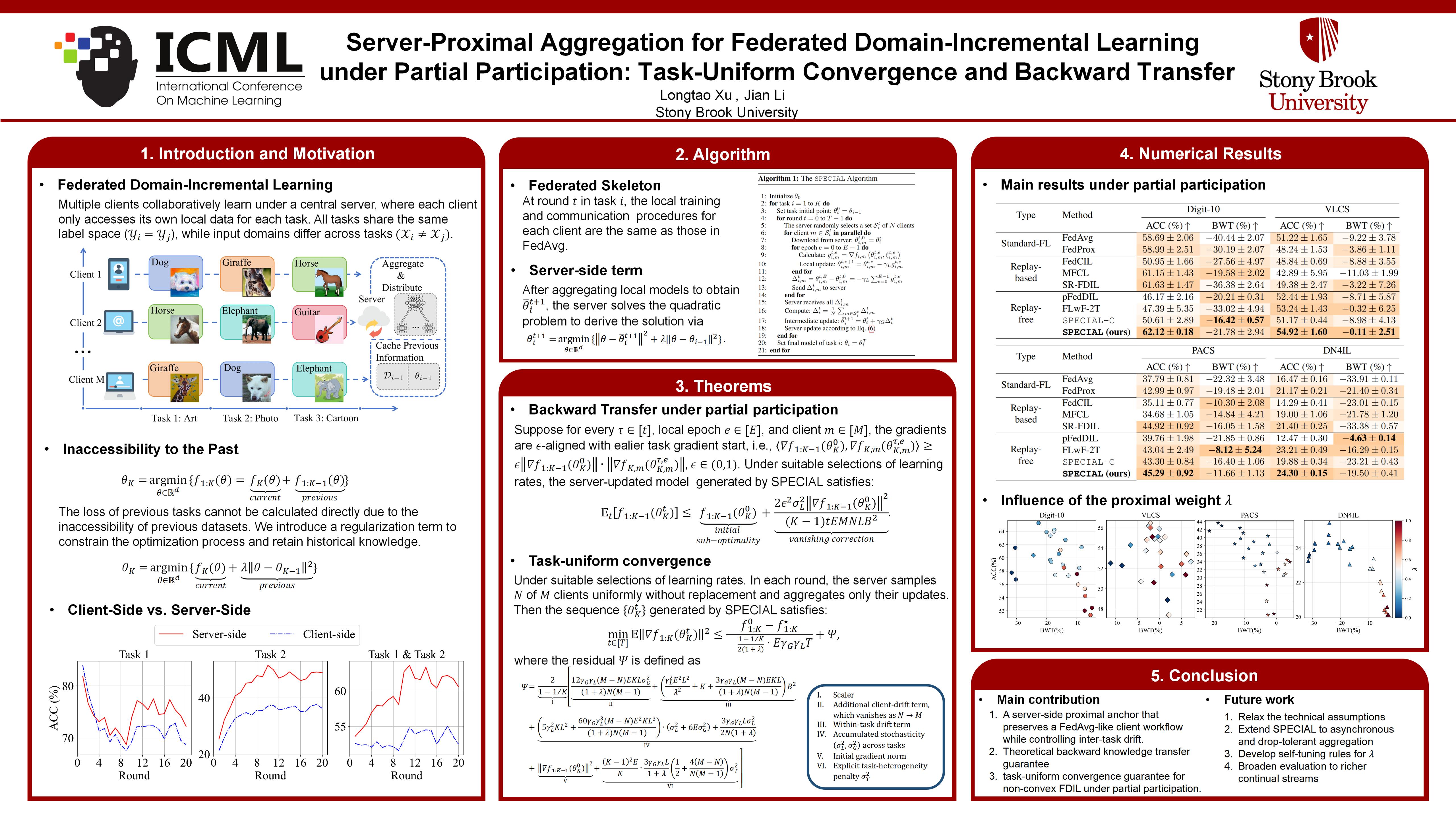
Server-Proximal Aggregation for Federated Domain-Incremental Learning under Partial Participation: Task-Uniform Convergence and Backward Transfer
Abstract
Lay Summary
Machine learning systems are often trained using data from many organizations or devices, such as hospitals, phones, or sensors. These participants usually cannot share their raw data because of privacy or policy restrictions. At the same time, the data they see can change over time. A medical model may encounter images from new scanners, or a mobile application may see changing user behavior. The challenge is to help the model learn from new situations without forgetting what it learned before. This paper presents SPECIAL, a simple method for making shared, privacy-preserving learning systems more stable over time. Each participant continues to learn from its current data in the usual way, while the central coordinator gently anchors the updated model to knowledge learned from earlier data. This helps the model adapt to new information while reducing forgetting. The method does not store old raw data, generate artificial past data, or require extra communication. We show mathematically that SPECIAL can protect earlier knowledge and keep training efficient, even when only some participants are available at a time. Experiments on image and language tasks show that SPECIAL performs well compared with existing methods. These results suggest that a simple anchoring strategy can make privacy-preserving machine learning more reliable in changing real-world environments.