
SP-Mind: An Autonomous Reasoning Agent for Spatial Proteomics Analysis
Abstract
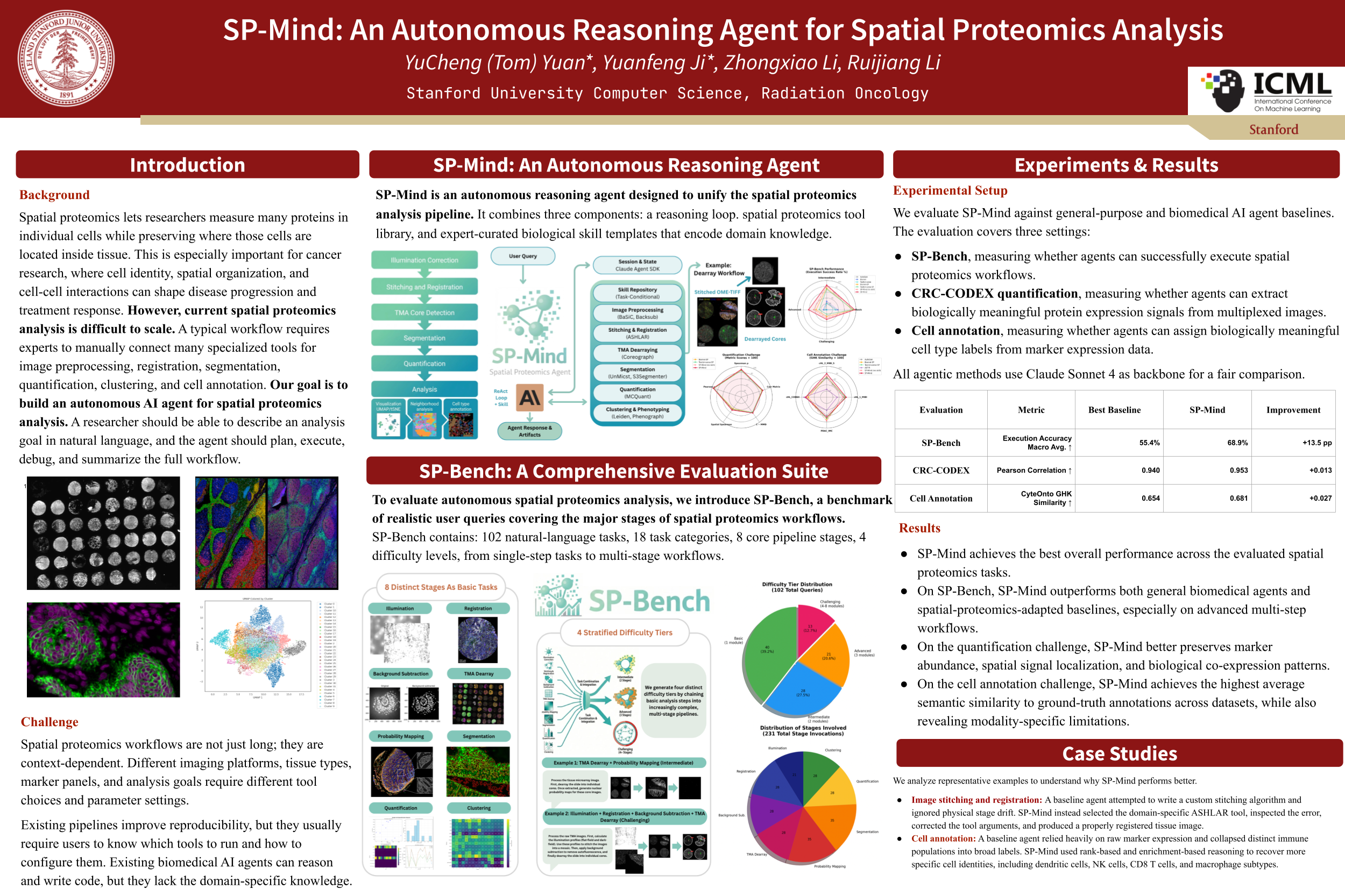
Spatial proteomics enables single-cell-resolution characterization of protein expression within tissue architecture, playing a critical role in understanding tumor microenvironments and guiding precision medicine. However, current analysis workflows remain fragmented, requiring expert manual orchestration of heterogeneous tools and limiting research scalability and reproducibility. We present SP-Mind, the first autonomous AI agent designed to unify the spatial proteomics analysis pipeline, from raw multiplexed tissue imaging to downstream phenotype discovery. Equipped with expert-curated biological analysis skills and specialized computational tools, SP-Mind converts natural-language queries into end-to-end analytical workflows without task-specific fine-tuning. To rigorously evaluate its capabilities, we introduce SP-Bench, a comprehensive benchmark spanning diverse tissue types, comprising 102 tasks across 18 distinct categories. Through extensive evaluation on SP-Bench and established downstream tasks, SP-Mind achieves state-of-the-art performance compared to existing open-source biomedical agent baselines.
Lay Summary
Modern microscopes can measure many proteins in individual cells while also showing where those cells are located inside a tissue sample. This is especially useful for studying cancer and other diseases, because the way tumor cells, immune cells, and surrounding cells are arranged can affect disease progression and treatment response. However, turning these large and complex images into useful biological findings usually requires experts to manually choose, configure, and connect many separate computer programs. We developed SP-Mind, an AI system that helps automate this process. A researcher can describe an analysis goal in ordinary language, and SP-Mind plans and runs the needed steps, such as preparing images, identifying cells, measuring protein levels, grouping similar cells, and summarizing results. We also created SP-Bench, a collection of 102 realistic test tasks for evaluating systems on spatial proteomics analysis. In our experiments, SP-Mind performed better than existing open-source biomedical AI systems, suggesting that AI can make spatial proteomics analysis more scalable, reproducible, and accessible.