
Distinguishing Imitation Error from Intrinsic Motion Learning Difficulty
Abstract
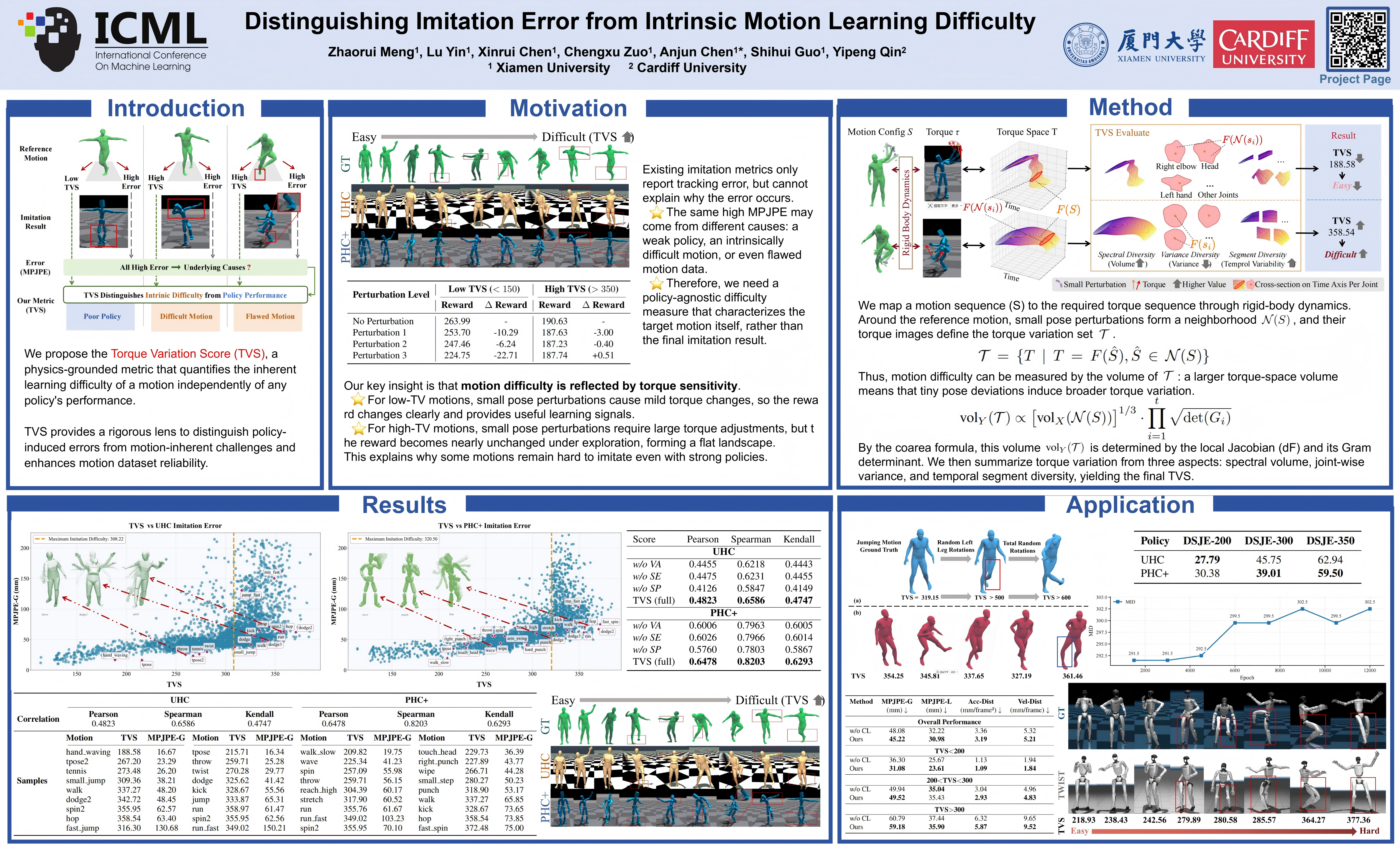
Physics-based motion imitation is central to humanoid control, yet current evaluation metrics(e.g., MPJPE) only quantify imitation outcomes, not their underlying causes. This conflation obscures a critical diagnostic question: when imitation error occurs, does it stem from policy limitations or the intrinsic learning difficulty of the target motion? To resolve this ambiguity, we propose the Torque Variation Score (TVS), a physics-grounded metric that quantifies the inherent learning difficulty of a motion independently of any policy's performance. TVS measures the magnitude of torque variation required to correct small pose perturbations, directly capturing how dynamical properties shape the reinforcement learning landscape. We establish that high-TV motions induce flat reward landscapes and vanishing policy gradients, explaining persistent imitation failures. Extensive experiments with state-of-the-art methods (UHC, PHC+) confirm TVS strongly correlates with imitation error and enables principled error attribution: high error on low-TV motions indicates policy deficiency, while high error on high-TV motions reflects fundamental learning constraints. Beyond error diagnosis, TVS facilitates three practical applications: Maximum Imitable Difficulty (MID) for policy capability assessment, Difficulty-Stratified Joint Error (DSJE) for granular performance profiling, and Flawed Motion Detection for identifying segments with abnormally high learning difficulty to support mocap data curation and quality control. TVS provides a rigorous lens to distinguish policy-induced errors from motion-inherent challenges and enhances motion dataset reliability.
Lay Summary
Humanoid robots can learn to imitate human motion, but when they fail, it is often unclear why. A robot may fail because its controller is not good enough, or because the target motion is intrinsically difficult to learn due to the physics of balance, contact, and torque control. We propose a new measure called Torque Variation Score (TVS) to estimate how difficult a motion is for a humanoid robot to learn, before judging any particular controller. Instead of only measuring the final imitation error, TVS looks at how much the required joint torques change when the robot’s pose is slightly disturbed. Motions with high TVS are harder because small mistakes can require large and unstable corrections, making reinforcement learning less effective. Our experiments show that TVS is strongly related to imitation failure in modern humanoid control methods. This allows us to separate two different cases: high error on an easy motion suggests a weak policy, while high error on a difficult motion reflects the motion’s inherent challenge. TVS can also help compare policy capability, analyze which joints fail under different difficulty levels, and detect flawed motion-capture clips that may harm training. Overall, TVS provides a clearer way to understand, evaluate, and improve physics-based humanoid motion imitation.