
Constrained hybrid modelling to predict microbial dynamics and organic matter turnover in soil systems
Abstract
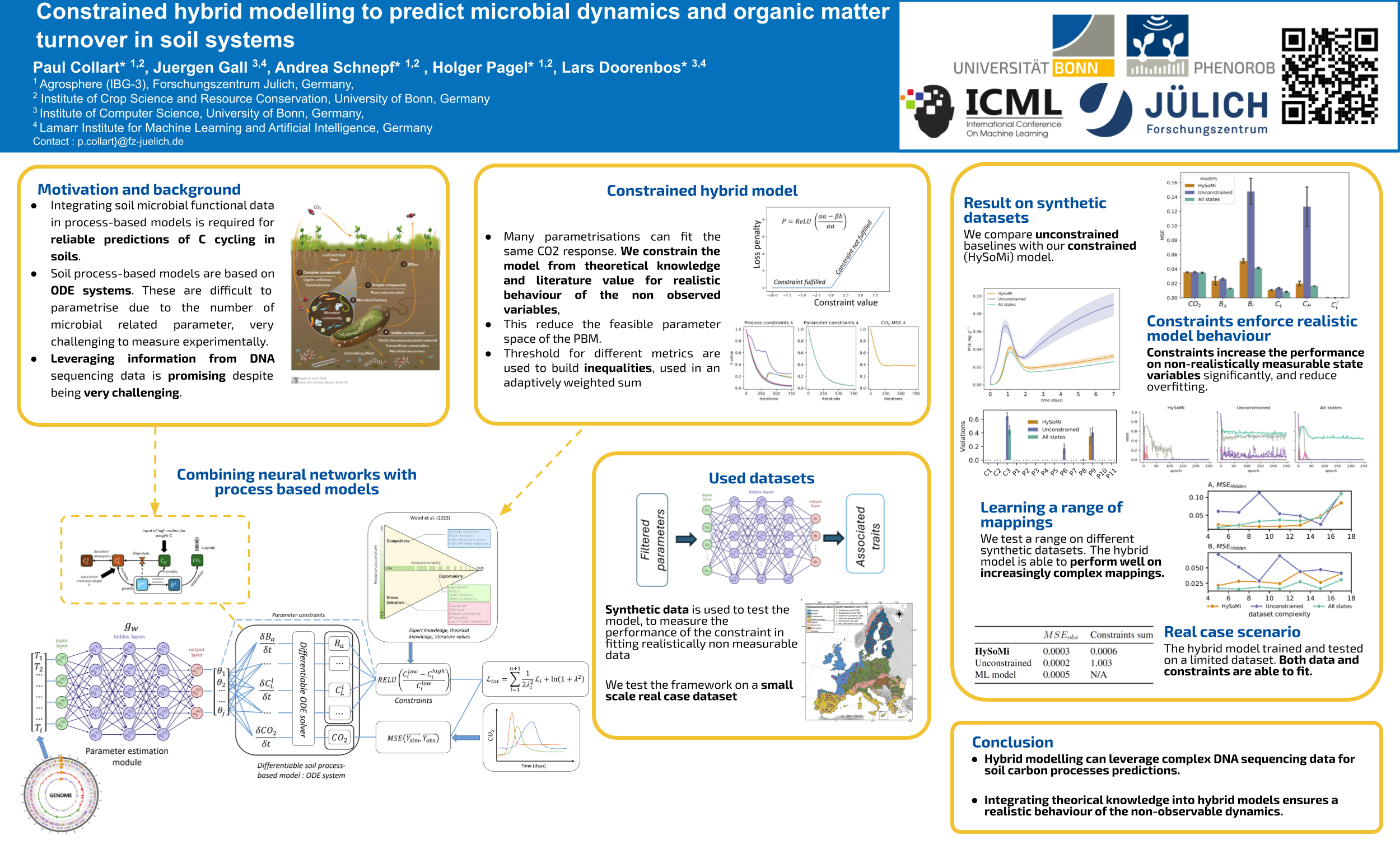
Soil microorganisms control organic matter cycling and largely determine how soil systems can cope with and mitigate climate change and environmental threats. Representing microbial dynamics in process-based soil models is therefore critical to predict carbon cycling in soils, albeit highly challenging to inform from data. One promising approach to improve their parametrisation is the integration of genomic data, yet modelling the complex and unknown relationship between genomes and the processes the microbes are driving is an unsolved problem. In this work, we present the first hybrid modeling framework for deriving biokinetic parameter values of a process-based soil organic matter turnover model from metagenome-inferred functional traits based on DNA sequencing data. Our model predicts biokinetic parameters of the process-based model from genomic trait data with a neural network and integrates constraints from ecological theory and literature to ensure realistic behavior, even of non-observed state variables. We evaluate our method on synthetic genomic trait datasets of varying complexity and on real data, showing that our approach improves performance over multiple baselines and learns the dynamics of unmeasurable components of the process-based model effectively, even for small training datasets.
Lay Summary
Microbial activity and the different processes they drive control the fate of carbon in soils and therefore influence global carbon cycling. We need to understand how microorganisms control soil organic matter turnover to predict and evaluate carbon storage and greenhouse gas mitigation. Soil biogeochemical models simulate microbial activities and fluxes of matter in soil, but predictions are limited because it is challenging to simulate the behavior of complex microbial populations in soil. The DNA of the microorganism provides information to understand their activity in soils and we have developed a method that uses the gene-encoded information in microbial DNA to improve simulations of microbial behavior and carbon fluxes in soil. We predict the parameters of the soil model from the genomic data with a neural network and integrate constraints from with experimental evidence and ecology theory to ensure realistic behavior, even of non-observable variables. We show that this approach can provide realistic simulations of microbial dynamics and carbon turnover in soils, thereby contributing to improved predictions of soil carbon cycling and soil resilience under environmental change.