
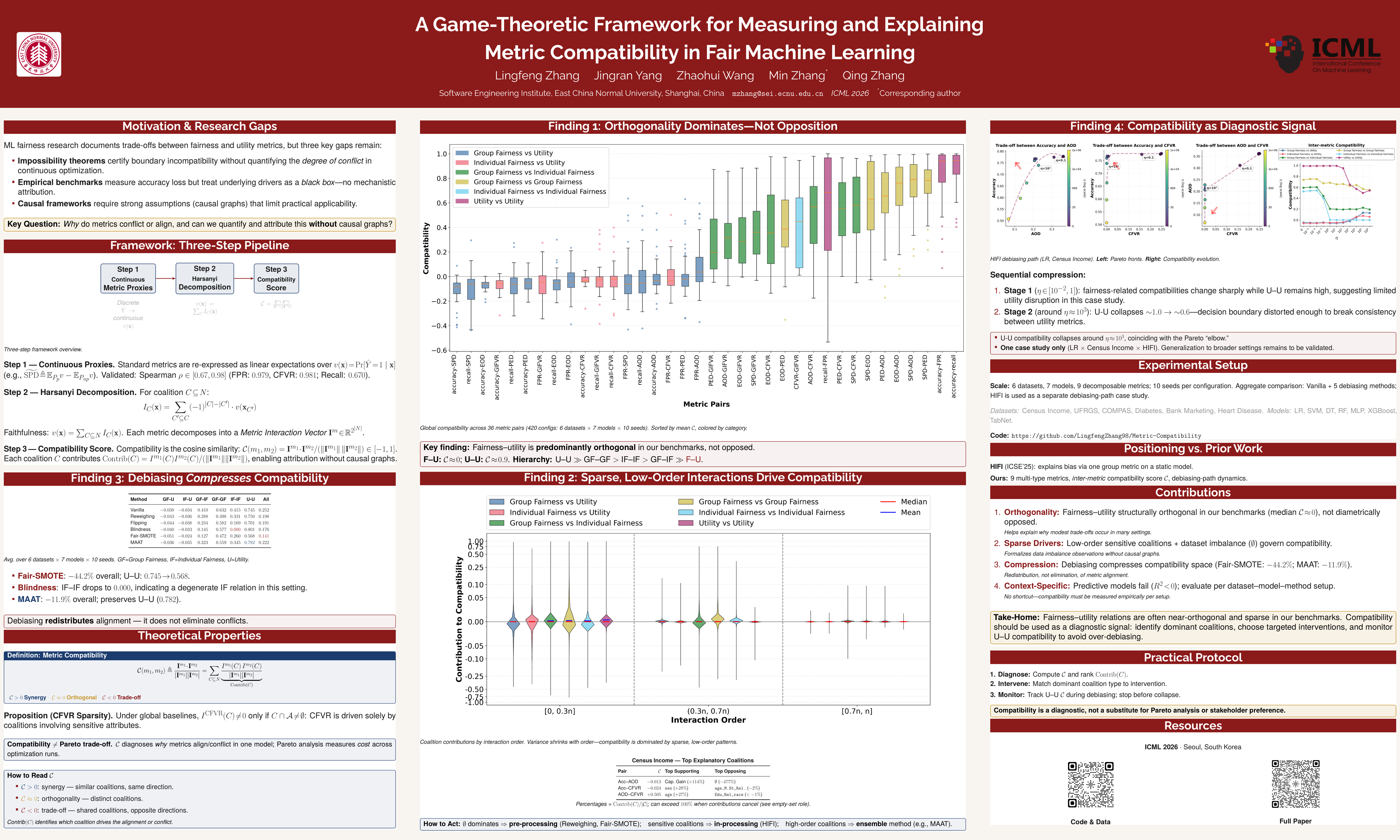
A Game-Theoretic Framework for Measuring and Explaining Metric Compatibility in Fair Machine Learning
Abstract
Lay Summary
Machine learning is now used to decide who gets a loan, a job, or even a prison sentence. These systems must be both accurate and fair, yet we often do not know whether improving fairness inevitably hurts accuracy, or whether the two goals simply rely on different information. We developed a method that reveals how well different fairness and accuracy scores align with one another. It works by breaking each score into the specific pieces of information it depends on — such as a person's age, income, or gender — and then comparing these ingredient lists across scores. Across many real-world datasets and models, we find that fairness and accuracy are usually not direct enemies. Instead, they often act like independent measuring tapes, tracking different aspects of a model's behavior. When conflicts do arise, they typically come from a few simple patterns in the data, such as imbalances between groups or the influence of particular attributes. This offers practitioners a practical way to diagnose why trade-offs occur and to make more informed choices about which fairness goals to pursue.