
Boundary Embedding Shaping with Adaptive Contrastive Learning for Graph Structural Disentanglement
Abstract
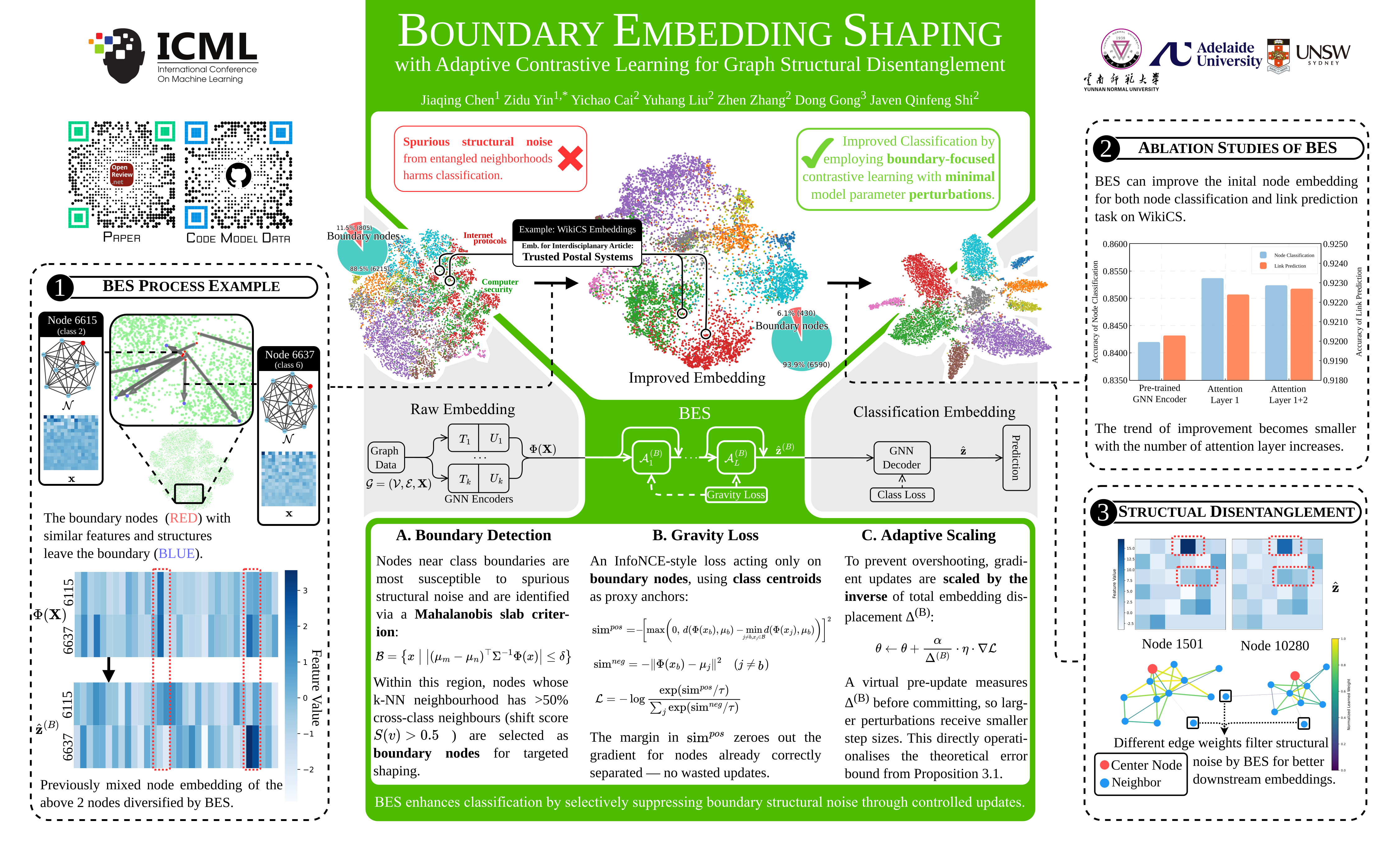
Graph neural networks (GNNs) excel at aggregating neighbor information for classification, yet their performance is hindered by graph structural entanglement, where spurious correlations from semantically irrelevant neighbors contaminate node embeddings. This challenge is most acute for nodes near class boundaries in the embedding space, where amplified structural noise blurs decision boundaries and destabilizes predictions. Existing robust GNN methods largely treat all nodes uniformly, ignoring boundary vulnerabilities. In this paper, to improve classification performance, we tackle graph structural disentanglement by identifying boundary-region entanglement as the primary bottleneck and propose Boundary Embedding Shaping (BES), an adaptive contrastive learning GNN plug-in module that selectively suppresses spurious structural noise at decision boundaries with minimal model parameter perturbation. Extensive experiments demonstrate that BES consistently improves boundary discrimination and outperforms existing leading methods. Notably, BES boosts GCN performance by an average of 3.3% in node classification (up to 5.0% on WikiCS) and achieves superior accuracy in link prediction.
Lay Summary
Graph neural networks (GNNs) are powerful tools that aggregate information from neighboring nodes to classify graph data. However, their performance often collapses when structural entanglement occurs: irrelevant or misleading neighbors inject spurious correlations into node embeddings, especially for nodes that lie near decision boundaries. Existing robust GNN approaches treat every node identically and therefore overlook this boundary‑specific vulnerability. In this work, we identify boundary‑region entanglement as the main bottleneck and introduce BES – Boundary Embedding Shaping. BES is a lightweight plug‑in that can be attached to any GNN. It uses an adaptive contrastive objective to (i) detect noisy structures around boundary nodes, (ii) suppress them via a center‑based similarity mechanism, and (iii) refine the embeddings with a pre‑update step that only touches a small fraction of model parameters. Extensive experiments on standard node‑classification and link‑prediction benchmarks show that BES consistently improves discrimination at class boundaries. Notably, it lifts the accuracy of a vanilla GCN by 3.3 % on average (up to 5 % on the WikiCS dataset) and yields higher link‑prediction scores, all while adding negligible computational overhead.