
LatentChem: From Textual CoT to Latent Thinking in Chemical Reasoning
Abstract
Lay Summary
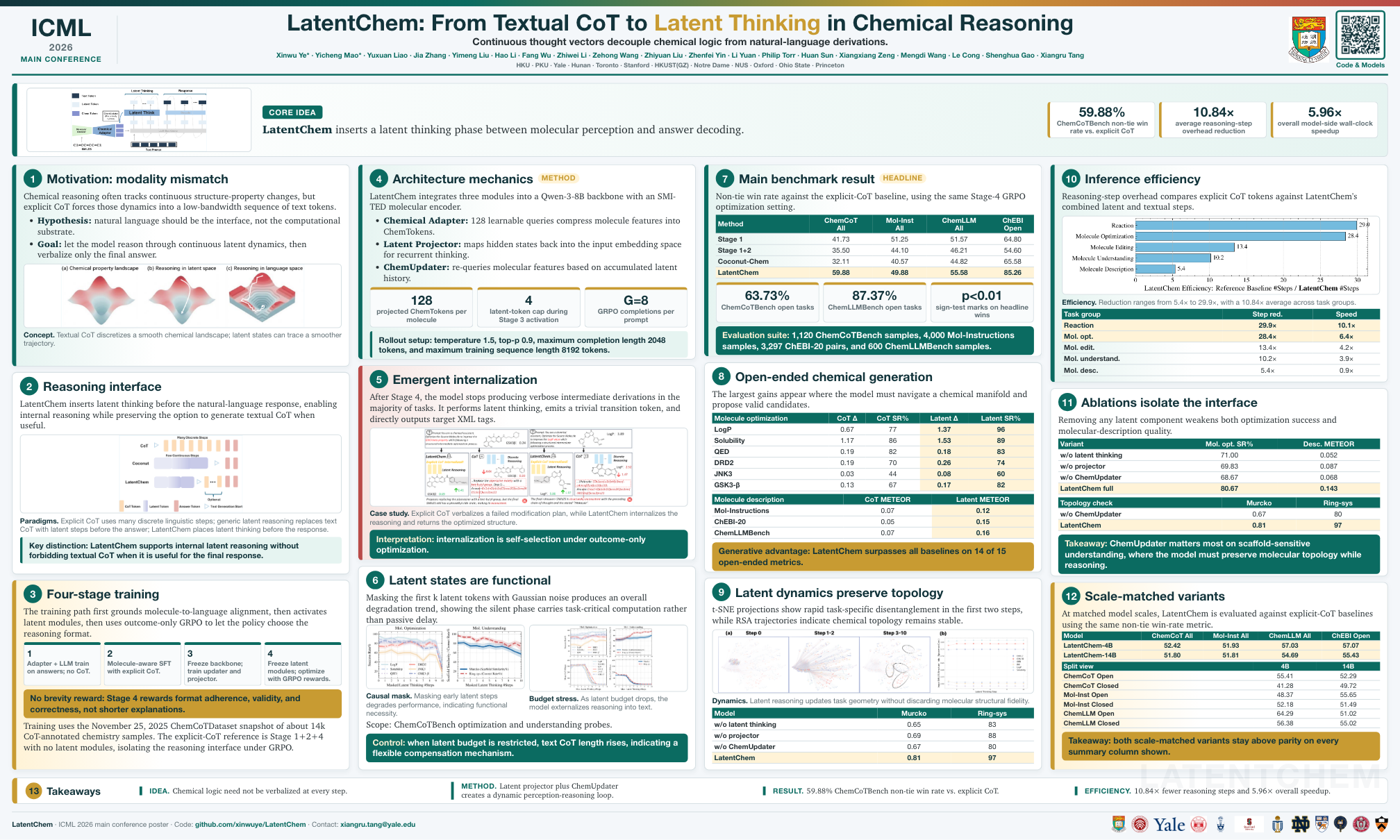
AI tools can help chemists design molecules, but many current systems solve chemistry problems by writing out long step-by-step explanations. This can be awkward because chemistry often depends on shapes, patterns, and smooth changes that are hard to squeeze into words. We built LatentChem, a system that lets an AI model do much of its chemical reasoning in compact internal signals before writing the text response. Surprisingly, after training, the model often stopped writing long explanations and chose these internal steps on its own. This made it both faster and stronger: it beat a strong step-by-step system on challenging chemistry benchmarks and needed about ten times fewer reasoning steps on average. The result suggests that future scientific AI systems may work better when they can reason in forms closer to the structure of the science, while still explaining themselves when people need to check the answer.