
From Associations to Activations: Comparing Behavioral and Hidden-State Semantic Geometry in LLMs
Abstract
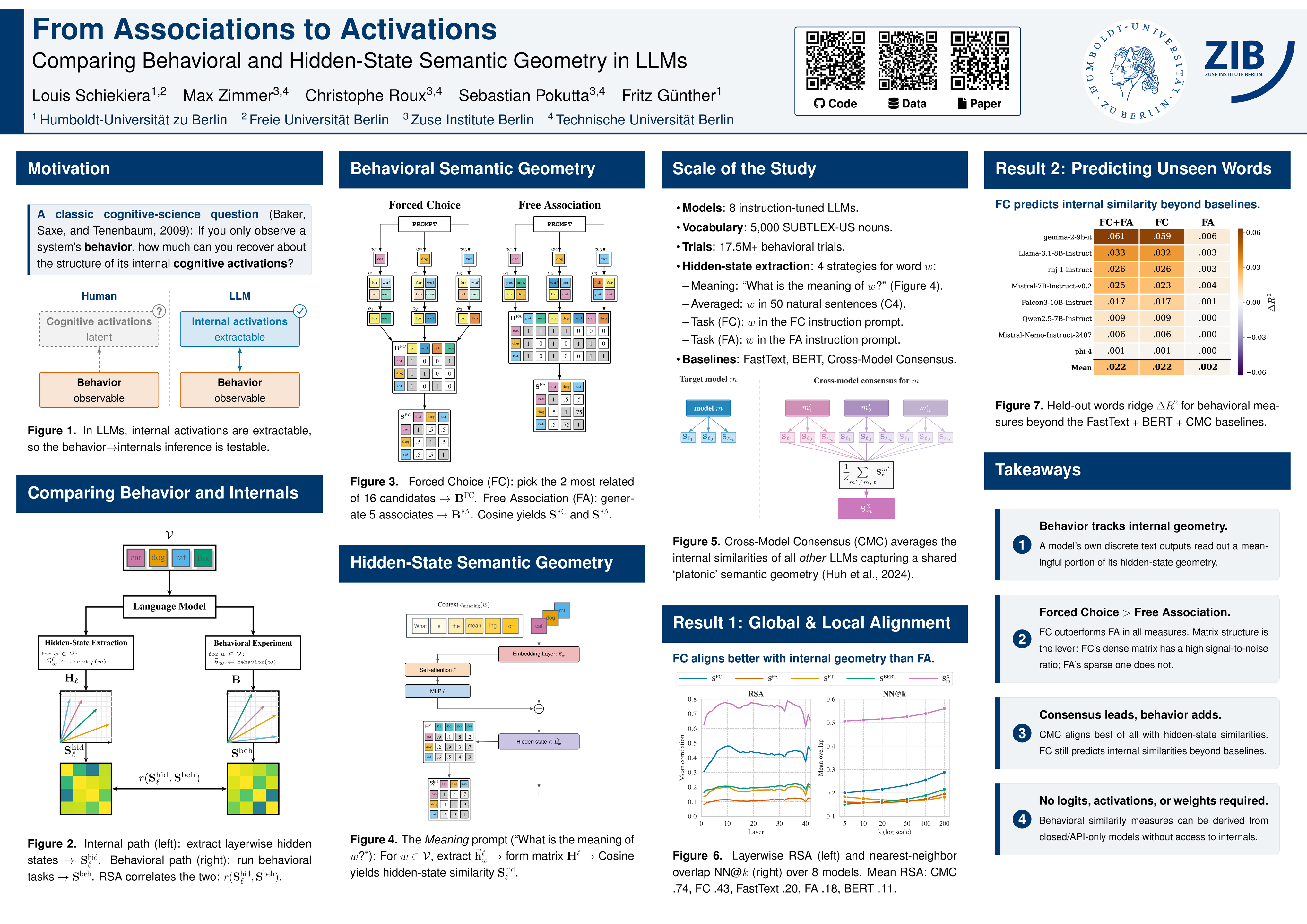
We investigate the extent to which an LLM’s hidden-state geometry can be recovered from its behavior in psycholinguistic experiments. Across eight instruction-tuned transformer models, we run two experimental paradigms---similarity-based forced choice and free association---over a shared 5,000-word vocabulary, collecting 17.5M+ trials to build behavior-based similarity matrices. Using representational similarity analysis, we compare behavioral geometries to layerwise hidden-state similarity and benchmark against FastText, BERT, and cross-model consensus. We find that forced-choice behavior aligns substantially more with hidden-state geometry than free association. In a held-out-words regression, behavioral similarity (especially forced choice) predicts unseen hidden-state similarities beyond lexical baselines and cross-model consensus, indicating that behavior-only measurements retain recoverable information about internal semantic geometry. Finally, we discuss implications for the ability of behavioral tasks to uncover hidden cognitive states.
Lay Summary
Large language models build an internal map of how word meanings relate to each other. Studying that map normally means inspecting a model's inner workings, which is not possible for the many systems whose internals are not public. We ask a narrower question: can the map be recovered just by watching how a model behaves? We borrow two tasks that psychologists have used for decades. In the first, we ask a model to pick which words are most related (forced choice). In the second, we ask it to freely associate words. From eight models we collected more than 17.5 million responses and turned them into maps of word relationships. Comparing these behavior-based maps with the models' actual internal maps, we found that forced choice recovers the internal structure far better than free association. Constraining the model's choices gives a clearer readout than letting it respond freely. Carefully designed behavioral tests can therefore recover meaningful internal structure from these systems using only their outputs, which offers a new tool at the intersection of machine learning and cognitive science. We release the full dataset as a community resource.