
Both Semantics and Reconstruction Matter: Making Representation Encoders Ready for Text-to-Image Generation and Editing
Abstract
Lay Summary
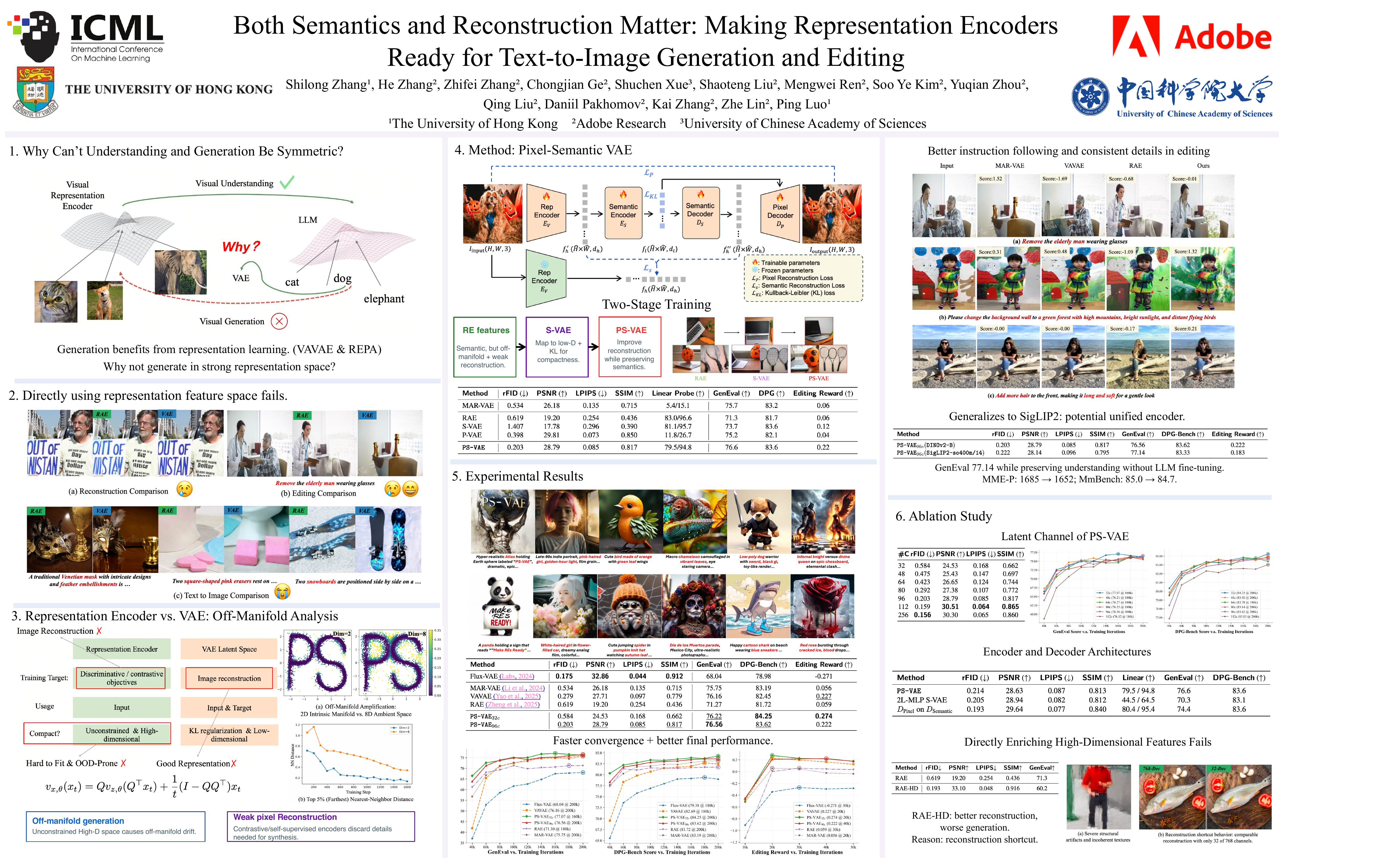
AI systems that create or edit images need a compact internal description of each image. Existing systems often use descriptions that preserve visual details but do not capture enough high-level meaning, while image understanding systems capture meaning but often lose fine details such as texture, text, and facial structure. This mismatch makes it difficult to build one image representation that works well for both understanding and generation. We study why this happens and propose PS-VAE, a method that adapts strong image understanding models so they can also support high-quality image generation and editing. The key idea is to preserve both semantic information, such as objects and layout, and fine visual details, such as geometry and texture, in a compact representation. As a result, our method improves image reconstruction, text-to-image generation, and instruction-based image editing. This work is a step toward image AI systems that can both understand visual content and generate or edit it reliably.