
Physics-informed Neural Operator Learning for Nonlinear Grad-Shafranov Equation
Abstract
Lay Summary
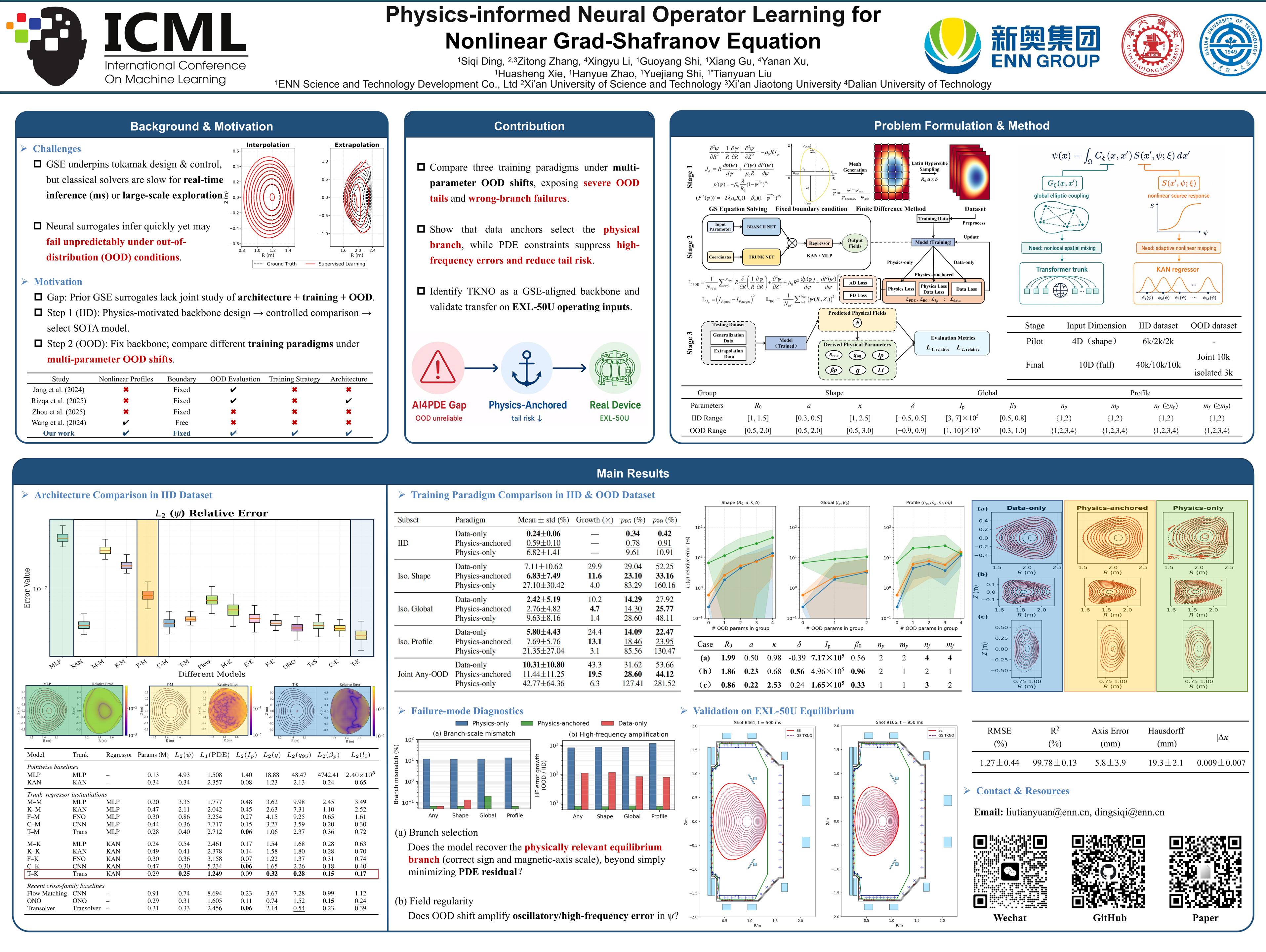
Fusion experiments try to control extremely hot charged gas inside doughnut-shaped machines. To plan and guide an experiment, scientists need fast estimates of where this gas will sit and what shape it will take. Trusted physics programs can do this, but they may be too slow when quick decisions are needed. Faster AI tools are attractive, but we found a risk: an AI model that only learns from past computer-generated examples can look accurate in familiar situations and still give impossible-looking answers when conditions change. We studied how to make this kind of AI tool more reliable. Instead of asking the model only to imitate examples, we also asked it to respect basic physics rules. We compared several designs and ways of teaching the model. The best approach in our study used both examples and physics rules, which helped reduce the worst mistakes in unfamiliar situations. We also compared our model with the planning software used on the EXL-50U fusion device. It gave closely matching results in milliseconds. This points toward faster AI tools for fusion experiments that stay tied to physics rather than only copying past examples.