
Fractional is Better: Learnable Derivative Orders in Neural Operator Learning
Abstract
Lay Summary
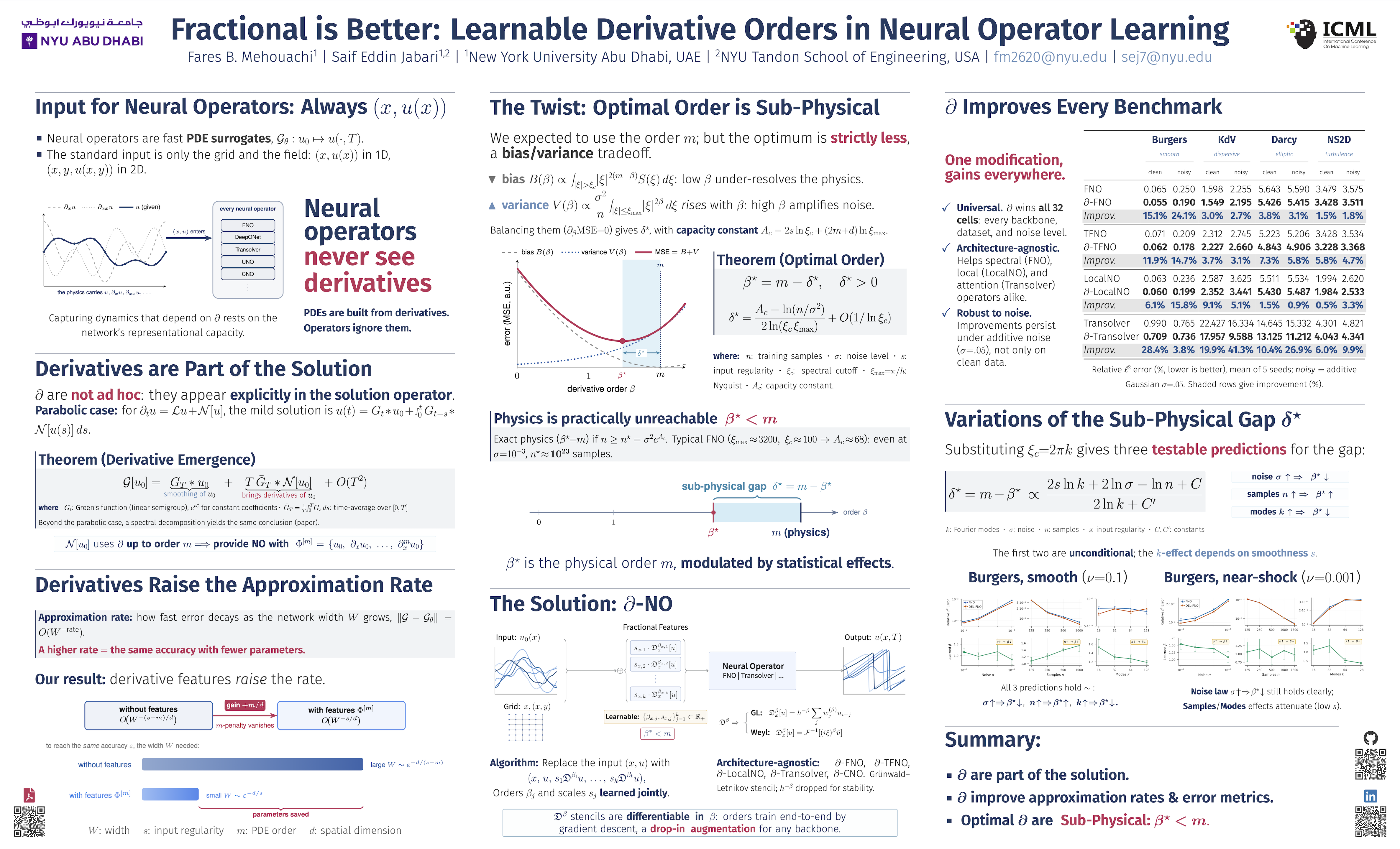
Physical phenomena around us follow simple rules: the rate of change of one quantity is tied to another, written down as partial differential equations. AI models can learn to predict these phenomena from data, but they only see raw values at points in space. To recover the physics, the model has to figure out the rates of change on its own, which is a hard thing to ask. A natural fix is to compute these rates of change in advance and feed them to the model as extra inputs. The catch is that taking a rate of change also amplifies any noise in the data, so the most physically faithful input is also the noisiest one. We let the model choose its own balance, using a tool called fractional calculus that smoothly tunes how strong each rate-of-change feature is. Across many physics problems and many AI architectures, this small change consistently improves accuracy. The model naturally picks a softer rate of change when data is noisy, and a sharper one when data is clean. The broader lesson is that when bringing science into AI, the textbook answer is rarely the statistically optimal one.