
Large Language Models as Topological Thinkers: A Benchmark on Graph Persistent Homology
Abstract
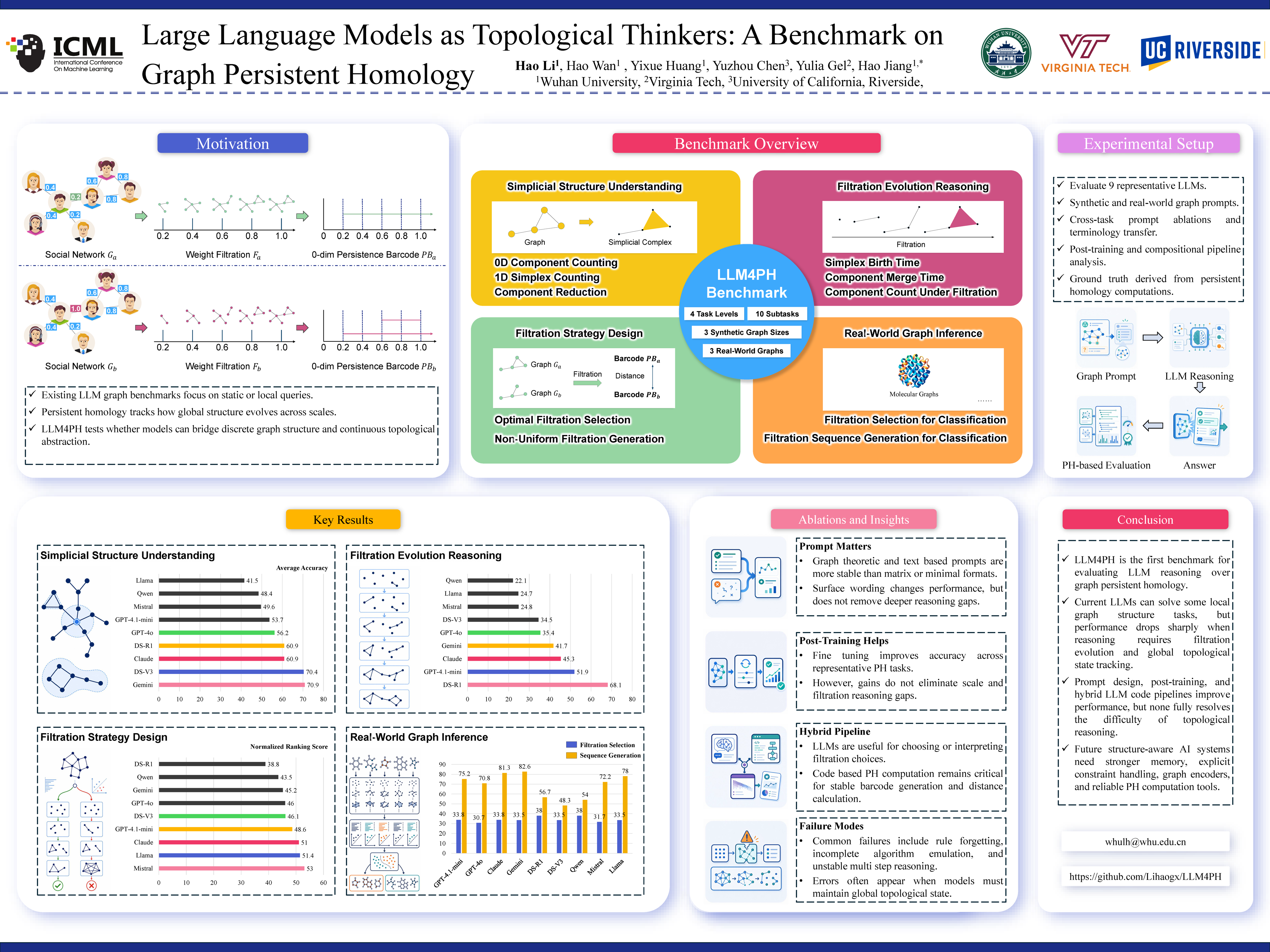
Large language models (LLMs) are increasingly used in scientific discovery, system modeling, and decision-making, prompting interest in their ability to reason over complex structured data. Existing benchmarks primarily focus on static or local graph reasoning, overlooking the high-order structures in real-world systems whose global properties evolve across multiple scales. We introduce LLM4PH, a benchmark that evaluates multi-scale structural reasoning through the lens of persistent homology (PH), a topological framework for tracking structural evolution. LLM4PH decomposes the PH pipeline into interpretable reasoning tasks spanning synthetic and real-world graphs, revealing that most models struggle with reasoning over structural transitions and persistence. Beyond task-level evaluation, we perform cross-task ablations on prompt encoding and transfer, explore post-training effects, and construct a compositional PH pipeline to assess end-to-end performance. Our results provide the first in-depth view of how well LLMs bridge discrete graph structures with continuous topological abstraction, and offer insights into their potential for structure-aware scientific reasoning.
Lay Summary
Large language models (LLMs) are increasingly used in scientific research, yet it remains unclear whether they can reason about complex structures rather than simply recognize patterns. We introduce LLM4PH, the first benchmark designed to evaluate LLMs on graph persistent homology, a framework for understanding how graph structures evolve across multiple scales. The benchmark contains ten tasks covering structural recognition, structural evolution, filtration design, and real-world graph analysis. Evaluations on nine leading LLMs show that while many models perform well on simple graph tasks, they struggle with tracking structural changes and reasoning about topological evolution. Our findings reveal important limitations in current LLMs' ability to perform multi-scale structural reasoning and provide a new benchmark for studying structure-aware scientific intelligence.