
C$^{2}$R: Cross-sample Consistency Regularization Mitigates Feature Splitting and Absorption in Sparse Autoencoders
Haoran Jin ⋅ Xiting Wang ⋅ Shijie Ren ⋅ Hong Xie ⋅ Defu Lian
Abstract
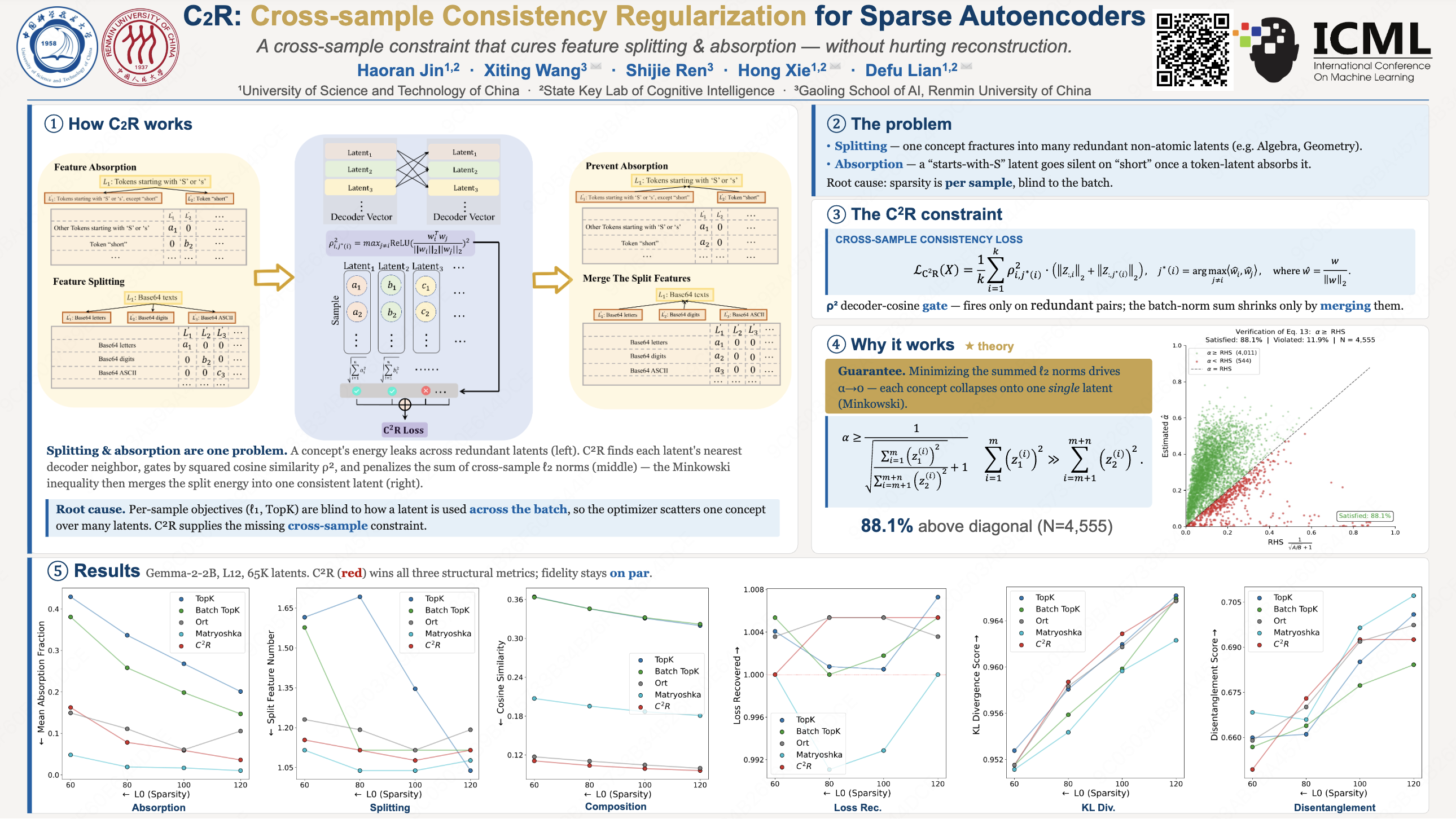
Sparse Autoencoders (SAEs) are widely used to interpret large language models by decomposing activations into sparse, human-understandable features, but scaling to large dictionaries exposes fundamental challenges. Systematic studies reveal pervasive feature splitting that fragments coherent concepts into non-atomic latents and widespread feature absorption that creates arbitrary exceptions in general features, severely compromising latent reliability. These issues stem from inconsistent latent assignment across samples: without cross-sample constraints, per-sample optimization often allows a single underlying concept to be inconsistently distributed across multiple redundant or interfering latents. To address this, we introduce C$^2$R (\underline{\textbf{C}}ross-sample \underline{\textbf{C}}onsistency \underline{\textbf{R}}egularization). C$^2$R explicitly encourages that each semantic feature is consistently represented by a unified latent across the batch by penalizing the co-activation of directionally similar latents. Comprehensive evaluation demonstrates that C$^2$R effectively mitigates both splitting and absorption while, crucially, preserving reconstruction fidelity, providing a principled solution that enhances latent interpretability without degrading model performance. Source code is available\footnote{\url{https://github.com/hr-jin/Cross-sample-Consistency-Regularization}}.
Lay Summary
Sparse autoencoders (SAEs) are used to interpret large language models by decomposing their internal activations into sparse, human-understandable features. Ideally, each learned feature corresponds to a single coherent concept. In practice, scaling SAEs to large dictionaries introduces two failure modes: feature splitting, where one concept is fragmented across multiple redundant features, and feature absorption, where a general feature develops arbitrary exceptions by absorbing unrelated information. Both problems reduce the reliability of learned features for downstream analysis. We introduce C$^2$R, a regularization method that penalizes inconsistent feature assignment across samples in a training batch. C$^2$R encourages each concept to be captured by a single unified feature rather than distributed across redundant ones. Experiments on Gemma-2-2B, Qwen3-8B, and Llama-3-8B show that C$^2$R reduces splitting and absorption while preserving reconstruction fidelity and interpretability. The method is architecture-agnostic and can be applied on top of existing SAE variants. These results improve the reliability of mechanistic interpretability tools for understanding model internals.
Video
Chat is not available.
Successful Page Load