
Recognize Your Orchestrator: An Entropy Dynamics Perspective for LLM Multi-Agent Systems
Abstract
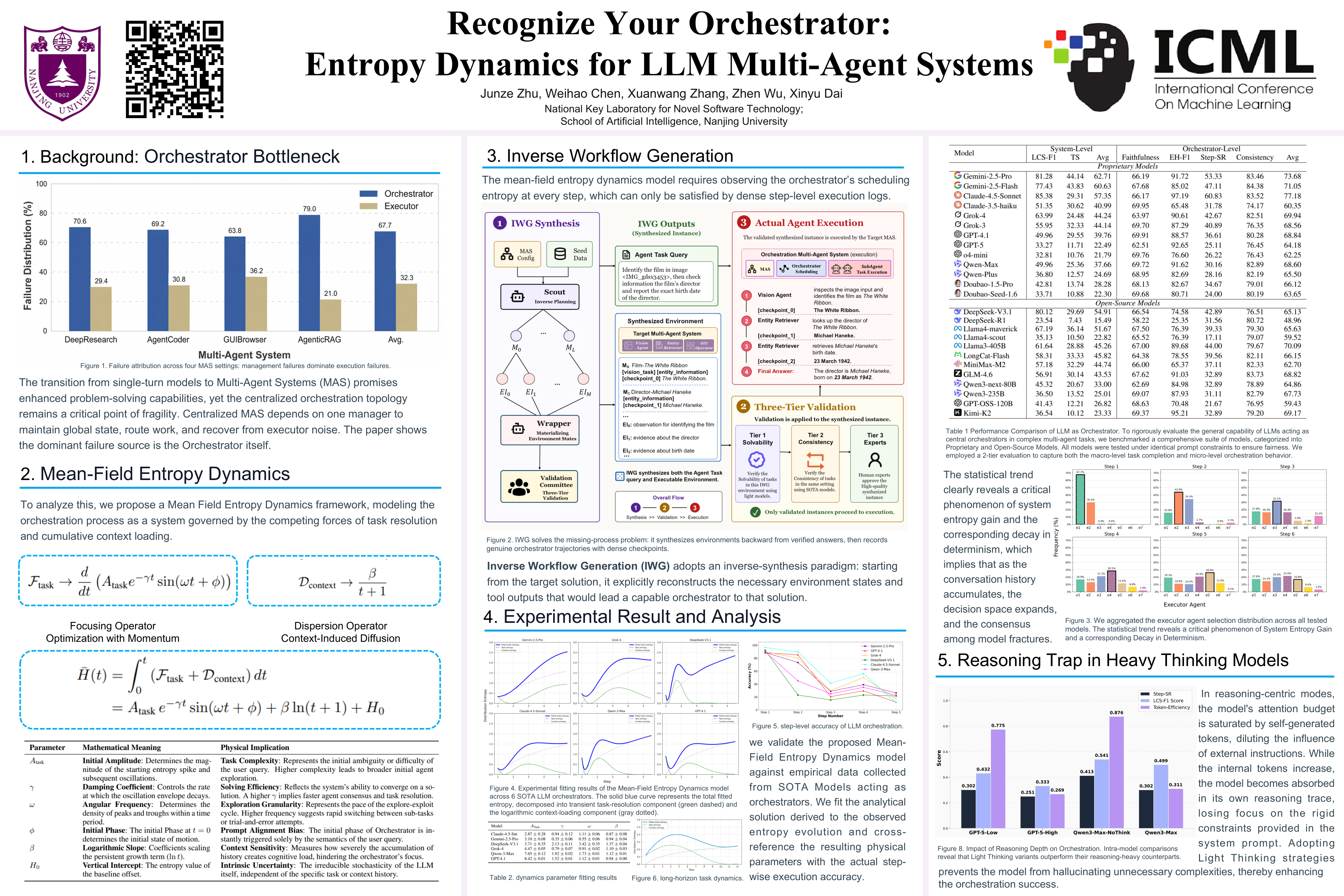
The transition from single-turn models to Multi-Agent Systems (MAS) promises enhanced problem-solving capabilities, yet the centralized orchestration topology remains a critical point of fragility. To analyze this, we propose a Mean-Field Entropy Dynamics framework, modeling the orchestration process as a system governed by the competing forces of task resolution and cumulative context loading. To facilitate high-resolution validation, we introduce Inverse Workflow Generation (IWG), a multi-agent pipeline that synthesizes process-verifiable, high-complexity benchmarks with dense intermediate checkpoints. We demonstrate that our entropy dynamics model fits empirical trajectories, providing physically interpretable parameters that quantify system stability and performance collapse. Crucially, our analysis uncovers a ``Reasoning Trap": while reasoning-heavy models excel in isolated tasks, they frequently fail as orchestrators due to context squeezing. By elucidating the physical mechanisms underlying the Orchestrator and quantifying systemic uncertainty, our findings offer insights for the architectural design development of Multi-Agent Systems in prospective research.
Lay Summary
Multi-agent AI systems often rely on an orchestrator to coordinate workflows among specialized expert agents, but this central layer can become the main source of failure in long and complex tasks. This paper studies such orchestration failures through an entropy dynamics perspective, modeling the process as a balance between task resolution and the growing burden of accumulated context. To support this analysis, we introduce an inverse workflow generation pipeline that creates tasks with verifiable intermediate steps. Experiments show that many failures originate from the coordinating layer rather than the worker agents, and that reasoning-heavy models can perform worse because excessive internal reasoning consumes context and weakens attention to external task signals. These findings highlight the importance of stable and efficient workflow orchestration for reliable multi-agent AI systems and offer insights for the architectural design of Multi-agent AI systems.