
Learning Flexible Generalization in Video Quality Assessment by Bringing Device and Viewing Condition Distributions
Abstract
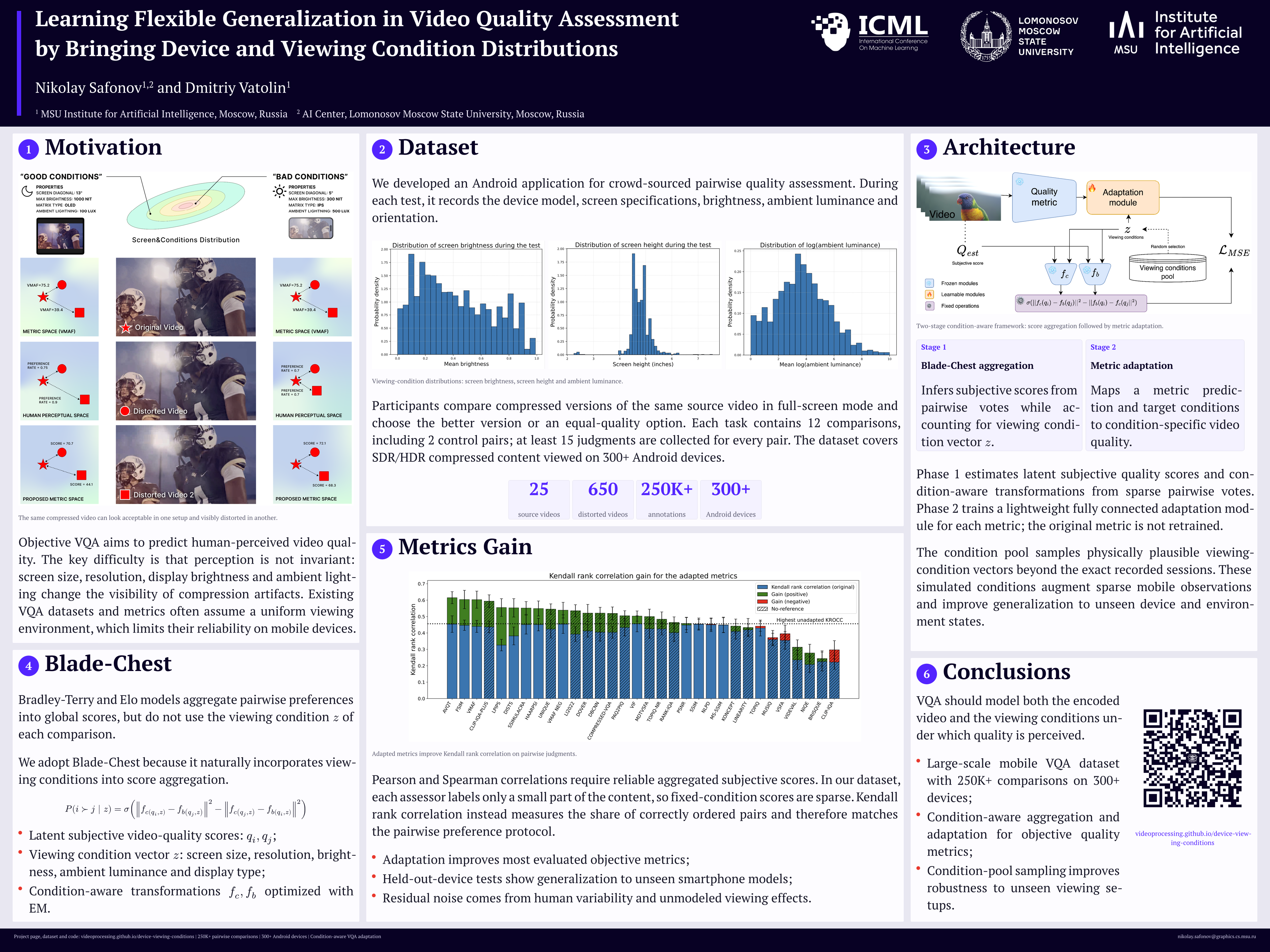
Video quality assessment (VQA) plays a critical role in optimizing video delivery systems. While numerous objective metrics have been proposed to approximate human perception, the perceived quality strongly depends on viewing conditions and display characteristics. Factors such as ambient lighting, display brightness, and resolution significantly influence the visibility of distortions. In this work, we address the question of the multi-screen quality assessment on mobile devices, as this area still tends to be under-covered. We introduce a first large-scale subjective dataset collected across more than different 300 Android devices, accompanied by metadata on viewing conditions and display properties. We propose a strategy for aggregated score extraction and adaptation of VQA models to device-specific quality estimation. Our results demonstrate that incorporating device and context information enables more accurate and flexible quality prediction, offering new opportunities for fine-grained optimization in streaming services. Ultimately, this work advances the development of perceptual quality models that bridge the gap between laboratory evaluations and the diverse conditions of real-world media consumption. We made the dataset and the code available at https://videoprocessing.github.io/device-viewing-conditions.
Lay Summary
Video quality depends not only on the video itself, but also on how and where it is viewed. The same compressed video may look very different on a large bright screen compared to a smaller or dimmer device. However, most existing video quality metrics ignore these viewing conditions. In this work, we introduce a large-scale dataset of human video quality judgments collected from nearly 10,000 participants using more than 300 mobile devices under diverse real-world conditions. We also propose a method that adapts video quality metrics to factors such as screen size, display type, brightness, and ambient lighting. Our results show that accounting for viewing conditions improves the ability of quality metrics to predict human perception. This can help streaming services optimize video delivery more effectively for different devices while improving user experience and reducing unnecessary bandwidth usage.