
Detecting Errors in AI-Generated Annotations: When and Why Semantic Neighbors Help
Abstract
Lay Summary
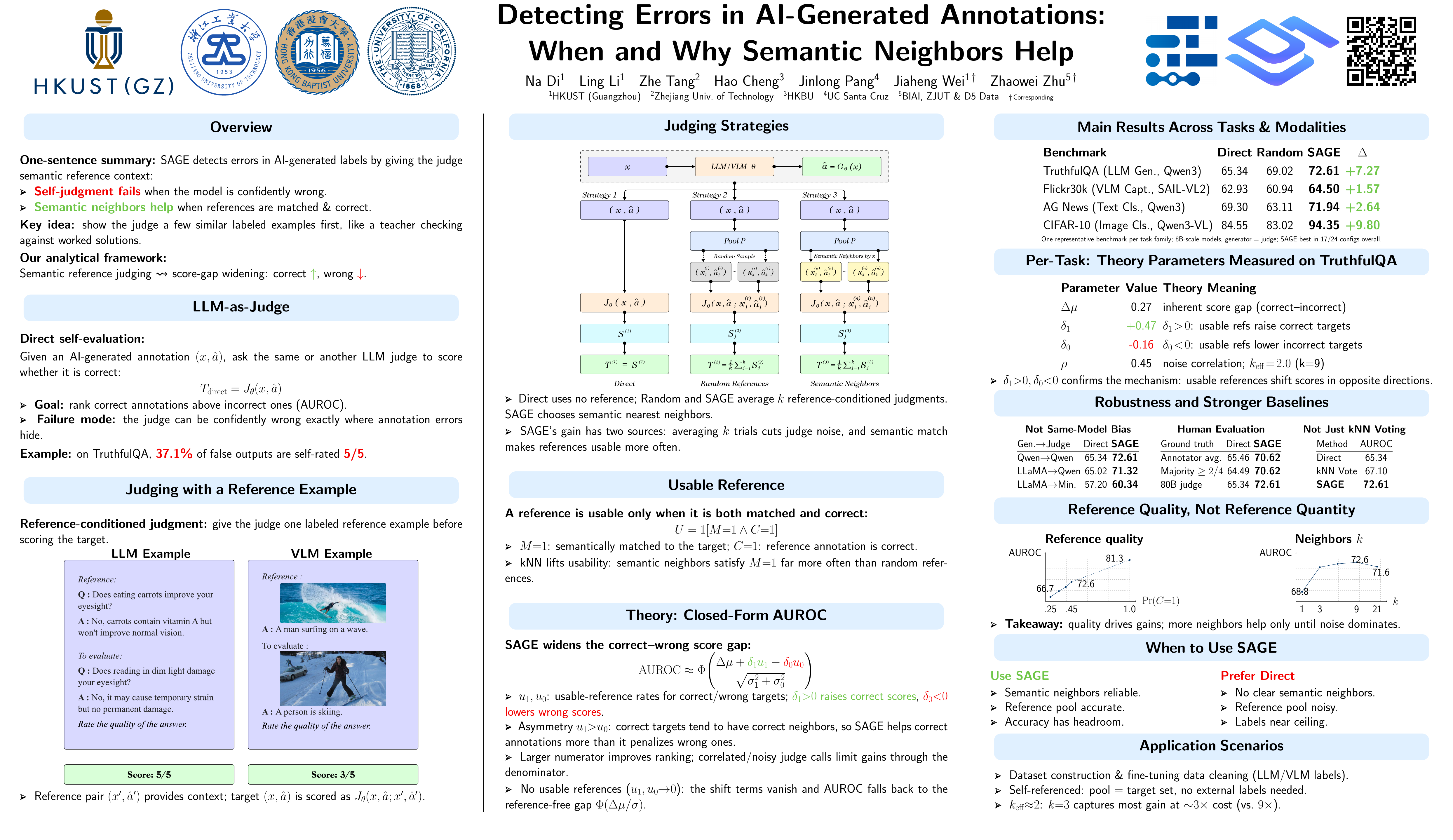
When we use large language models (LLMs) to label vast amounts of data (sorting reviews, captioning photos, classifying documents), they work far faster than humans can. But how do we catch the mistakes these AI labelers inevitably make? The standard trick of asking the AI to grade itself ('LLM-as-judge') often fails: the model tends to be confidently wrong exactly where errors hide. Our paper introduces SAGE, which shows the AI judge a few semantically similar examples before scoring each new label, like a teacher checking answers against model solutions for similar problems. The familiar context helps the AI catch its mistakes far more reliably. We also prove mathematically why this works: similar examples raise scores for correct answers and lower them for wrong ones. We tested SAGE on text generation, image captioning, and classification tasks; it consistently improves error detection. This matters for anyone using AI to label data at scale (researchers cleaning training datasets, companies moderating content, organizations validating AI-generated reports): catching errors becomes much cheaper, letting people fix mistakes before they propagate downstream.