
Brain Networks Should Be Learned, Not Constructed
Abstract
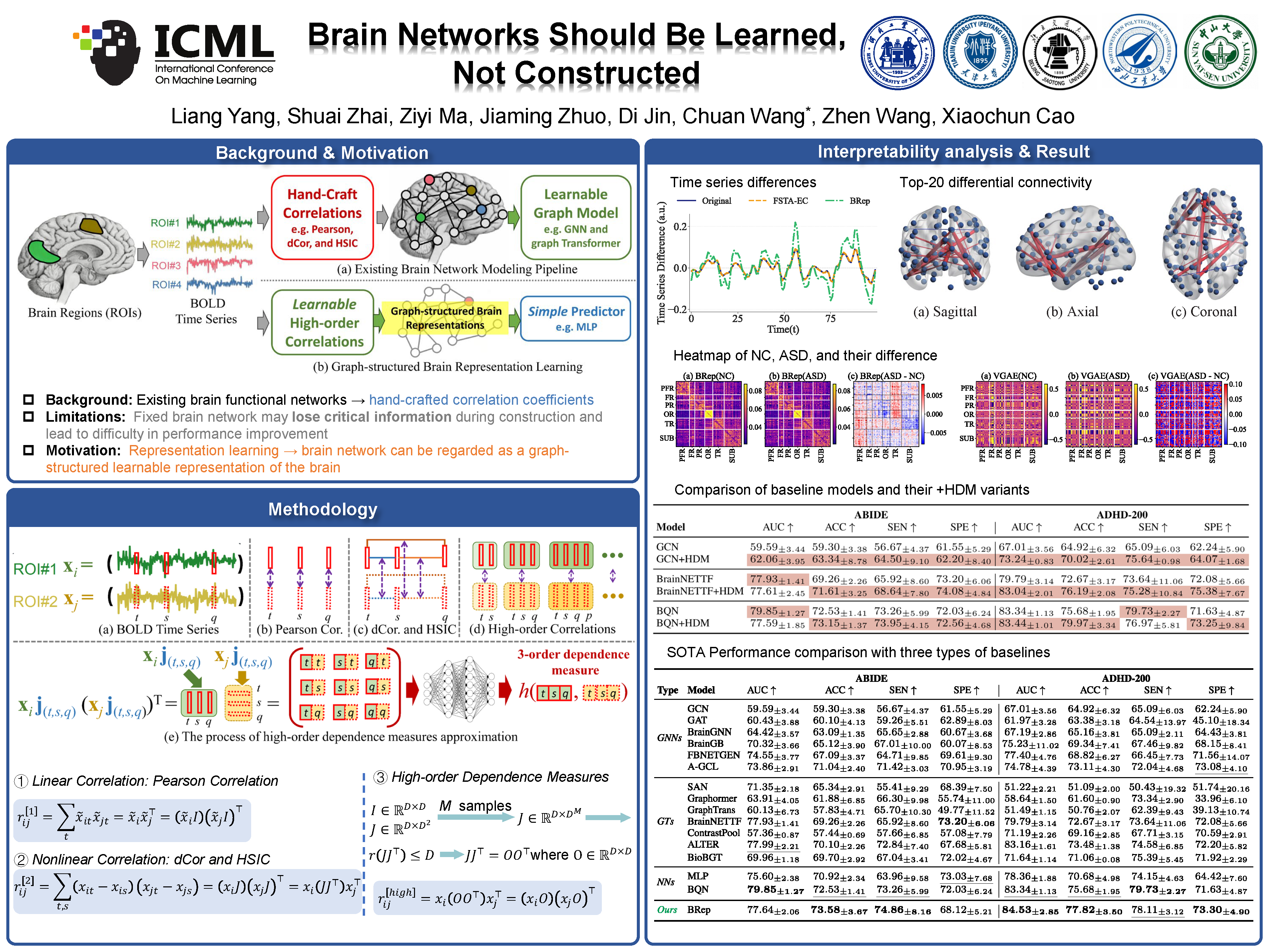
The construction of the brain functional network often follows the hand-crafted Correlation Coefficients without any learnable components. Meanwhile, most efforts are made to the models, such as graph neural networks, that make predictions with the constructed brain network as input. Unfortunately, the fixed brain network may lose critical information during construction and lead to difficulty in performance improvement, even with deliberately designed graph models. From this perspective, the current situation is similar to the machine learning community, i.e., hand-crafted features and learnable predictors, before the advent of representation learning. In fact, the brain network can be regarded as a graph-structured learnable representation of the brain. By drawing on representation learning, this paper presents the Brain Representation (BRep) learning problem. To this end, the widely used linear and nonlinear correlations are enhanced to be high-order, parametric, and learnable. The expressive brain representation shifts the heavy computational burden away from downstream architectures, enabling a simple yet accurate predictor. Theoretical analysis guarantees the model's universal approximation to any U/V-statistics. Extensive evaluations demonstrate that BRep possesses superior performance, high efficiency, and interpretability. The code is available at https://github.com/Kevin-916/BRep-demo/.
Lay Summary
Brain researchers often study brain scans by first turning activity signals from different brain regions into a network. Today, this network is usually built with fixed, hand-designed formulas that measure how similar two brain signals are. Many studies then use complex prediction models on top of this fixed network. However, if useful information is lost while building the network, even a powerful model may struggle to recover it. This paper proposes BRep, which treats the brain network itself as something that should be learned from data. Instead of relying only on fixed correlation formulas, BRep makes these formulas flexible and trainable, so the network can better capture rich relationships among brain regions. Because the learned brain network already contains more useful information, the final prediction model can be simpler while still being accurate. Experiments show that BRep achieves strong performance, runs efficiently, and produces brain networks that can be interpreted in relation to brain function. This suggests that learning how to construct brain networks may be as important as designing better models to analyze them.