
SuperHype: Hypergraph Generation via Graph-Superposition Decomposition
Abstract
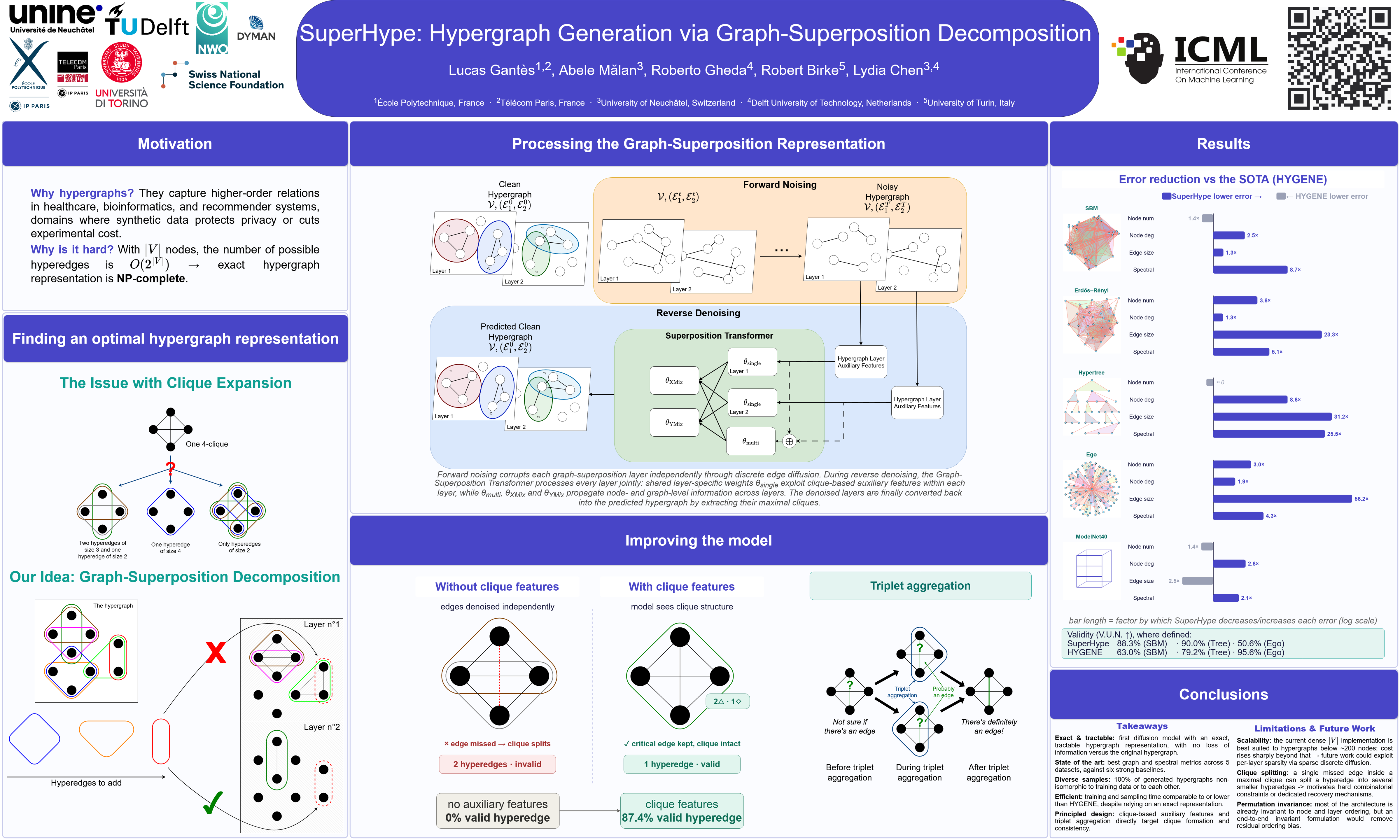
Hypergraphs are graph generalizations with key applications in domains such as healthcare, where strict data privacy requirements apply, or bioinformatics, where testing new compounds is costly. However, due to their combinatorial nature, hypergraph representations are often either intractable or lead to significant information loss. For this reason, research into hypergraph synthesis is limited, and state-of-the-art approaches yield poor generation quality in terms of overall structural patterns and graph-level validity. To address such shortcomings, we introduce SuperHype, an exact and tractable hypergraph diffusion model. The core of SuperHype is the graph-superposition decomposition, a novel representation that embeds a hypergraph into a multi-layer graph, enabling a tractable representation with no loss of generalization. To generate new samples from such representations, we introduce a Graph-Superposition Transformer that treats the superposition as an interconnected sequence of layers. Moreover, we enhance the model's performance by incorporating hypergraph-specific auxiliary features and aggregating indirect node interactions via triplet pooling. Our evaluation across five datasets shows that SuperHype generally reproduces local and global connectivity patterns with superior fidelity compared to state-of-the-art baselines.
Lay Summary
Many real-world systems involve group relationships, not just one-to-one links: a set of patients may share symptoms, several genes may act together, or multiple users may interact with the same item. Hypergraphs are well-suited to representing such group-based patterns, but creating realistic synthetic hypergraphs is difficult because the number of possible groups grows extremely quickly. Existing methods often simplify the problem, but this can lose important information about the original data. We introduce SuperHype, a method for generating new hypergraphs while preserving these group relationships more faithfully. The key idea is to break a hypergraph into several graph-like layers, so the data is easier for a machine learning model to handle without losing structural information. SuperHype then learns how to create new examples that resemble the original hypergraphs. Across five benchmark datasets, SuperHype generally produces synthetic hypergraphs that better match real data than prior methods. Its improved generation quality can help researchers test algorithms, expand limited datasets, and work with realistic substitutes for sensitive data.