
Semi-Supervised Hypothesis Testing by Betting on Predictions
Abstract
Lay Summary
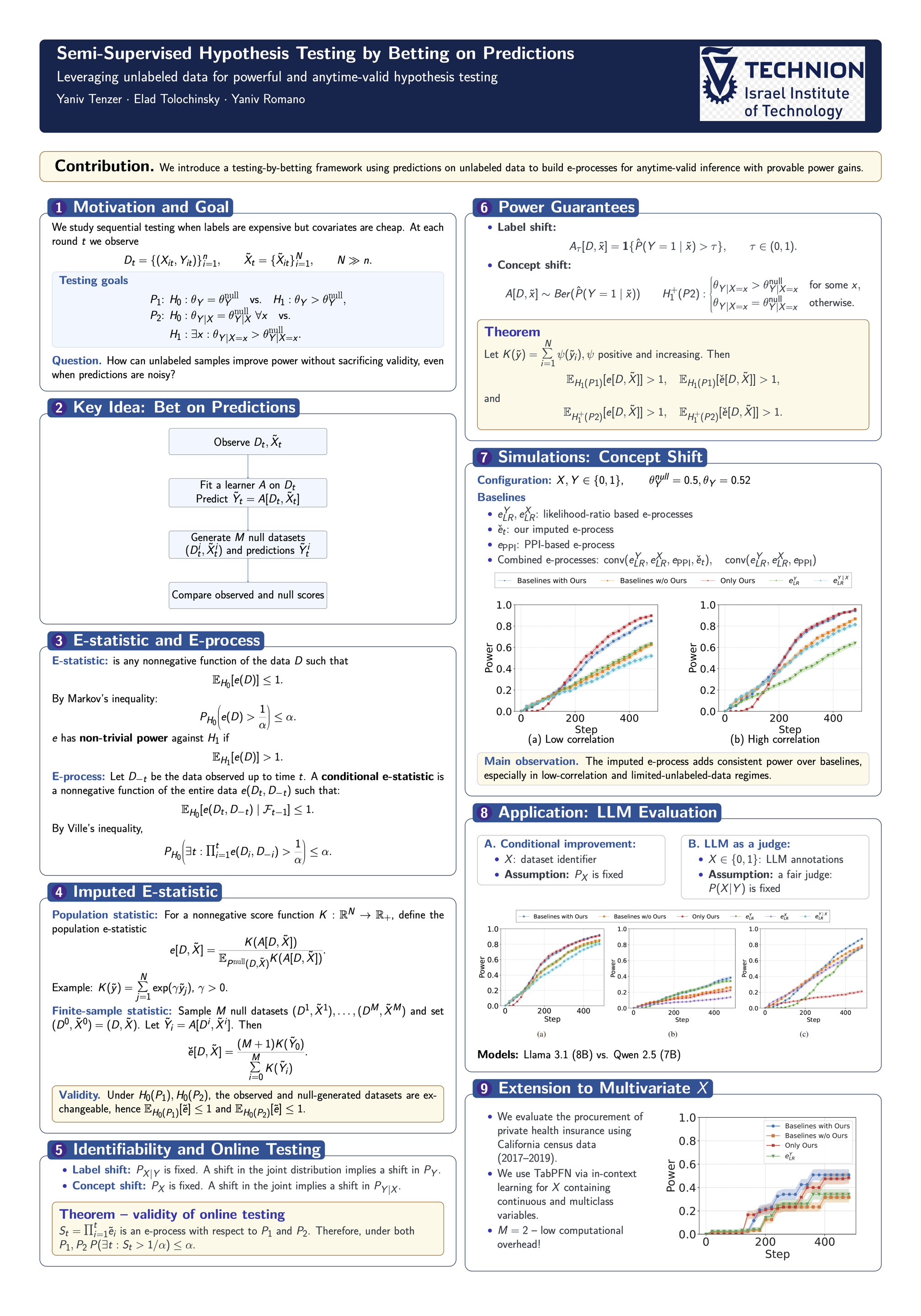
Statistical hypothesis testing is a fundamental tool for determining whether observed data provide sufficient evidence to support a scientific claim. In many modern applications, obtaining labels from humans is expensive and time-consuming, while large amounts of unlabeled data are readily available. This raises a natural question: can machine learning models be used to predict labels for unlabeled data and still support statistically reliable conclusions, even when those predictions are imperfect? In this work, we develop a new statistical testing method that uses predictions from unlabeled data to strengthen the evidence gathered during the test. Importantly, the method remains statistically reliable even when predictions are biased and imperfect. We show that our method improves the power of statistical tests in real-world applications such as large language model evaluation. In particular, it can detect meaningful improvements using fewer expensive human annotations, potentially reducing evaluation costs for modern AI systems and other data-driven applications.