
Efficient Diffusion LLMs via Temporal-Spatial Parallel Decoding and Confidence Extrapolation
Abstract
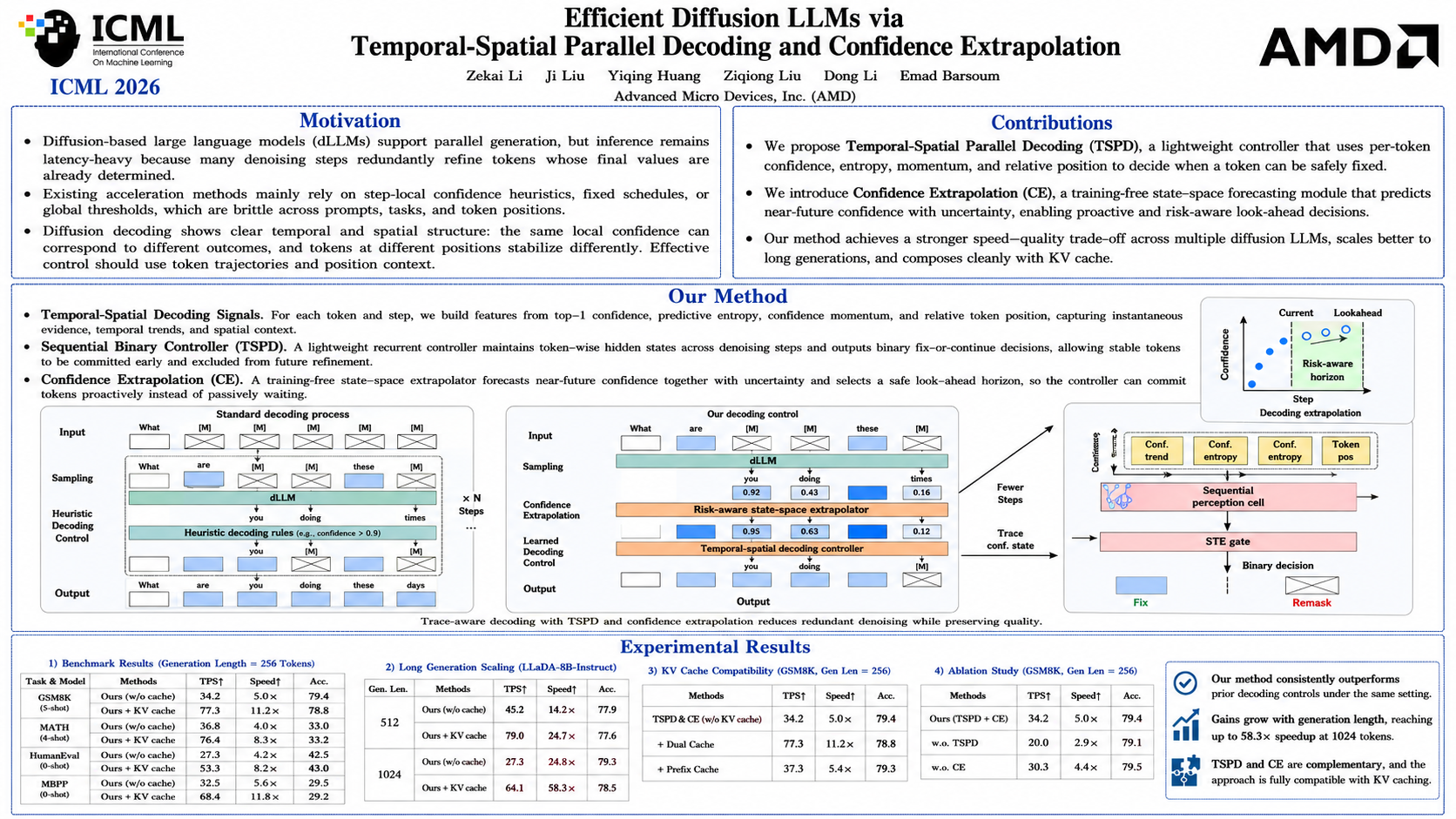
Diffusion-based large language models (dLLMs) support parallel text generation via iterative denoising, yet inference remains latency-heavy because many steps are spent on redundant refinement and repeated remasking of tokens whose final values are already determined. Prior acceleration methods mainly depend on step-local confidence heuristics or fixed schedules, which are sensitive to prompt and task variation and ignore strong positional effects within a sequence. We cast diffusion decoding as a dynamic control problem and show that token-wise denoising trajectories provide the key signal for reliable control. We propose a trace-aware decoding framework with two components. First, Temporal-Spatial Parallel Decoding (TSPD) uses a lightweight temporal-spatial correctness sensor that consumes per-token trajectory features, including confidence, entropy, and momentum, together with token position, to decide when a token has converged and can be safely fixed. Second, we introduce ]Confidence Extrapolation (CE)}], a training-free state-space module that forecasts future logit trends with uncertainty to support proactive decisions, including safe look-ahead and targeted stabilization when trajectories are oscillatory or underconfident. Together, TSPD and CE reduce unnecessary denoising iterations while preserving output quality, and they compose cleanly with system optimizations such as KV caching.
Lay Summary
Large language models are increasingly used for reasoning, coding, and writing, but generating answers can still be slow and expensive. This paper studies a new type of language model that writes by repeatedly revising many words in parallel. Although this process can be efficient, the model often keeps revising words that have already settled, wasting time and computation. We propose a lightweight method that tracks how the model’s confidence in each word changes over time and uses this information to decide when a word can be safely kept fixed. It also predicts when a word is likely to become stable soon, so the model can avoid unnecessary extra revision steps. Experiments on math and coding tasks show that our method makes generation much faster while keeping answer quality nearly unchanged. Because it does not require changing the original model and can work with existing speedup techniques, it can help make advanced language models cheaper, faster, and easier to use in real-world applications.