
Dual-channel Dynamic Graph Neural Networks with Adaptive Adjacency Learning and Multi-scale Representation Fusion
Abstract
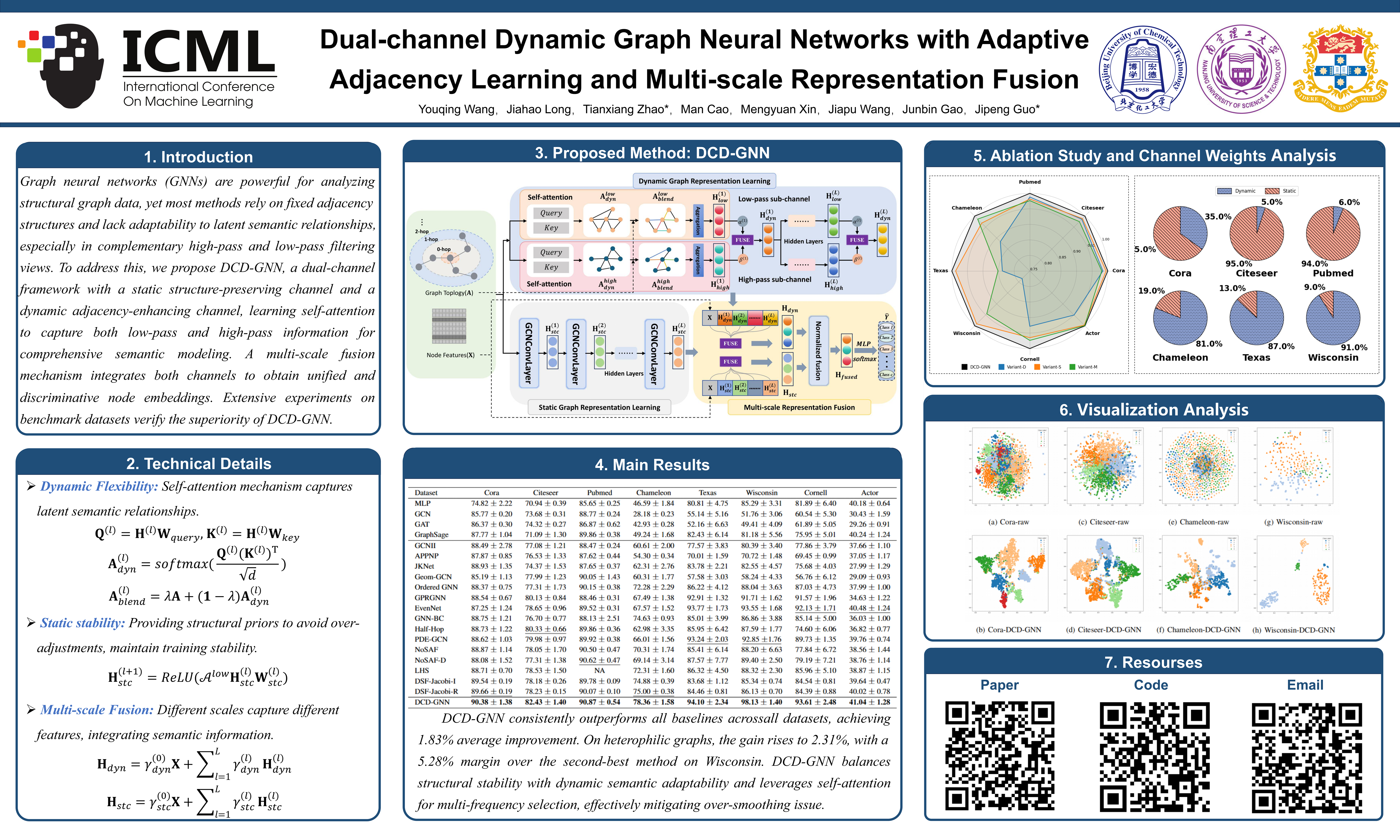
Graph neural networks (GNNs) have been demonstrated to be powerful tools for analyzing structural graph data. However, most existing methods usually rely on fixed adjacency structures for information propagation, lacking strong adaptability to the latent semantic relationships that exist but are not explicitly connected in graph, especially in complementary high-pass and low-pass filtering views. To this end, this paper proposes a novel Dual-channel Dynamic Graph Neural Network (DCD-GNN), mainly consisting of parallel representation learning channels: a static structure-preserving channel and a dynamic adjacency-enhancing channel. The dynamic channel exploits both low-pass structural filtering and high-pass personalized detail via the self-attention adjacency learning and then integrates them for comprehensive semantic modeling, while the static channel maintains structural stability. Both channels employ a multi-scale representation fusion mechanism and a unified and discriminative node embedding representation is obtained by integrating them. Extensive experiments on various benchmark datasets verify the superiority of DCD-GNN in discriminative graph representation learning.
Lay Summary
Problem: Graphs are widely used, but existing GNNs struggle to capture hidden semantic relationships in complementary high-pass and low-pass filtering views. Solution: We propose a Dual-channel Dynamic GNN (DCD-GNN) with a static channel for structure preservation and a dynamic channel that integrates low-pass and high-pass filtered information for richer node embeddings by self-attention adjacency learning. Impact: This approach improves graph embedding representation learning quality, enabling more accurate classification performance.