
CSOR: Coreset Selection for Object Re-identification via Class Pruning
Abstract
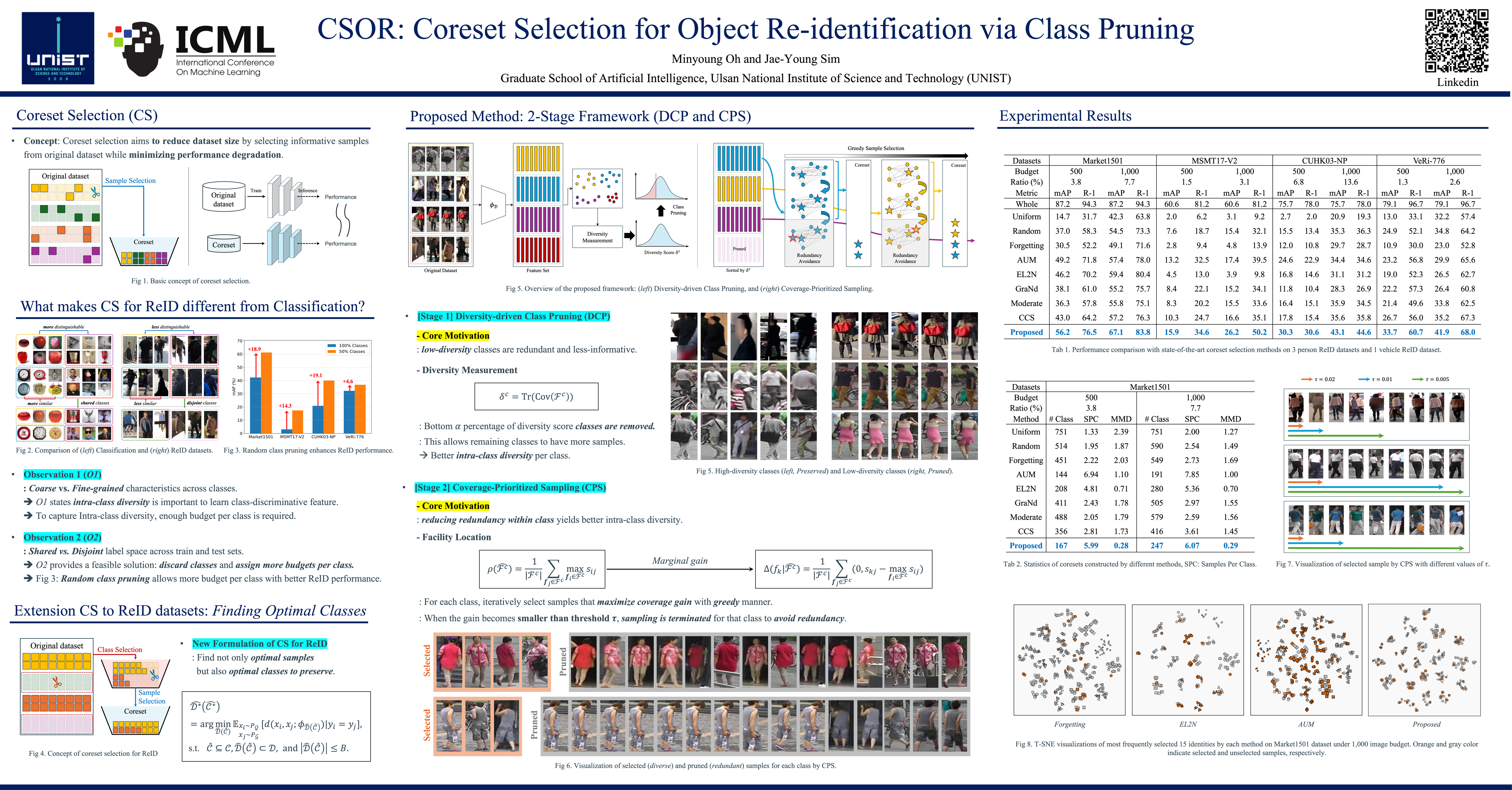
Coreset Selection (CS) aims to extract a small yet representative subset from a large dataset, reducing the complexity of model training. Although CS has been primarily investigated for classification tasks, it is still underexplored for object Re-identification (ReID). In this paper, we first formulate Coreset Selection for Object Re-identification (CSOR) as a joint optimization problem to find both the optimal coreset and the optimal class subset. We identify intra-class diversity as a key factor for effective coreset construction for ReID. Based on this insight, we propose a novel two-stage framework, consisting of Diversity-driven Class Pruning (DCP) and Coverage-Prioritized Sampling (CPS), to address the unique challenges of ReID datasets. First, classes with low feature diversity are pruned to allocate the storage budget to the remaining informative classes. Then, samples are greedily selected in an easy-to-hard class order to maximize feature coverage within each class. Extensive experiments on three person ReID datasets and one vehicle ReID dataset demonstrate that our method consistently outperforms existing CS approaches, establishing a new state-of-the-art in CSOR.
Lay Summary
Training AI to recognize the same person or vehicle across different cameras requires massive datasets, which costs tremendous time and computing power. To solve this, researchers use "coreset selection" to extract a smaller, representative subset of data for training. However, existing methods struggle with re-identification tasks because a single object can look completely different depending on the camera angle or lighting. To address this, we propose a two-step method to find the most informative data. First, we filter out categories of images that are highly repetitive and lack visual variety. Second, from the remaining data, we handpick a small set of images that covers the widest possible range of appearances for each object. By focusing on visual diversity, our method successfully trains highly accurate models using only a fraction of the original data. This dramatically cuts down storage costs and training time, establishing a new standard for efficient AI training.