
Temporal Preference Optimization for Unsupervised Retrieval
Abstract
Lay Summary
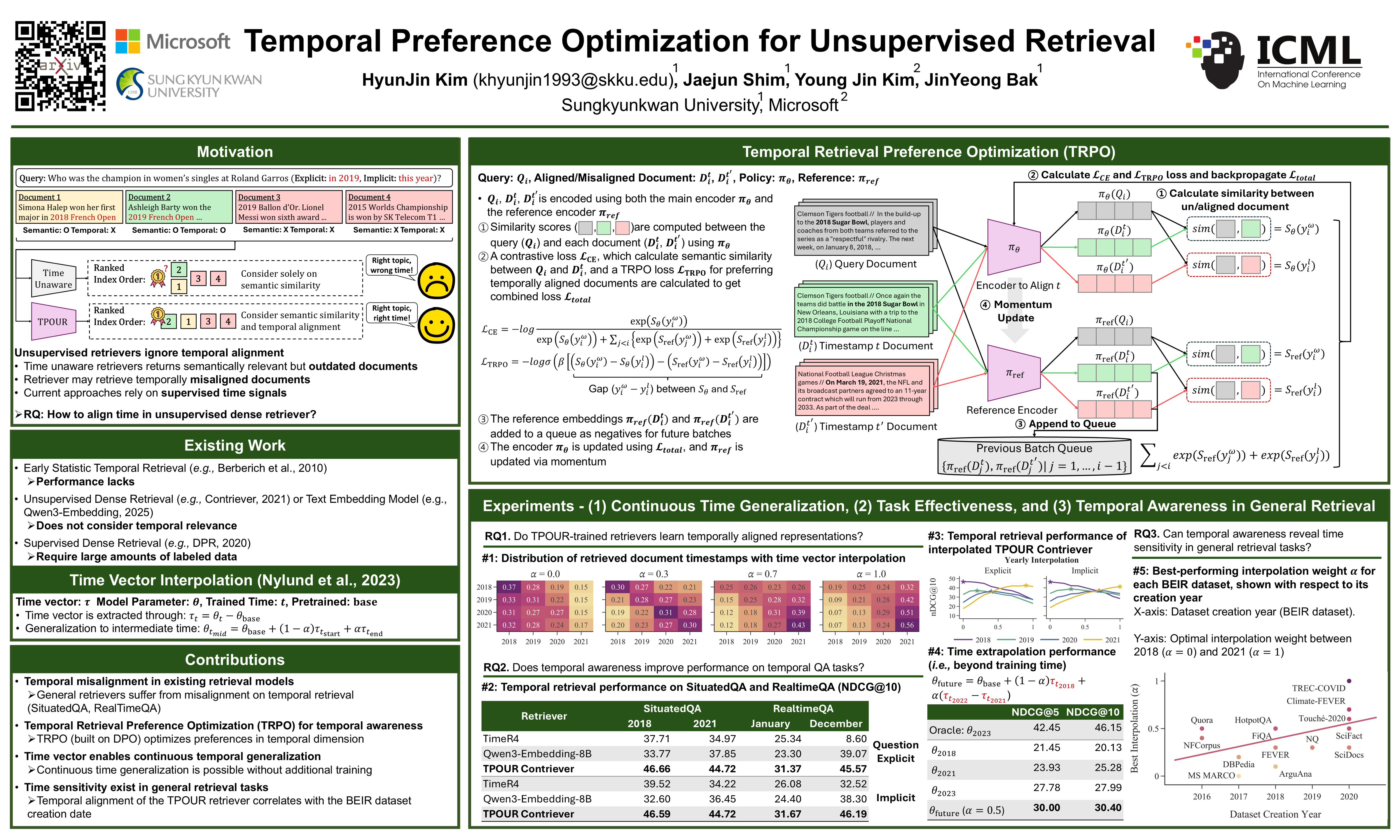
Search systems are often asked questions whose answers depend on time, such as "Who was the president in 2019?" This is challenging because a document may be topically relevant but from the wrong time period, causing the system to return misleading results. Many existing methods address this by using supervised training data with explicit time labels, but such information is not always available for large document collections. We introduce TPOUR, a method for training search systems to better understand time without requiring labeled data. Our key idea is to teach the retriever to prefer documents from the correct time period over semantically similar but temporally mismatched documents. TPOUR can also adapt to intermediate or future time periods it has not directly seen during training by combining models trained for different time periods. In experiments on time-sensitive information retrieval, TPOUR retrieves more temporally appropriate documents than baselines. Even though our model is 72.7 times smaller than Qwen-Embedding-8B, it achieves stronger retrieval performance on both explicit and implicit temporal queries. We release our code to support future research on time-aware retrieval.