
SpikeVLA: Vision-Language-Action Models with Spiking Neural Networks
Abstract
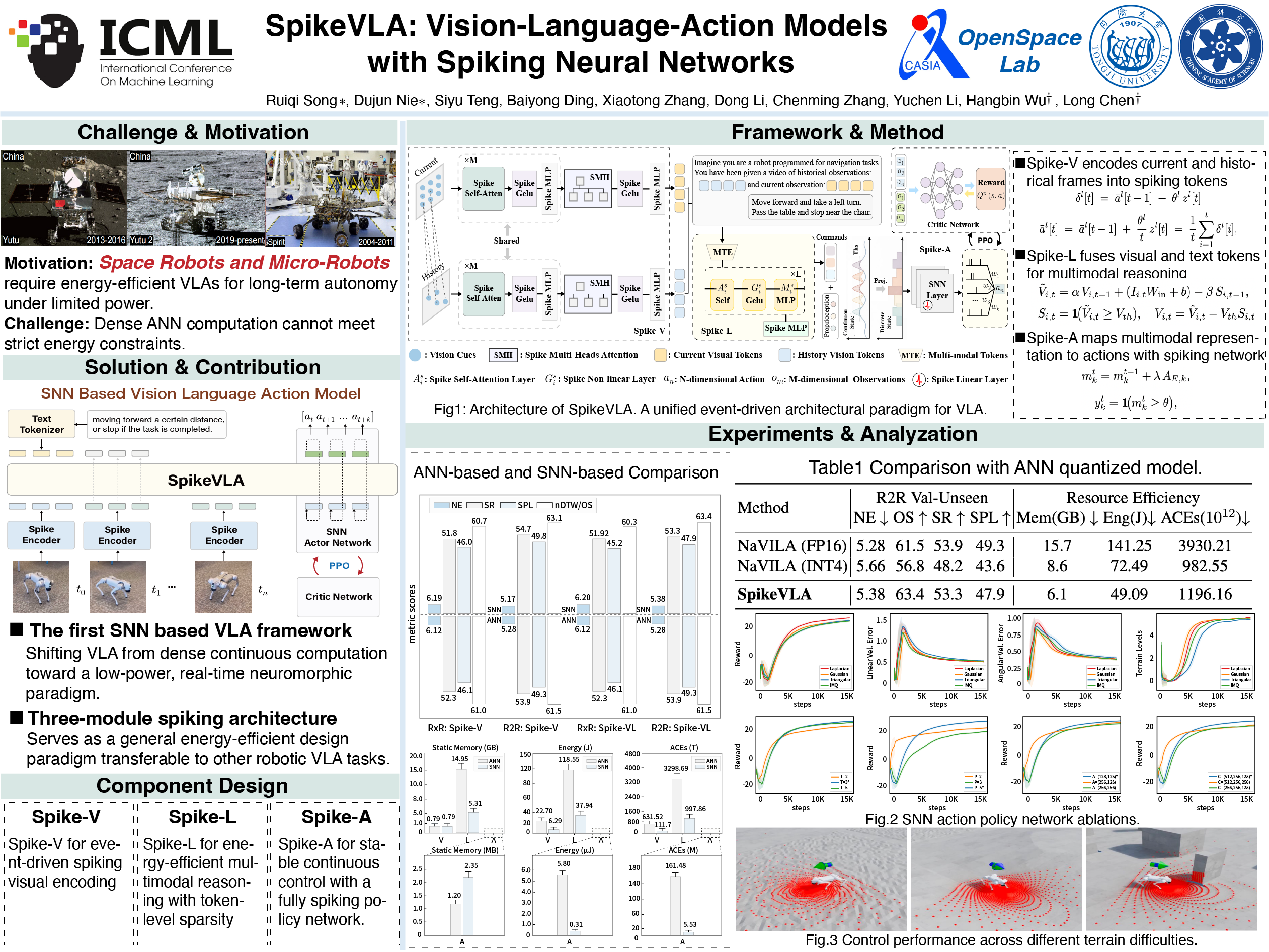
Vision-Language-Action (VLA) models have become a central paradigm for embodied intelligence. However, most existing approaches are built on large-scale Transformers, resulting in substantial inference latency and energy consumption that limit their practical deployment in low-power, real-time scenarios. We propose SpikeVLA, an end-to-end spiking VLA framework for embodied navigation with energy-efficient inference, consisting of three key components. (i) a spiking vision encoder, Spike-V, that replaces dense continuous computation with event-driven spiking representations to reduce the energy cost of visual representation learning, (ii) a multimodal spiking large language model, Spike-L, that reformulates cross-modal reasoning with spiking dynamics and token-level event-driven sparsity to further lower inference overhead, and (iii) a spiking action policy network, Spike-A, that uses Laplacian-kernel population coding and end-to-end reinforcement learning to produce stable, robust continuous control under low-energy constraints. Experiments on multimodal interaction and robotic control tasks show that SpikeVLA significantly reduces energy consumption and computational overhead while maintaining competitive performance, highlighting its potential for low-power, real-time embodied intelligence.
Lay Summary
Vision-language-action models enable robots and embodied agents to understand visual scenes, follow language instructions, and take actions in the physical world. However, many existing models are very large and computationally expensive, making them difficult to deploy in real-time or low-power settings such as mobile robots, wearable devices, and edge platforms. This paper introduces SpikeVLA, a new framework that makes embodied intelligence more energy-efficient. Inspired by how biological brains communicate through sparse spikes, SpikeVLA reduces unnecessary computation across three parts of the system: visual understanding, language-based reasoning, and action control. Instead of continuously processing all information with dense computations, the model uses event-driven signals so that computation occurs only when needed. Experiments on navigation and robotic control tasks show that SpikeVLA can greatly reduce energy use and computational cost while still achieving competitive performance. These results suggest that spiking computation is a promising direction for building practical embodied AI systems that can operate efficiently in real-world, real-time environments.