
Scaling depth capacity via zero/one-layer model expansion
Abstract
Lay Summary
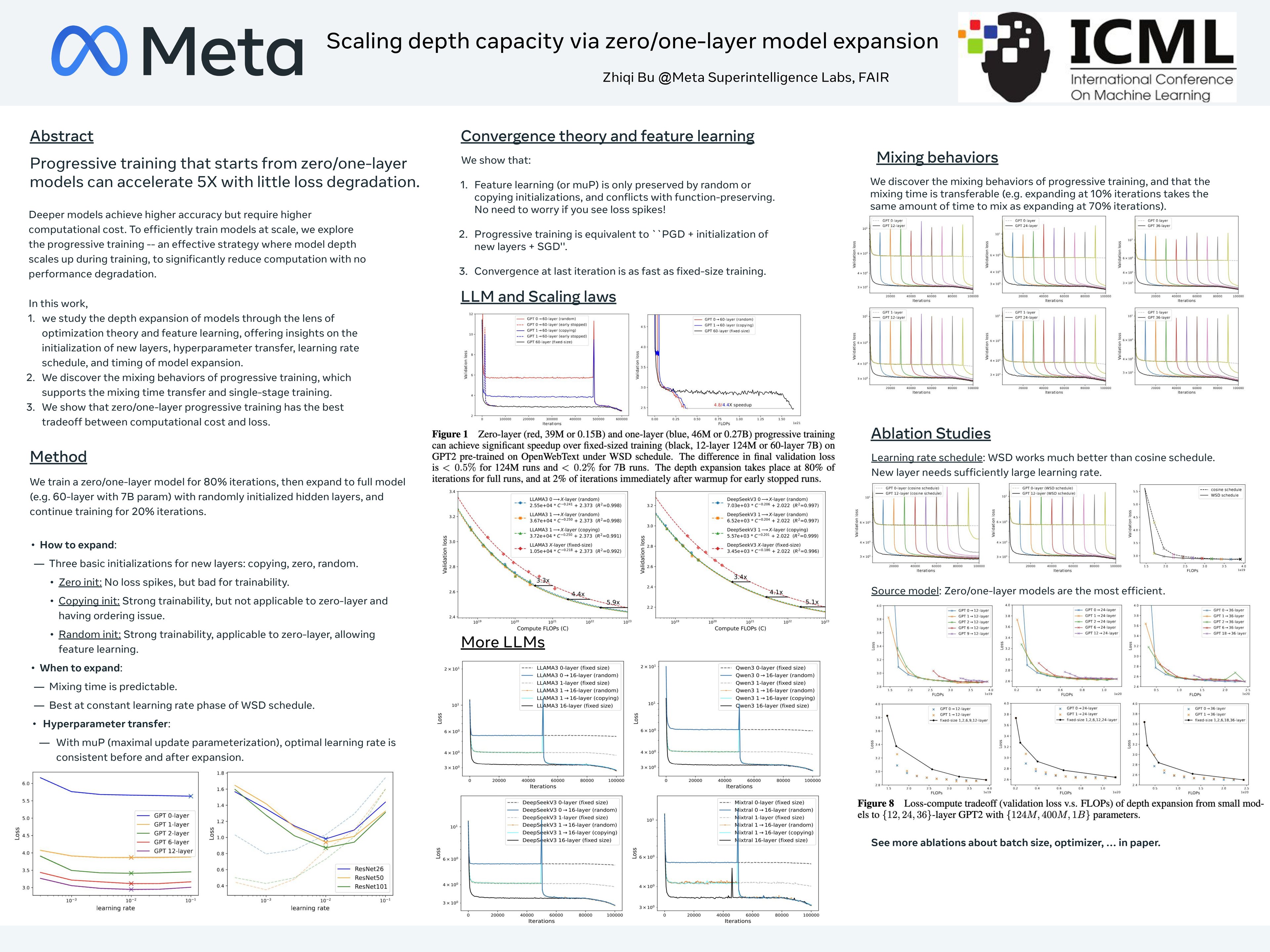
Modern AI models often become more capable when they are made deeper, but training very deep models from the beginning is expensive. This creates a practical challenge: how can we obtain the benefits of large, deep models without paying the full training cost? We study a simple strategy called progressive training, where a model starts smaller and gains new layers as training proceeds. Our work focuses on when and how to add these new layers so that the model continues learning smoothly instead of being disrupted. We analyze this problem using optimization theory and feature learning, and we test design choices such as how to initialize new layers, how to transfer hyperparameters, how to schedule the learning rate, and when to expand the model. Our proposed zero/one-layer progressive training method gives a strong tradeoff between training cost and final loss. On GPT-2, it can save about 80% of compute, or achieve about a 5× speedup, while reaching a loss comparable to training a full 60-layer, 7B-parameter model from scratch. Experiments on LLAMA3 and DeepSeekV3 model families further show 3–5× better compute efficiency, with larger gains at larger scales.