
MapUQ: Map with Uncertainty Quantification for Robust BEV Vectorized Construction
Abstract
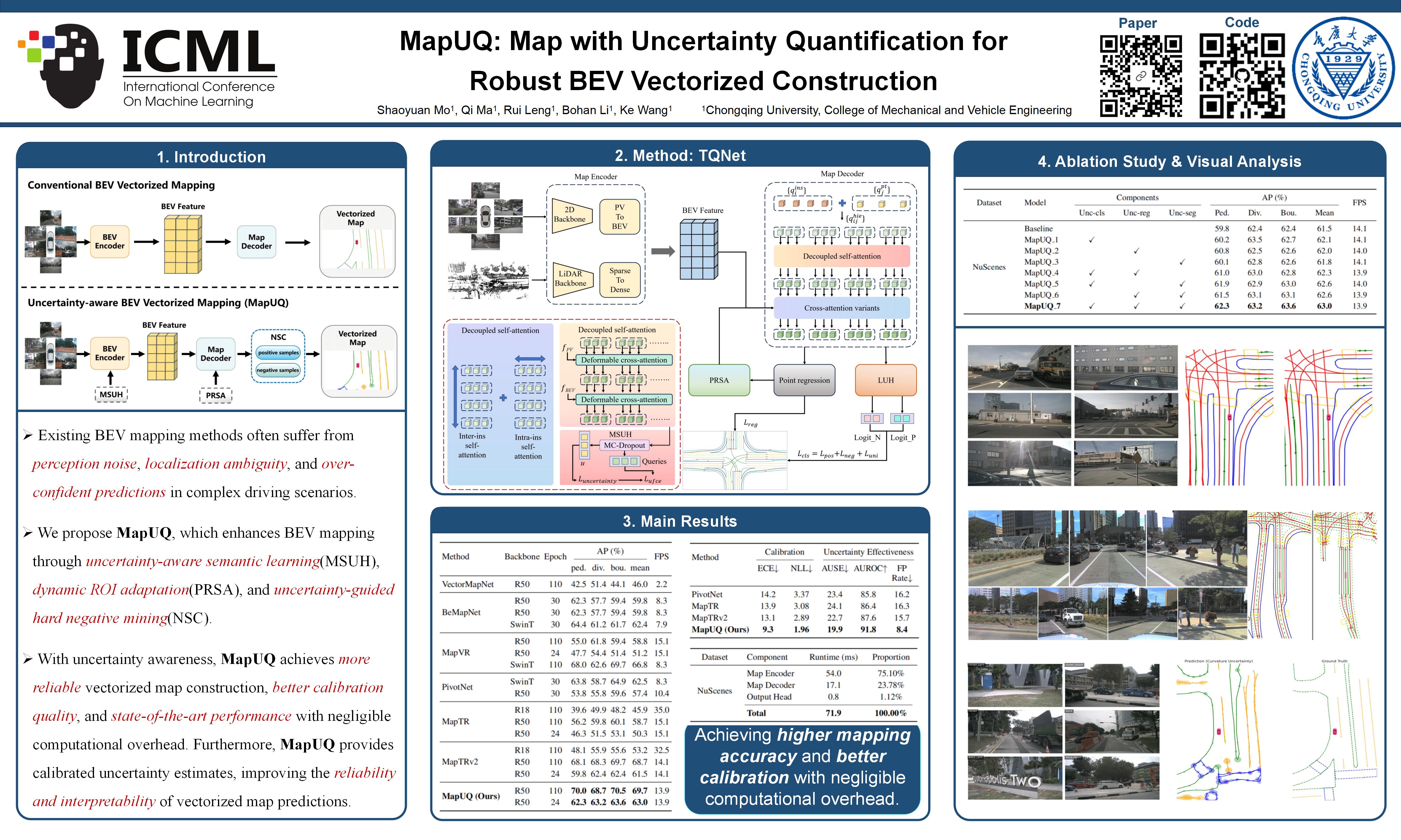
End-to-end online map generation is a core component of autonomous driving perception systems. However, in complex traffic scenes, Bird’s-Eye-View (BEV) with vectorized mapping suffers from limitations such as target misclassification, spatial localization drift, and ambiguous semantic segmentation. Introducing uncertainty quantification can alleviate these problems, so we propose MapUQ, a robust BEV vectorized mapping method guided by uncertainty-aware optimization. Specifically, we quantify uncertainty at the feature level to enhance semantic perception, apply an error-driven dynamic receptive field adaptation mechanism at the decoding stage to enforce geometric consistency, and leverage negative sample information at the output head to improve lane classification accuracy. Experimental results on the nuScenes and Argoverse 2 datasets show that our method outperforms prior approaches in AP across three road types, achieving an average improvement of 1.5% over the baseline with marginal computational overhead. In addition, our method surpasses the baseline on uncertainty metrics such as ECE and NLL, significantly improving robustness and mapping accuracy in complex scenarios. Our code has been released at github: https://anonymous.4open.science/r/MapUQ-D287.
Lay Summary
Self-driving cars need to build an instant map of the road to navigate safely, such as recognizing lanes, intersections, and drivable areas. However, in complex traffic scenes—like crowded intersections or adverse weather—current map-building methods often make mistakes: they may misclassify a lane, drift away from the true position of a turn, or produce blurry boundaries between lanes. We developed a new method, called MapUQ, to tackle these problems. The key idea is to let the system measure its own uncertainty—knowing when it is unsure about a decision. By quantifying uncertainty at different processing stages, our method helps the car’s perception system pay more attention to ambiguous areas, adjust its focus based on errors, and learn from incorrect predictions to improve lane classification. We tested MapUQ on two real-world driving datasets, nuScenes and Argoverse 2. Compared with previous state-of-the-art approaches, our method improved mapping accuracy by an average of 1.5% across three types of road elements (e.g., lanes, dividers, boundaries). More importantly, it made the system more robust and reliable in challenging scenarios. To help other researchers, we have released our code openly.