
Hyperbolic neural population geometry benefits computation
Abstract
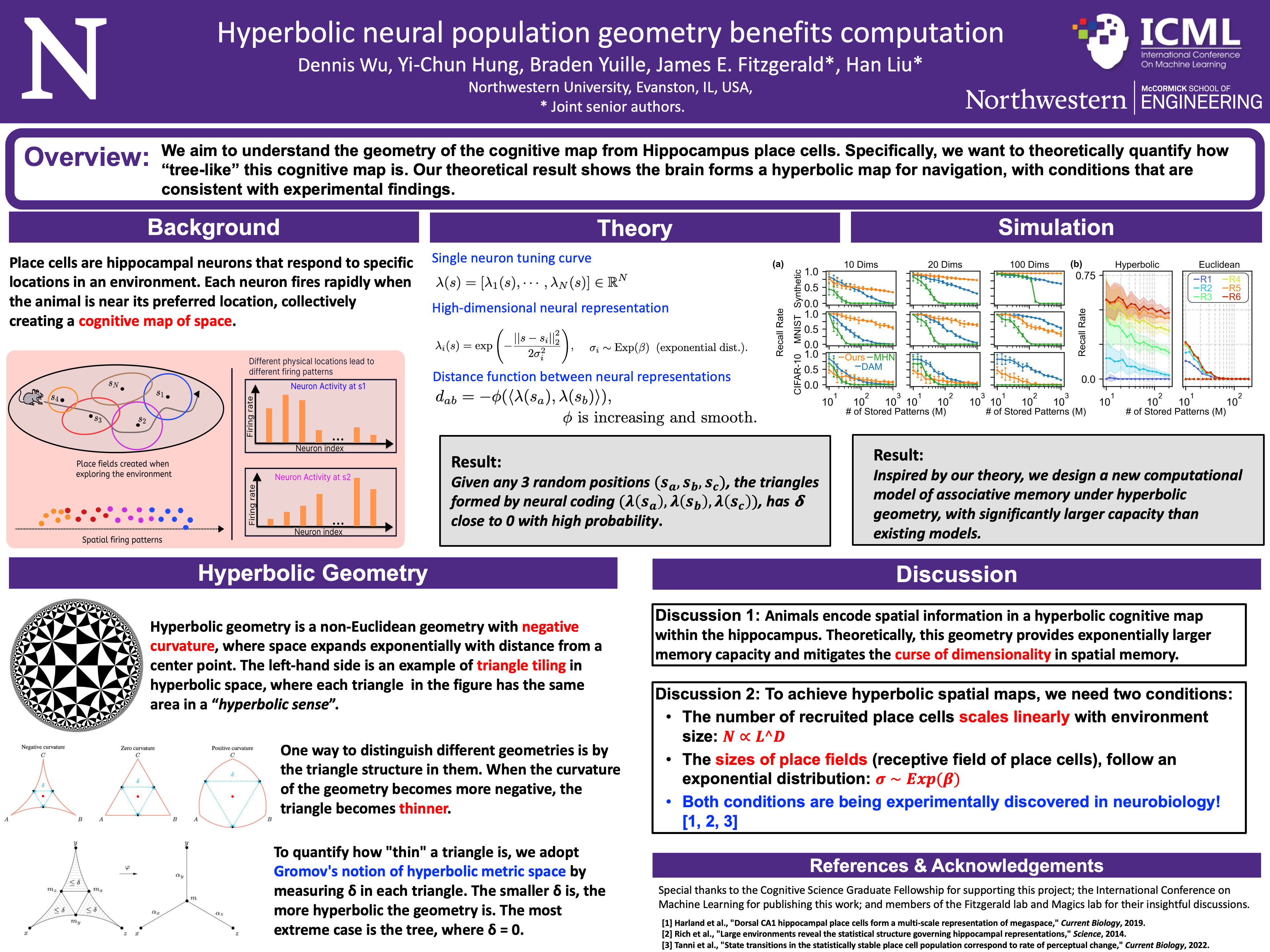
Neural population geometry shapes downstream computation. Recent empirical findings in neurobiology suggest that a hyperbolic structure underlies population activity in the hippocampus. Here we provide a theoretical framework for this phenomenon. First, we propose a plausible construction of hippocampal tuning curves that statistically induces hyperbolic geometry. Next, we establish a connection between neural decoding and associative memory by demonstrating that the Modern Hopfield Network update rule computes the minimum mean-squared-error (MMSE) estimator. Finally, we introduce a novel associative memory model defined in hyperbolic space that yields significantly larger capacity than leading models. Our results suggest that animals encode spatial information as a latent hyperbolic cognitive map, improving both memory capacity and decoding accuracy.
Lay Summary
Empirical findings in neurobiology suggested that hippocampal neural population activity has a hyperbolic structure, but there was no theoretical framework explaining why or how this geometry arises, what it means for downstream computation, or how to exploit it in AI. First, we constructed a biologically plausible hippocampal tuning curve model and showed it statistically induces hyperbolic geometry. Second, we connected neural decoding to associative memory by proving the Modern Hopfield Network update rule computes the optimal MMSE estimator. Third, building on both results, we designed a new associative memory model that operates directly in hyperbolic space. It suggests animals encode spatial information as a latent hyperbolic cognitive map, and that this geometric structure is computationally advantageous. We show that our hyperbolic associative memory model achieves significantly larger memory capacity than leading models, while also offering a more efficient representation space particularly in low dimensions.