
Content-Style Identification via Differential Independence
Abstract
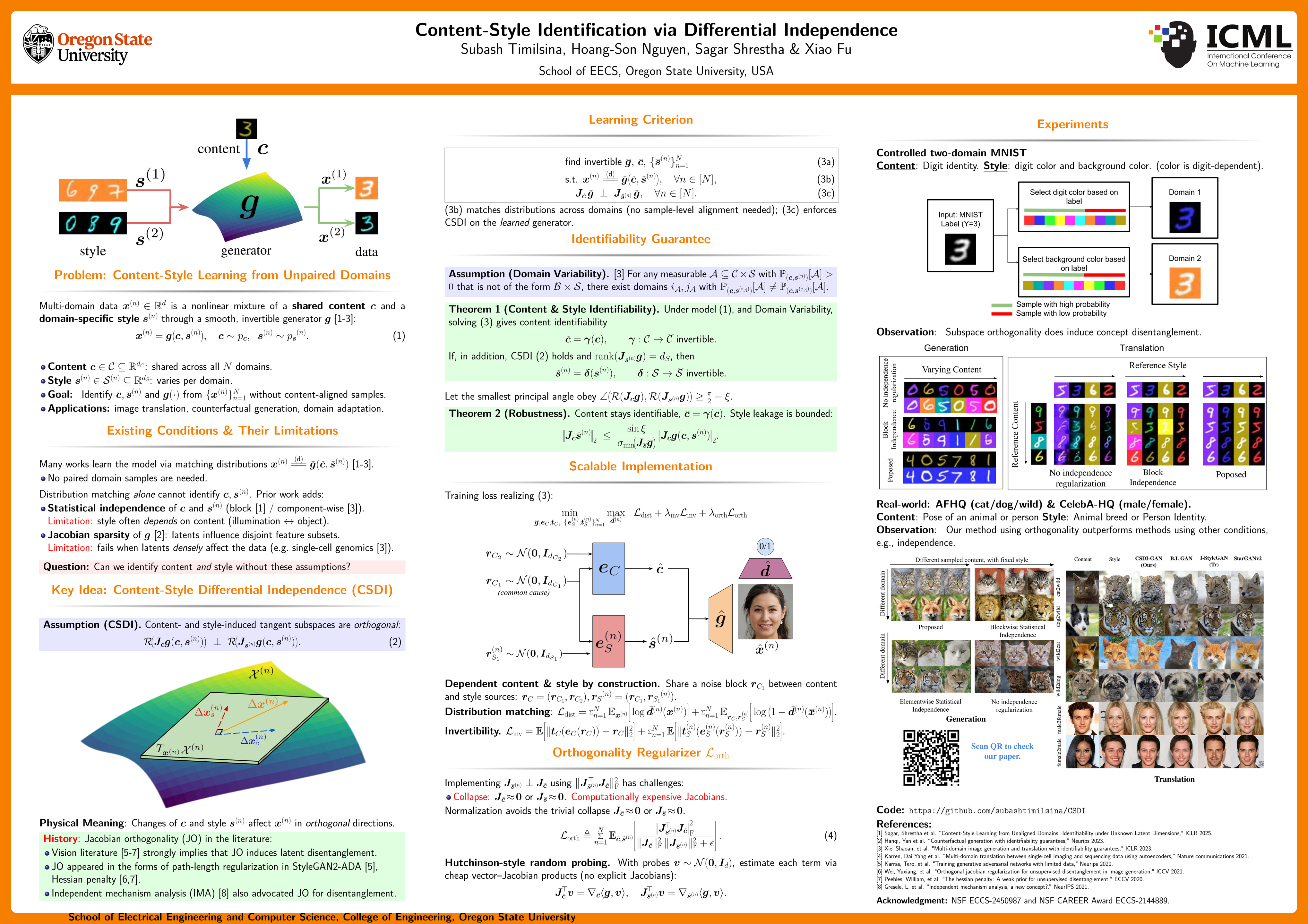
Generative analysis often models multi-domain observations as nonlinear mixtures of domain-invariant content variables and domain-specific style variables. Identifying both factors from unpaired domains enables tasks such as domain transfer and counterfactual data generation. Prior work establishes identifiability under (block-wise) statistical independence between content and style, or via sparse Jacobian assumptions on the nonlinear mixing function, but such conditions can be restrictive and may not hold in practice. In this work, we introduce differential independence, a weaker structural condition requiring that infinitesimal variations in content and style induce orthogonal directions on the data manifold, thereby enabling identifiability even when content and style are dependent and the Jacobian is dense. We operationalize this condition through a blockwise orthogonality constraint on the Jacobian subspaces associated with content and style. To support high-dimensional generative models, we design a stochastic regularizer based on numerical Jacobian approximation, enabling scalable training in settings such as high-resolution image generation. Experiments across multiple datasets corroborate the identifiability analysis and demonstrate practical benefits on counterfactual generation and domain translation tasks.
Lay Summary
Many AI models can generate or translate images, but they often struggle to control what changes and what stays the same. For example, when translating a cat photo into a dog photo, we may want to keep the pose and layout while changing the animal-specific appearance. We call the information to preserve content and the information to change style. This separation is useful for changing one aspect of an image while keeping another fixed, but it is hard with unpaired data, where the model sees images from different classes without knowing which ones share the same content. Existing methods often assume that content and style are statistically independent. We provide an alternative perspective where style may depend on content: content and style can still be separated if small changes in each move the generated data in different directions. We turn this idea into a practical training method for generative models. Our experiments show improved image generation and domain translation, such as changing style while preserving content. More broadly, our study deepens the understanding of content-style learning even when they are statistically dependent.Together with established approaches, our method provides a wider range of scenarios where content-style learning can be both practically effective and mathematically justified.