
GeoEvo: Identity-Aware Potential Game with Geometric Evolution for Personalized Multimodal Federated Learning
Abstract
Lay Summary
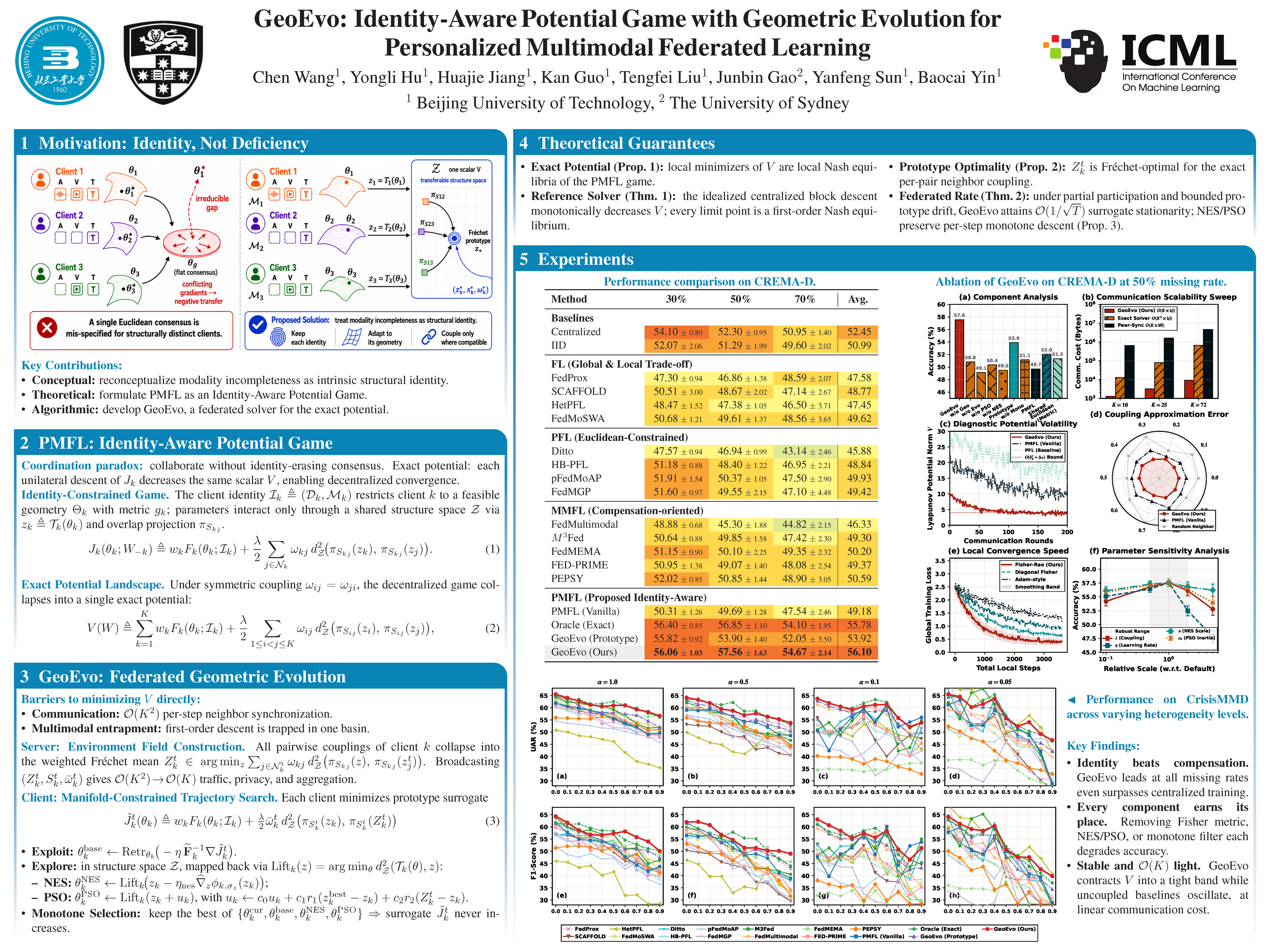
In collaborative networks (e.g., hospitals jointly predicting behavior), participants collect divergent data—some images, some text, few both—pushing each model onto a distinct curved surface, rendering a one-size-fits-all model unworkable. Existing approaches treat these missing modalities as flaws, while we see them as fundamental to each participant’s identity; forcing a uniform model ignores hidden geometric limits, creating severe optimization conflicts and degraded local performance. To bridge this gap without erasing individual differences, we model the problem as a potential game: all clients pursue their own goals while implicitly descending a shared landscape, guaranteeing stable coordination. Our method, GeoEvo, uses a central server to share lightweight geometric checkpoints across these distinct surfaces, while each client runs an evolutionary process to escape mathematical plateaus without crossing its hidden boundaries. The network exchanges only compatible insights, strictly preserving each client’s unique geometry and data privacy. GeoEvo mathematically guarantees steady, safe improvement for the entire decentralized network. Extensive experiments show diverse devices learn together successfully, significantly boosting personalization and robustness under real-world data mismatches. Our work demonstrates that treating missing modalities as a geometric identity and modeling collaboration as a potential game fundamentally advances personalized multimodal federated learning.