
CatFlow: Co-generation of Slab-Adsorbate Systems via Flow Matching
Abstract
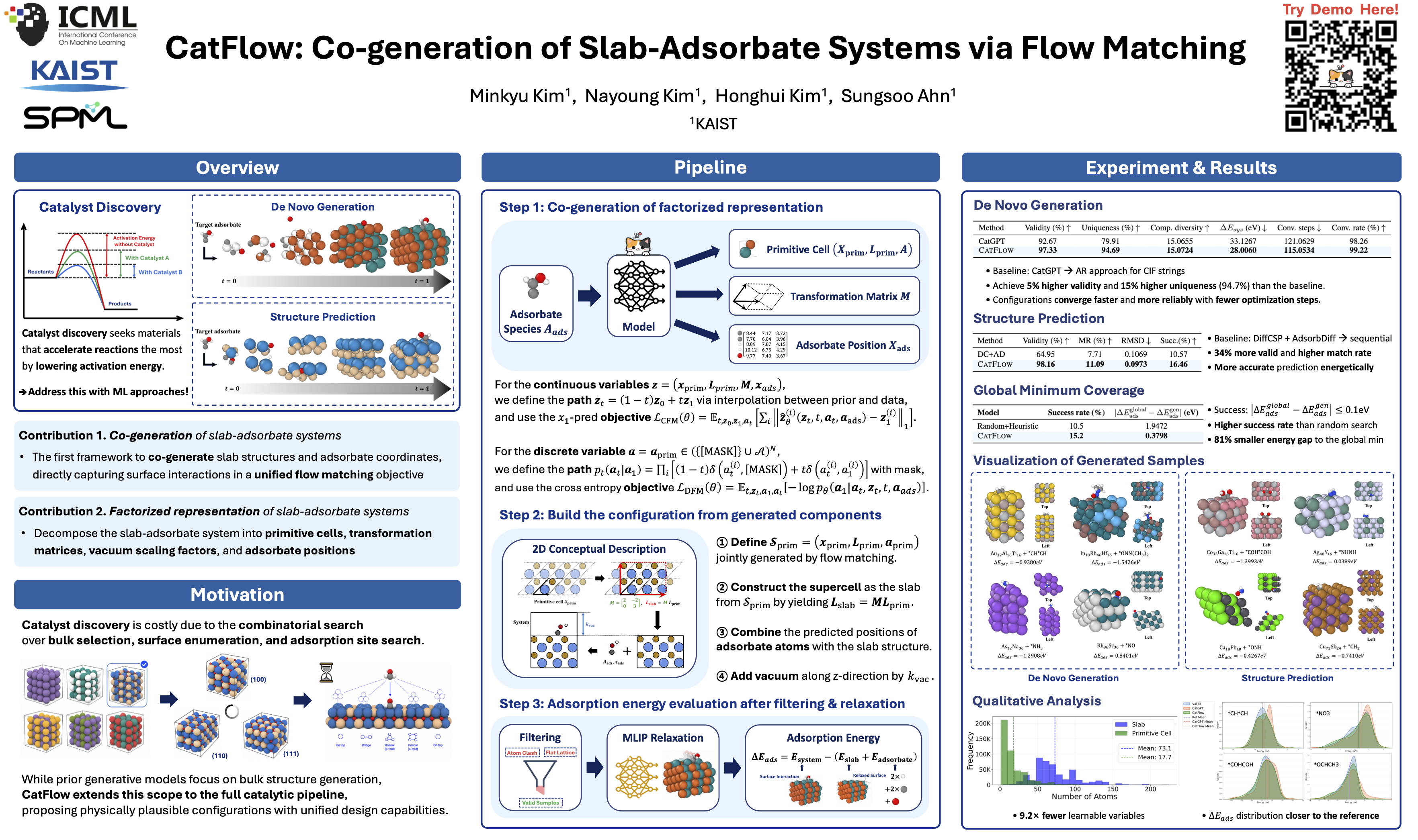
Discovering heterogeneous catalysts tailored for specific reaction intermediates remains a fundamental bottleneck in materials science. While traditional trial-and-error methods and recent generative models have shown promise, they struggle to capture the intrinsic coupling between surface geometry and adsorbate interactions. To address this limitation, we propose CatFlow, a flow matching-based framework for de novo design and structure prediction of heterogeneous catalysts. Our model operates on a primitive cell-based factorized representation of the slab-adsorbate complex, reducing the number of learnable variables by an average of 9.2x while explicitly encoding the surface orientation of the slab-adsorbate interface. Experiments on the Open Catalyst 2020 dataset demonstrate that CatFlow significantly improves the structural fidelity of generated catalysts compared to autoregressive and sequential baselines. Further experiments show that the generated structures accurately capture the adsorption energy distributions of physically plausible interfaces and lie closer to thermodynamic local minima.
Lay Summary
Catalysts are materials that speed up chemical reactions, and they are central to clean energy, fertilizers, fuels, and carbon capture. A working catalyst is a matched pair: a solid surface and the molecule that binds to it, and the two are tightly linked, so they cannot be designed in isolation. Existing methods treat the surface and the molecule separately, designing one and then the other, which is slow and misses how the two adjust to each other. We propose CatFlow, a generative AI model that builds both parts together in a single process. This matters because the surface and the molecule must fit together precisely to form a realistic structure. To make this efficient, we describe each surface by its smallest repeating tile instead of the full structure, which shrinks the complexity about nine times on average. This lets the model focus on the surface and the molecule rather than redundant repeated atoms. On the Open Catalyst 2020 benchmark, CatFlow produces far more physically valid and diverse structures than previous methods, and its structures sit closer to stable, low-energy forms. Tested against known optimal configurations, it finds stable arrangements more often and far more accurately than simple placement strategies. This brings automated catalyst discovery a practical step closer.