
Reason, Then Re-reason: Cross-view Revisiting Improves Spatial Reasoning
Abstract
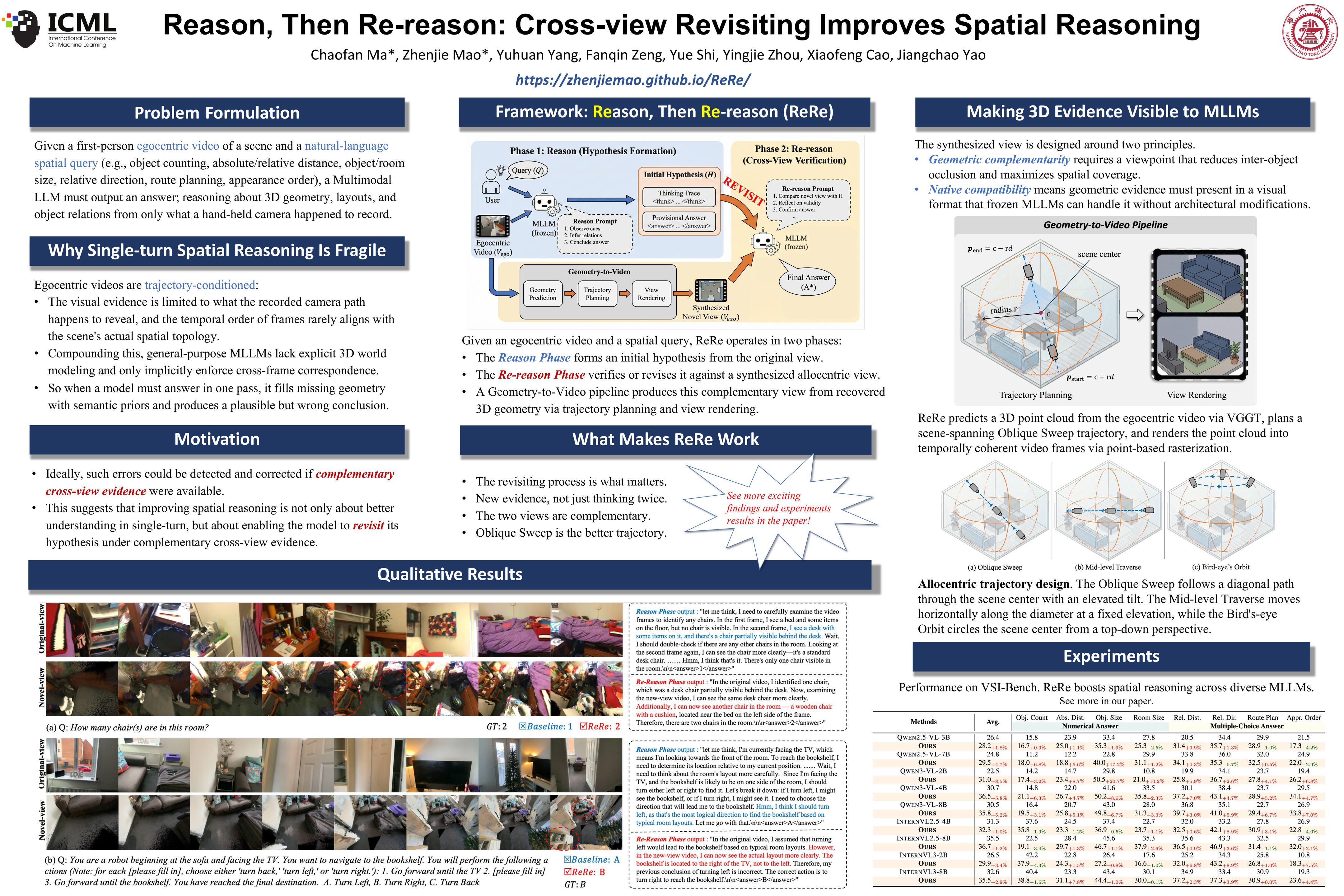
Spatial reasoning from egocentric videos is inherently challenging because the observable evidence is constrained by the camera trajectory. Existing methods rely on single-turn inference, forcing models to resolve geometric ambiguity through semantic priors rather than verifiable evidence. We argue that spatial reasoning should be revisitable: conclusions formed under limited evidence should remain open to revision when complementary viewpoints become available. Building on this insight, we propose Reason, then Re-reason (ReRe), a training-free, inference-time framework with two phases: in the Reason Phase, an MLLM forms a spatial hypothesis from the original video; in the Re-reason Phase, it verifies or revises the hypothesis by observing a synthesized novel-view video. To enable effective cross-view revisiting, we design a Geometry-to-Video pipeline that renders strategically complementary novel views from predicted 3D geometry. These views feature an elevated, oblique perspective with scene-spanning coverage, while preserving the MLLM's native video interface without architectural modifications. Extensive evaluations on VSI-Bench and STI-Bench demonstrate that ReRe substantially boosts open-source MLLMs to rival proprietary state-of-the-art performance.
Lay Summary
When you walk through your living room with a camera, an AI watching the video has a surprisingly hard time answering basic questions: "How many chairs are in the room?" or "Is the desk to the left or right of the bed?" The reason is simple: cameras only capture what they happen to point at. Objects slip behind furniture, walls block the view, and the AI is left guessing about a 3D world it only glimpsed in fragments. We built ReRe ("Reason, then Re-reason"), a system that lets the AI take a second look from a different angle. After the AI commits to an initial answer, ReRe reconstructs the room in 3D from the original video and generates a brand-new "virtual flyover" from a tilted, sweeping perspective the camera never actually filmed. The AI then watches this new view and decides whether to stick with its answer or revise it. Best of all, ReRe works without any retraining: it plugs into existing AI models out of the box. On standard tests, ReRe pushes free open-source AI to rival expensive commercial systems like GPT, Claude, and Gemini, with potential uses in household robots, AR glasses, and tools for visually impaired users.