
Particle Flow for Learning from Label Proportions
Abstract
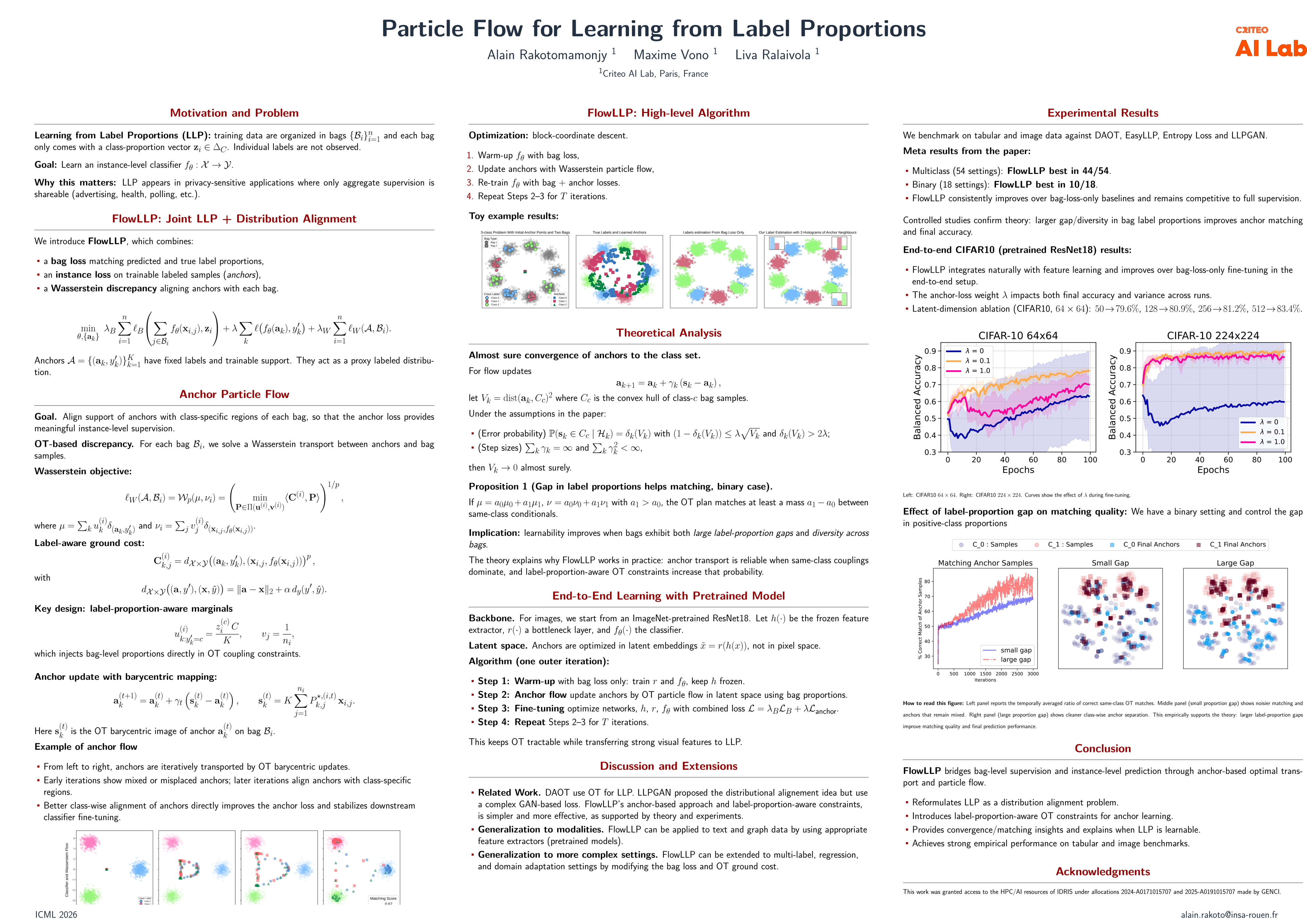
This work proposes a novel method for solving learning from label proportion problems. For this purpose, we learn a classifier that minimizes three key objectives: (i) a bag-level loss, which quantifies the discrepancy between true and predicted label proportions in bags, (ii) an instance-level loss, inspired from domain adaptation, which leverages anchor samples with known labels and trainable supports and (iii) a distribution discrepancy that aims at aligning anchor's learned support with those of the bag samples. The problem is formulated as an alternating optimization process, iteratively updating the classifier and aligning distributions via a particle flow method. The flow of anchor samples is governed by a vector field designed to minimize the anchor loss while ensuring alignment between anchor and bag distributions. We provide a theoretical analysis, guaranteeing the convergence of the flow and identifying conditions under which the method achieves effective alignment. Our analysis highlights that gap and diversity in label proportions within bags is a critical factor for learnability. Empirical results on tabular and image datasets demonstrate the method's effectiveness, outperforming state-of-the-art approaches.
Lay Summary
This research introduces a new way to train a machine learning model when we only know the overall mix of categories (like 60% cats and 40% dogs) in groups of data, rather than the exact label for each item. The method uses a few clearly labeled examples as anchors and aligns their distribution with the rest of the data, ensuring the model’s predictions match the known proportions. It iteratively improves the model and adjusts the data distributions, with mathematical proof that it works best when the groups have diverse mixes. Tests on real-world data show it performs better than existing methods.