
The Role of Target Update Frequencies in Q-Learning
Abstract
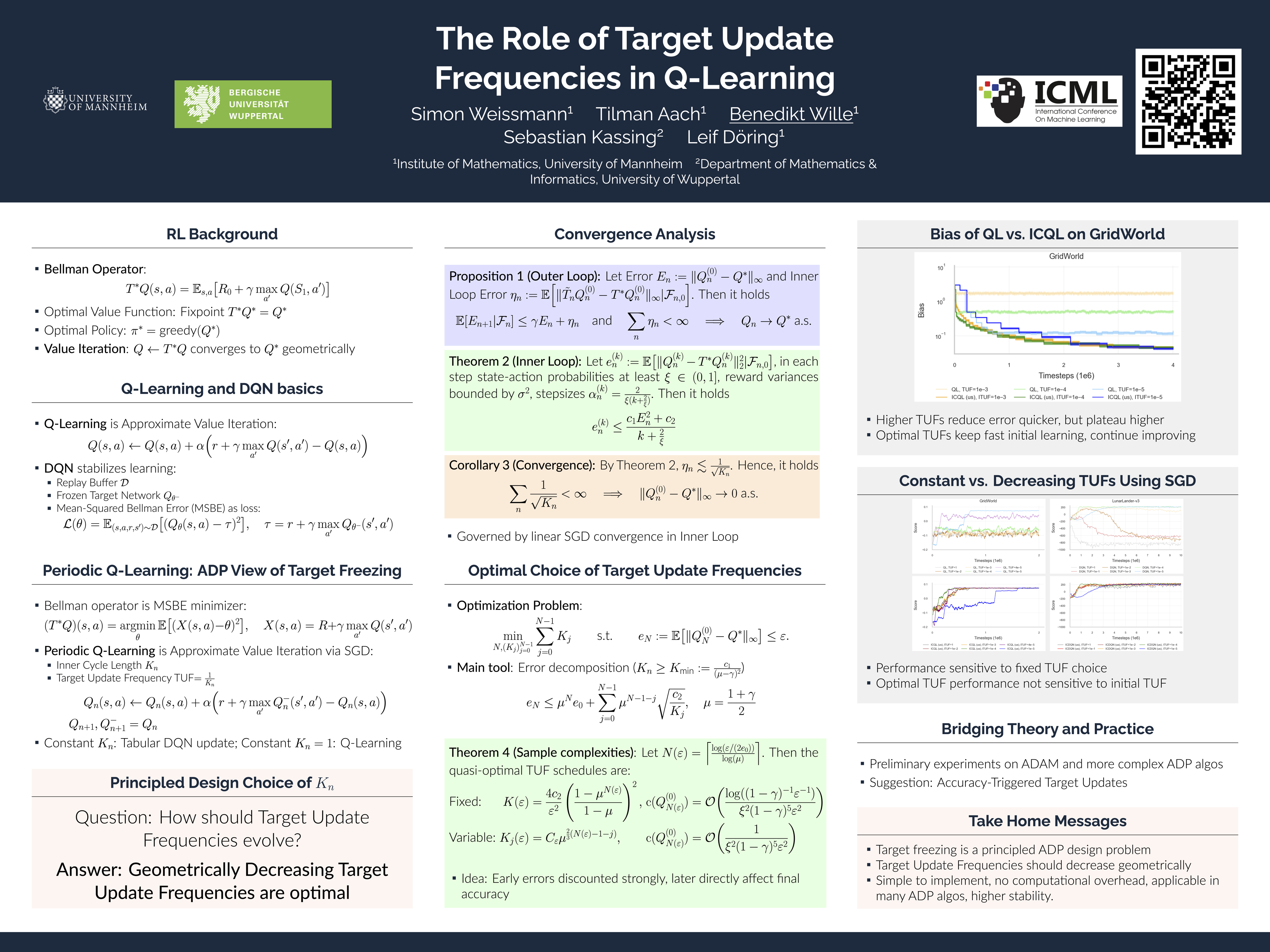
The target network update frequency (TUF) is a central stabilization mechanism in (deep) Q-learning. However, its selection remains poorly understood and is often treated merely as another tunable hyperparameter rather than as a principled design decision. This work provides a theoretical analysis of target fixing in tabular Q-learning through the lens of approximate dynamic programming. We view periodic Q-learning as a nested optimization scheme in which each outer iteration applies an inexact Bellman optimality operator, approximated by a generic inner loop optimizer. Rigorous theory yields a finite-time convergence analysis for the asynchronous sampling setting, specializing to stochastic gradient descent in the inner loop. Our results deliver an explicit characterization of the bias–variance trade-off induced by the target update period, showing how to optimally set this critical hyperparameter. We prove that constant target update schedules are suboptimal, incurring a logarithmic overhead in sample complexity that is entirely avoidable with adaptive schedules. Our analysis shows that the optimal target update frequency decreases geometrically over the course of the learning process.
Lay Summary
Reinforcement learning allows computers to learn through trial and error, but keeping this learning process stable is often difficult. To avoid changing their predictions too quickly based on unreliable new information, many learning algorithms temporarily keep older estimates fixed before updating them. A key question, however, is how long these estimates should remain unchanged. This work shows that the best choice actually changes over time. Early in learning, rough estimates are already helpful because they point the algorithm in roughly the right direction. Later on, as the algorithm gets closer to the correct solution, much more precise estimates are needed, and obtaining them requires more effort and more data. It is similar to finding a destination in a city: from far away, it is enough to know the general direction, but as you get closer, you need increasingly precise instructions to find the exact building and floor. Theoretical analysis together with experiments in several learning environments support this idea. In summary, the work demonstrates that reinforcement learning systems can learn faster and more reliably when they spend more effort on precision later in the learning process.