
Topology-Aware Contrastive Learning: Regulating Representation Connectivity via Persistent Homology
Abstract
Lay Summary
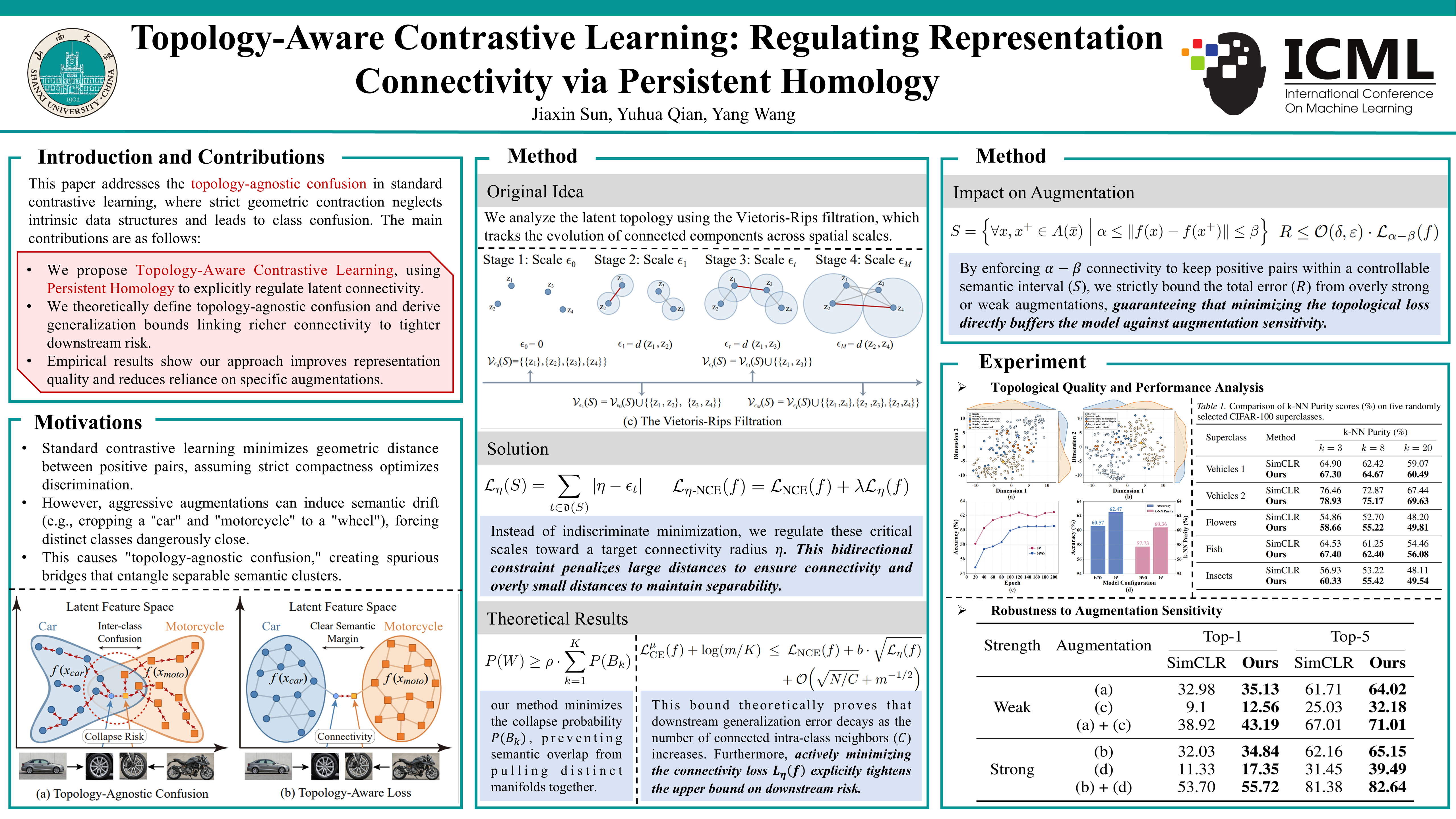
How do machine learning models learn to recognize images without human labels? They typically try to group similar pictures as tightly together as possible. However, this ignores the natural underlying "shape" of the data. When images are heavily modified during training, this over-tightening causes "class confusion," where the model starts mixing up visually similar but distinct objects—like mistakenly blurring the lines between a bicycle and a motorcycle. To solve this, we introduced Topology-Aware Contrastive Learning (TACL). Instead of crushing similar images into a single microscopic point, our framework acts like a mapmaker. It learns the broader structural connections within the data. This allows the system to keep similar items logically connected while maintaining clear, healthy boundaries between different categories. We mathematically proved that forcing too much compactness directly causes this confusion. By preserving the natural structural connections instead, our approach helps algorithms avoid these mix-ups. This makes the learned representations much more robust and reliable when handling complex, real-world visual data, without relying on specific training tricks.