
TF-FACE: Time-Frequency Fusion Learning via Frequency-Domain Adaptive and Controllable Enhancement for Trajectory Prediction
Abstract
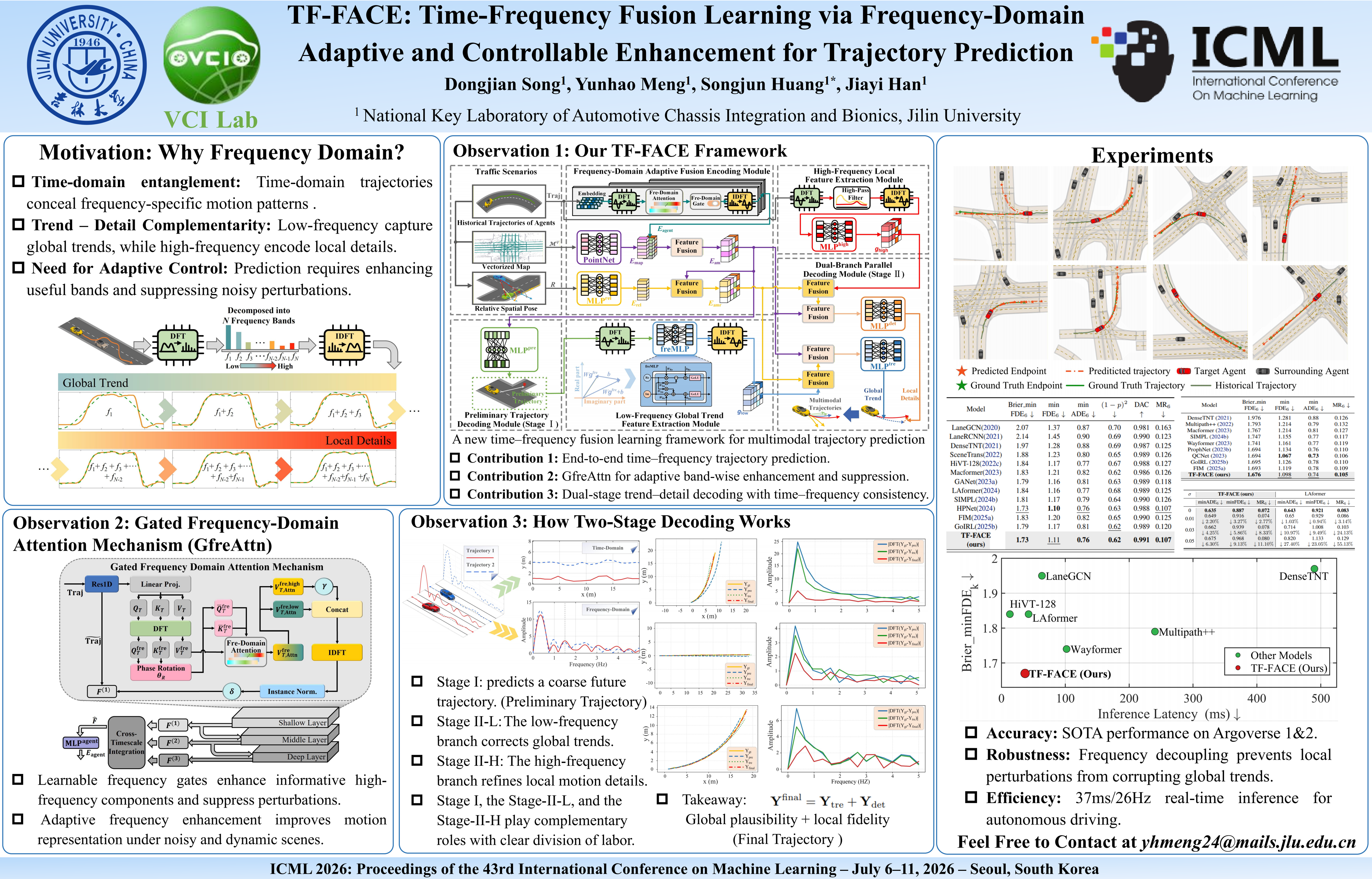
Accurately predicting the future trajectories of traffic participants is critical for safe, efficient, and human-friendly autonomous driving. Existing learning-based trajectory prediction methods are predominantly time-domain and insufficiently exploit latent frequency information, which limits their capability to capture low-frequency long-term dependencies and high-frequency short-term dynamics. To address this, we propose TF-FACE, a time-frequency learning framework via frequency-domain adaptive and controllable enhancement. TF-FACE introduces a fusion encoder with learnable gated frequency-domain attention that adaptively manipulates band-specific features for trajectory prediction. Building on the fused representation, we design a dual-stage decoder and a band-specific time–frequency dual-consistency loss to enable controllable decoupling and coupling across long- and short-term temporal scales, global and local scales, and then generate final multimodal predictions. Experiments on Argoverse 1 demonstrate that TF-FACE achieves state-of-the-art accuracy, while maintaining real-time inference for autonomous driving. Additional experiments are conducted on Argoverse 2, further validating TF-FACE's performance and generalizability.
Lay Summary
Accurately predicting the future trajectories of traffic participants is critical for safe, efficient, and human-friendly autonomous driving. Existing learning-based trajectory prediction methods are predominantly time-domain and insufficiently exploit latent frequency information, which limits their capability to capture low-frequency long-term dependencies and high-frequency short-term dynamics. To address this, we propose TF-FACE, a time-frequency learning framework via frequency-domain adaptive and controllable enhancement. TF-FACE introduces a fusion encoder with learnable gated frequency-domain attention that adaptively manipulates band-specific features for trajectory prediction, which can jointly model long-term trends and transient motions while filter high-frequency noise. Building on the fused representation, we design a dual-stage decoder and a band-specific time–frequency dual-consistency loss to enable controllable decoupling and coupling across long- and short-term temporal scales, global and local scales, and then generate final multimodal predictions. The first stage produces preliminary trajectories, which extracts reliable future low-frequency features. The second stage employs two channels to decode global trends from reliable future low-frequency features and local details from historical high-frequency features, whose combination yields the final multimodal predictions. Experiments on Argoverse 1 demonstrate that TF-FACE achieves state-of-the-art accuracy, while maintaining real-time inference for autonomous driving. Additional experiments are conducted on Argoverse 2, further validating TF-FACE's performance and generalizability.