
Euler–Poincaré Neural Dynamics: A Geometric-Mechanics Framework for Scientific Simulation
Abstract
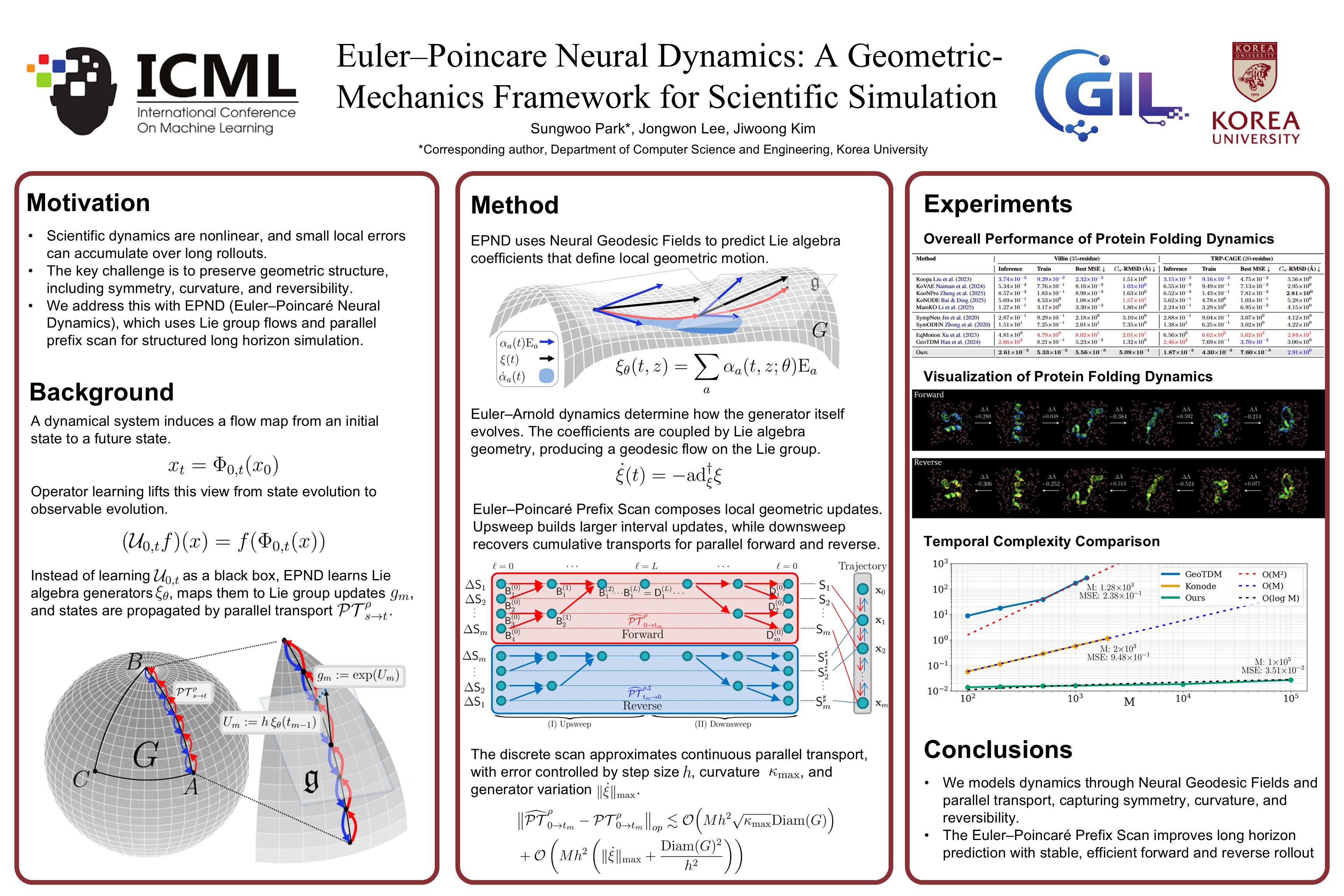
We introduce Euler--Poincar\'e Neural Dynamics (EPND), a geometric-mechanics framework that casts evolution-operator learning as Lie-group flows for long-horizon dynamical modeling. Unlike conventional operator-learning approaches that treat temporal propagation as an unconstrained black-box map, EPND places geometric mechanics at the core of its architecture, playing a role of the mathematical engine. This foundation enables a principled treatment of curvature, symmetry, and conservation, with the learned evolution expressed in geometric terms. Building on this foundation, we develop the Euler--Poincar\'e Parallel Scan, a parallel algorithm that leverages the associative algebra of Lie-group compositions to overcome the inefficiencies of sequential computation. By unifying geometric structure with scalable computation, EPND achieves high accuracy, strong stability, and significant parallel acceleration in modeling long-horizon dynamics in versatile scientific simulations.
Lay Summary
Scientific simulations often require not only predicting how a system evolves from an initial condition, but also reconstructing how an observed final state may have arisen. We introduce Euler–Poincaré Neural Dynamics, which learns evolution as geometry-aware transport along structured trajectories, allowing the same model to move consistently forward and backward in time. This unified formulation addresses both initial value problems (IVPs) and terminal value problems (TVPs) within a single reversible framework. By parallelizing long-horizon transport, our method enables accurate, stable, and efficient modeling of complex dynamical systems.