
Information-Geometric Adaptive Sampling for Graph Diffusion
Abstract
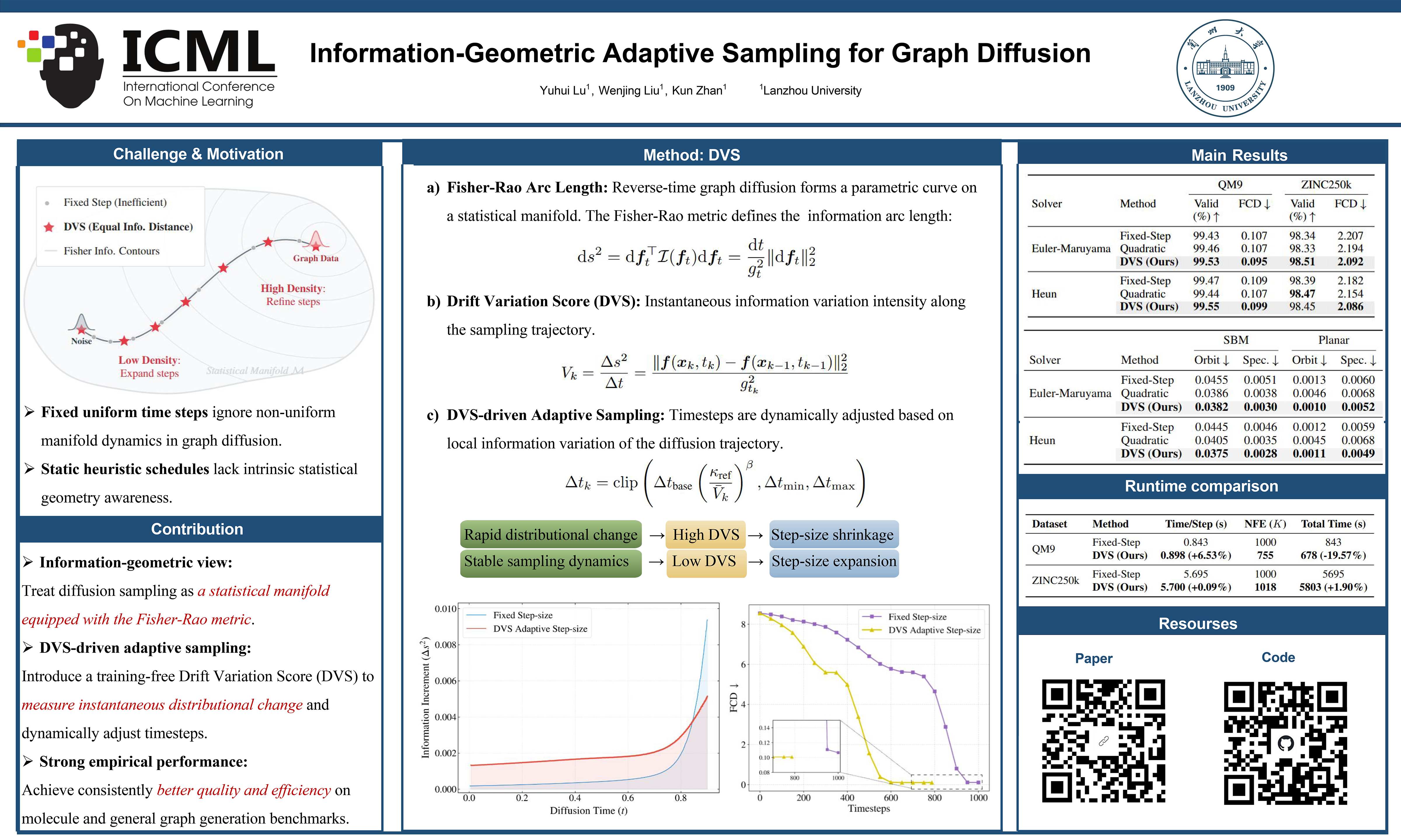
Standard diffusion models for graph generation typically rely on uniform time-stepping, an approach that overlooks the non-homogeneous dynamics of distributional evolution on complex manifolds. In this paper, we present an information-geometric framework that reinterprets the diffusion sampling trajectory as a parametric curve on a Riemannian manifold. Our key observation is that the Fisher-Rao metric provides a principled measure of the intrinsic distance. By analyzing this metric, we derive the Drift Variation Score (DVS), a geometry-aware indicator that quantifies the instantaneous rate of distributional change. Unlike prior heuristic-based adaptive samplers, our DVS solver enforces a constant informational speed on the statistical manifold, automatically maintaining a uniform rate of distributional change along the sampling trajectory. This equal arc-length strategy ensures that each discretization step contributes equally to the information speed. Theoretical analysis verifies that DVS characterizes the local stiffness of the sampling dynamics in the Fisher-Rao sense. Experimental results on molecule and social network generation show that DVS significantly improves structural fidelity and sampling efficiency.
Lay Summary
- We strengthened the discussion in the manuscript to emphasize why learning with a constant rate of distributional change along the sampling trajectory is crucial. Maintaining a uniform rate of informational progression ensures more accurate and stable sampling behavior, particularly in regions where the distribution evolves rapidly. 2. All author names in the references are now correctly capitalized. This includes ensuring proper capitalization for names such as Schrödinger and others associated with Langevin, and Hamiltonian Monte Carlo methods. 3. We added experiments evaluating the statistical significance of our results. These analyses are presented in Table 9, confirming the robustness and reliability of the proposed method. 4. All equations and symbols have been carefully reviewed and revised to improve readability and comprehension. Special attention was given to clarifying the roles of instantaneous DVS versus EMA-smoothed in controlling adaptive step sizes.