
Contrastive Geometric Learning Unlocks Unified Structure- and Ligand-Based Drug Design
Abstract
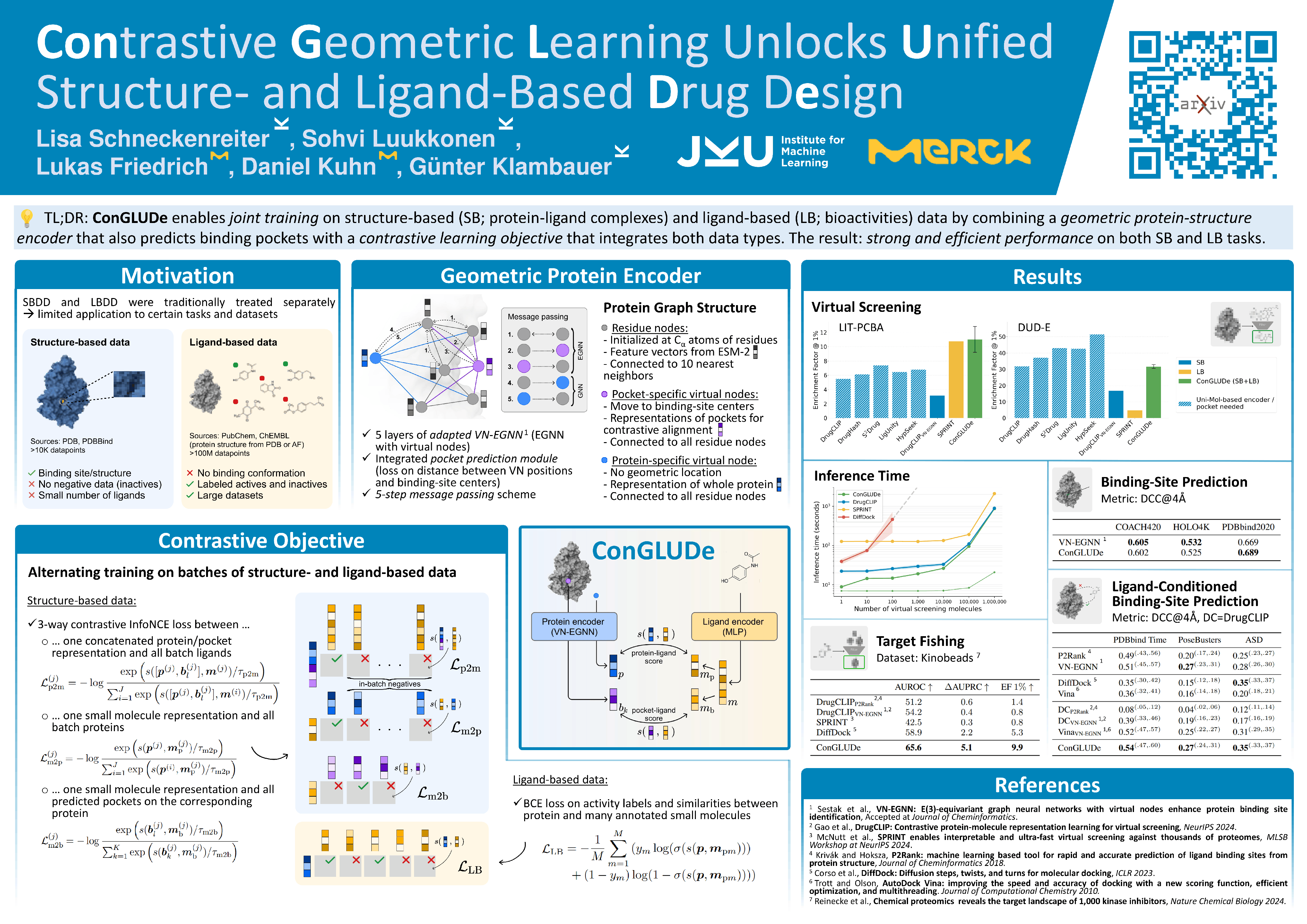
Structure-based and ligand-based computational drug design have traditionally relied on disjoint data sources and modeling assumptions, limiting their joint use at scale. In this work, we introduce Contrastive Geometric Learning for Unified Computational Drug Design (ConGLUDe), a single contrastive geometric model that unifies structure- and ligand-based training. ConGLUDe couples a geometric protein encoder that produces whole-protein representations and implicit embeddings of predicted binding sites with a fast ligand encoder, removing the need for pre-defined pockets. By aligning ligands with both global protein representations and multiple candidate binding sites through contrastive learning, ConGLUDe supports ligand-conditioned pocket prediction in addition to virtual screening and target fishing, while being trained jointly on protein-ligand complexes and large-scale bioactivity data. Across diverse benchmarks, ConGLUDe achieves competitive zero-shot virtual screening performance, substantially outperforms existing methods on a challenging target fishing task, and demonstrates state-of-the-art ligand-conditioned pocket selection. These results highlight the advantages of unified structure-ligand training and position ConGLUDe as a step toward general-purpose foundation models for drug discovery.
Lay Summary
Most diseases involve proteins - the molecular machines that carry out nearly every function in our cells - either because they malfunction or because they are introduced by viruses or bacteria. To treat a disease, we need to find a drug molecule that binds to the right protein and blocks or corrects its behavior, but with billions of candidate molecules, lab testing is too slow and costly, making computational methods essential. Machine learning models can learn to predict whether a molecule will bind to a protein. They rely on two different data sources: (1) 3D structures of molecules bound to proteins, and (2) large lab experiments that test many molecules at once and reveal whether they bind to the protein but not how. Each data type unlocks different capabilities, yet existing models typically only use one or the other. We built ConGLUDe, a single AI model that learns from both data sources simultaneously. The result is a model that does the work of several specialized tools at once: identifying which molecules are likely to bind a given protein, predicting where on the protein they will bind, and finding all proteins a molecule might interact with. ConGLUDe matches or outperforms existing methods on all these tasks and is extremely fast, making it practical for large-scale drug candidate searches and bringing us closer to a general-purpose AI for drug discovery.