
TimeSpot: Benchmarking Geo-Temporal Understanding in Vision–Language Models in Real-World Settings
Abstract
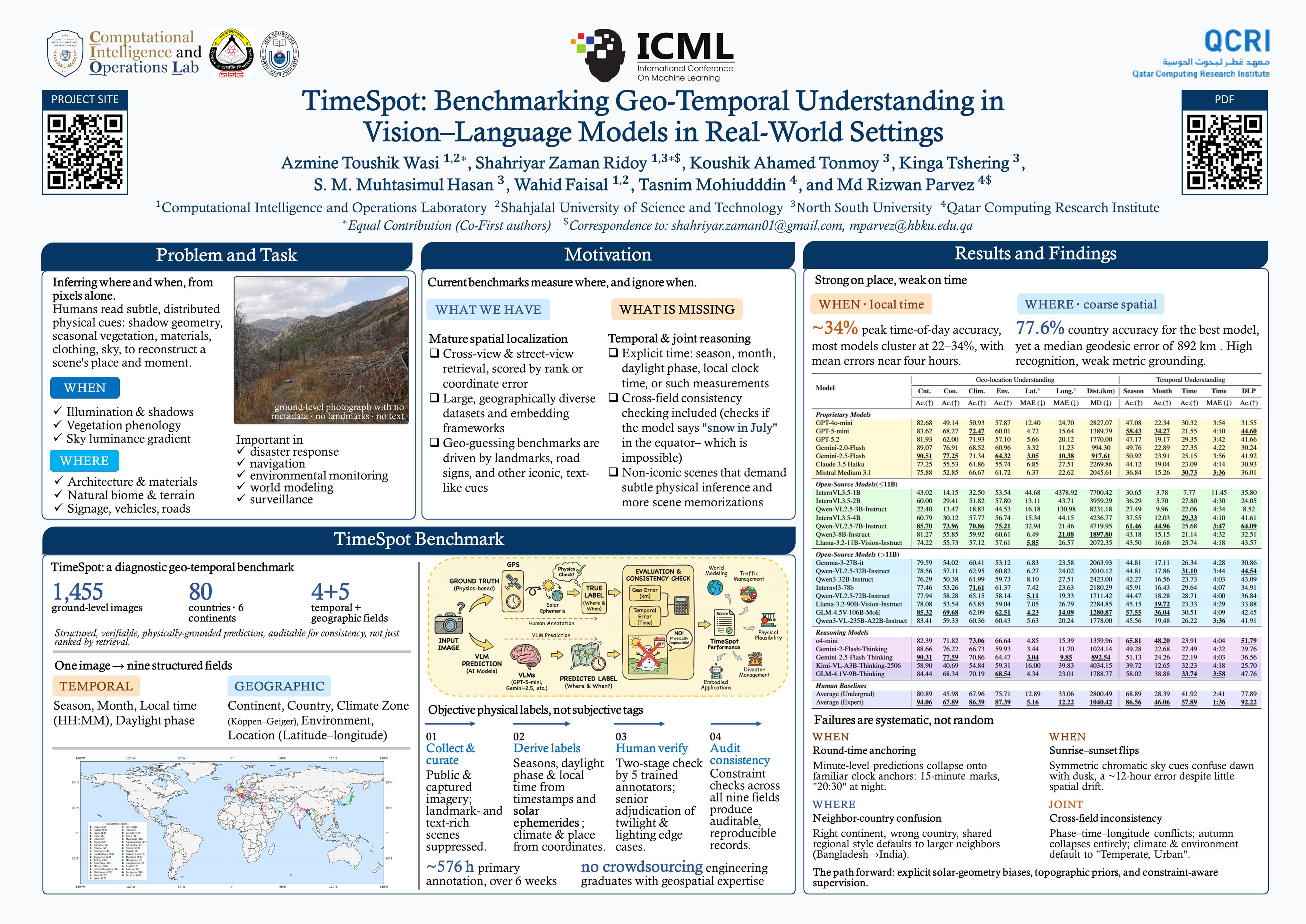
Geo-temporal understanding, the ability to infer location, time, and contextual properties from visual input alone, underpins applications such as disaster management, traffic planning, embodied navigation, world modeling, and geography education. Although recent vision–language models (VLMs) have advanced image geo-localization using cues like landmarks and road signs, their ability to reason about temporal signals and physically grounded spatial cues remains limited. To address this gap, we introduce TimeSpot, a benchmark for evaluating real-world geo-temporal reasoning in VLMs. TimeSpot comprises 1,455 ground-level images from 80 countries and requires structured prediction of temporal attributes (season, month, time of day, daylight phase) and geographic attributes (continent, country, climate zone, environment type, latitude–longitude) directly from visual evidence. It also includes spatial–temporal reasoning tasks that test physical plausibility under real-world uncertainty. Evaluations of state-of-the-art open- and closed-source VLMs show low performance, particularly for temporal inference. While supervised fine-tuning yields improvements, results remain insufficient, highlighting the need for new methods to achieve robust, physically grounded geo-temporal understanding. TimeSpot is available at: https://TimeSpot-GT.github.io.
Lay Summary
Imagine handing someone a photograph and asking them to tell you not just where it was taken but what time of day and what season it was. using only what they can see in the image. Humans do this naturally, reading clues like shadow angles, vegetation color, sky brightness, and architectural style, because understanding where and when a scene occurred is fundamental to making sense of the world around us. This capability matters far beyond academic interest: disaster response teams need to know whether a scene was captured at dawn or dusk to plan safe operations, navigation systems depend on correct temporal grounding to avoid dangerous misroutes, and media verification tools must detect when images have been mislabeled or manipulated in time. We built a benchmark called TimeSpot to test whether modern AI vision systems can do the same, using 1,455 photographs from 80 countries, each carefully verified against solar geometry and geographic databases, asking AI models to predict nine attributes simultaneously: continent, country, climate zone, environment type, coordinates, season, month, time of day, and daylight phase. When we tested a wide range of the most capable AI vision models available today, we found a striking split: the best models can identify countries from photographs at rates matching or exceeding trained human experts, yet they fail badly at temporal reasoning, with time-of-day errors averaging nearly four hours compared to under two hours for human domain experts. The models frequently produce physically impossible combinations, such as predicting January alongside summer conditions in the Northern Hemisphere, revealing that they recognize places by memorizing visual patterns rather than understanding the physical rules that govern how the world looks at different times and seasons. We also show that standard fine-tuning on labeled examples improves performance but cannot fix these fundamental gaps and that training a model to predict location and time simultaneously causes the two objectives to interfere with each other. TimeSpot provides the research community with a concrete diagnostic tool to measure and ultimately close this gap between surface-level visual recognition and genuine physical understanding of the world.