
Persona-Pruner: Sculpting Lightweight Models for Role-Playing
Abstract
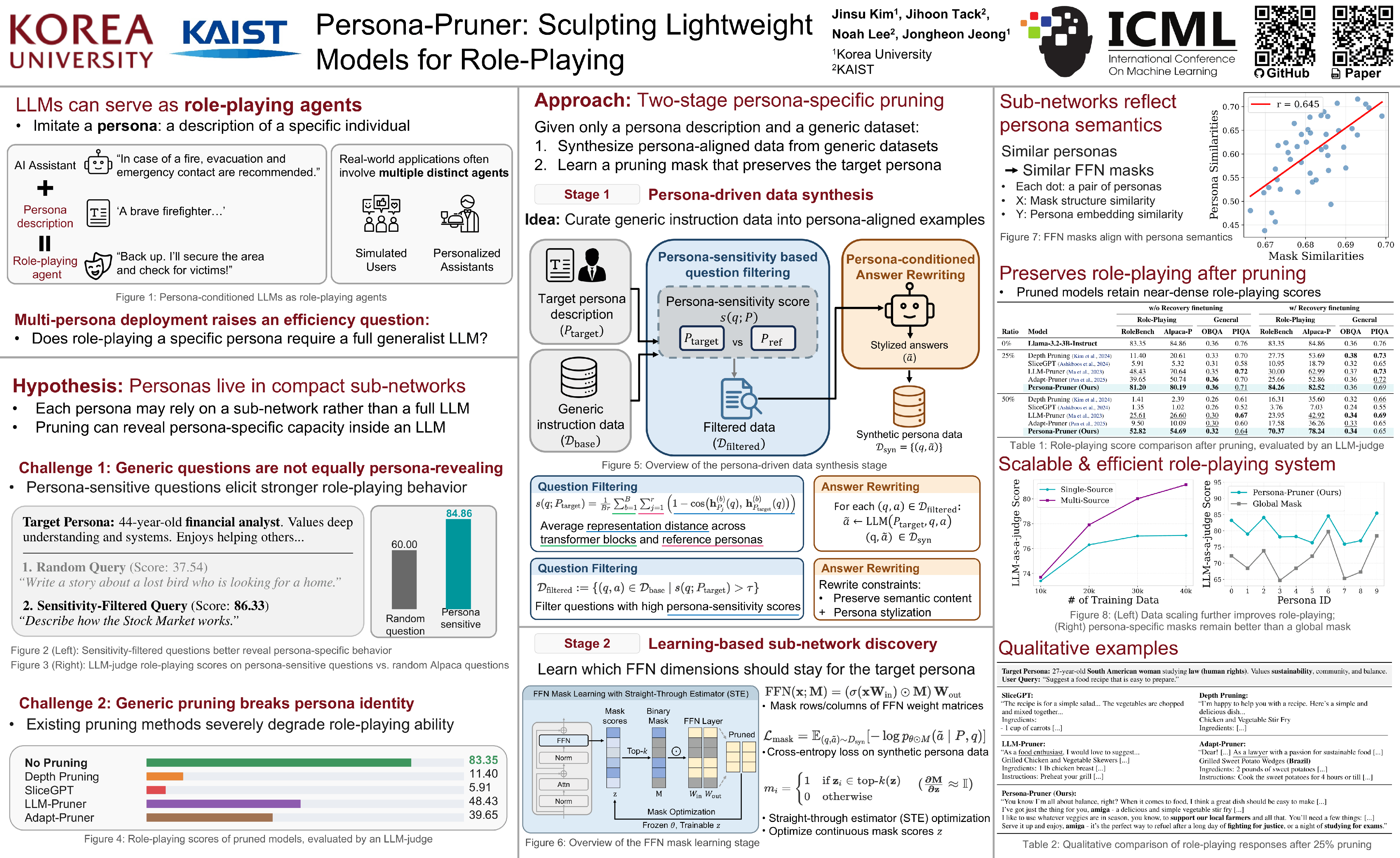
Language Models (LMs) have shown remarkable potential as role-playing chatbots, delivering consistent, stylized interactions when given a specification of a character or user persona. However, applying these capabilities to real-world applications (e.g., ecosystems with numerous NPCs interacting simultaneously) exposes a critical inefficiency due to the excessive computational cost. In this paper, we question the necessity of dedicating a full, generalist model to a single persona, hypothesizing that a specific character identity relies on only a fraction of the model’s total capacity. We observe that naïvely pruning LMs often severely degrades the role-playing performance for a specific persona; it does not distinguish between redundant knowledge and essential character traits. We propose Persona-Pruner, a framework that sculpts a lightweight role-playing model by isolating persona-specific sub-networks from a single description. Our experiments consistently show that Persona-Pruner preserves role-playing performance substantially more effectively than existing state-of-the-art LLM pruning techniques, reducing the performance drop from the dense model by up to 93.8% over the strongest baseline on RoleBench in LLM-as-a-judge score, while still maintaining general LLM capabilities. Code is available at https://github.com/jsu-kim/Persona-Pruner.
Lay Summary
Large language models can imitate different characters or personas, but running a large model for every persona can be expensive. This becomes especially difficult when only a short description of the persona is available, rather than many examples of how that persona would speak. Our work introduces a way to make a language model smaller for a specific persona while keeping its ability to respond in character. The method uses the persona description to identify which parts of the model are most important for that persona and removes less relevant parts. Across several experiments, we find that this approach preserves the model’s ability to respond consistently as the target persona better than existing methods for making language models smaller. This can make persona-based AI systems cheaper and easier to deploy, especially in settings with limited memory or computing resources.