
Near-Optimal Regret for KL-Regularized Multi-Armed Bandits
Abstract
Lay Summary
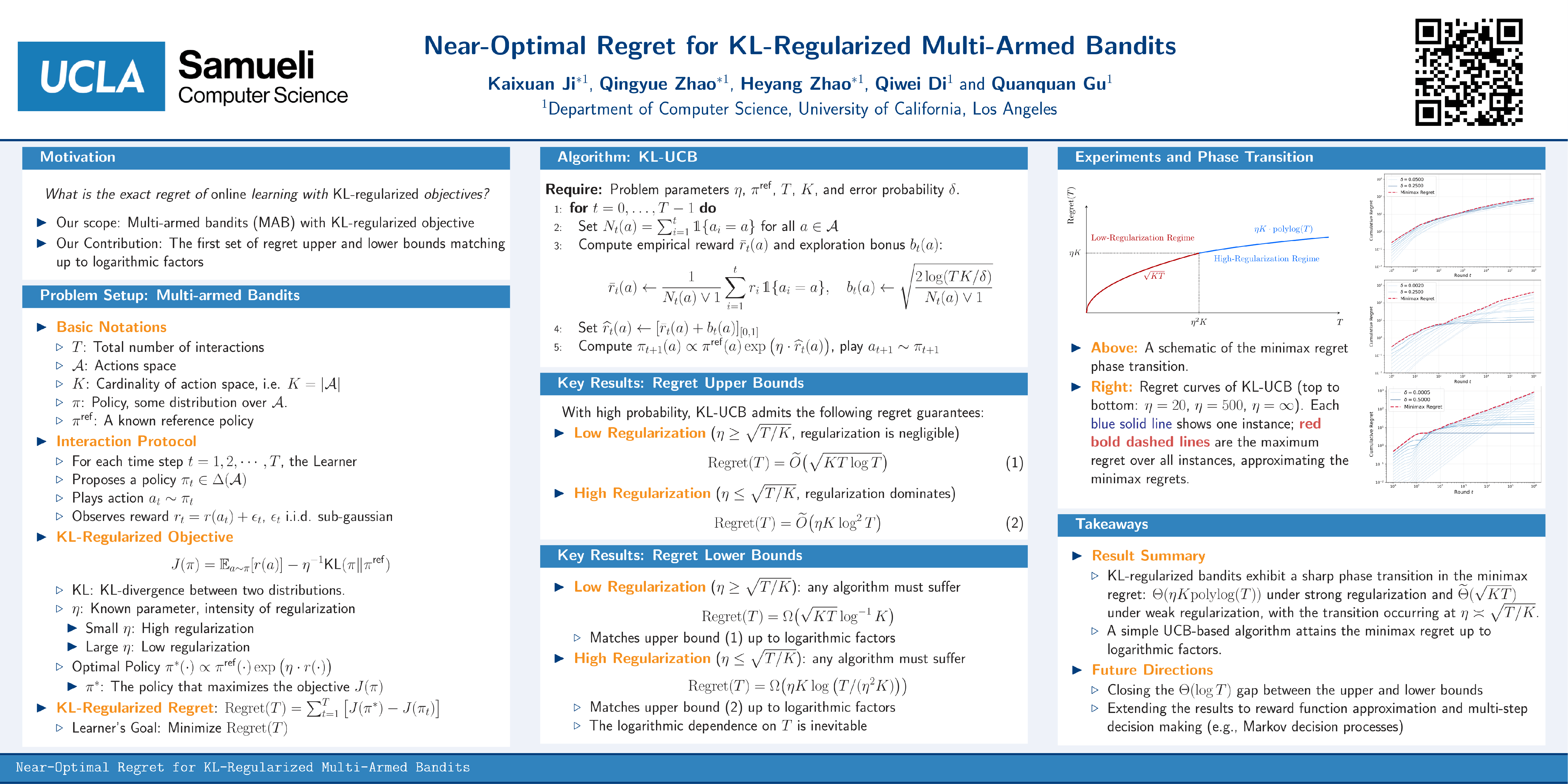
Reinforcement learning with KL regularization is widely used in modern AI systems, including robotic learning, recommendation systems, and large language model alignment, because it encourages models to improve while remaining close to a reference behavior. Despite its practical success, the optimal strategy of learning with KL regularization is still poorly understood. In this paper, we study this question in the multi-armed bandit setting, a fundamental model of online decision making. We show that KL regularization fundamentally changes the difficulty of learning. When regularization is strong, the learner can achieve regret that grows only logarithmically with the number of interactions, a dramatic improvement over the classical square-root regret in standard bandits. When regularization is weak, the problem behaves similarly to standard bandits and admits the classical square-root regret. We develop a new analysis of an optimistic exploration algorithm and prove nearly matching upper and lower bounds on regret, providing the first near-complete theoretical characterizations of KL-regularized online learning.