
Unlearning’s Blind Spots: Over‑Unlearning and Prototypical Relearning Attack
Abstract
Lay Summary
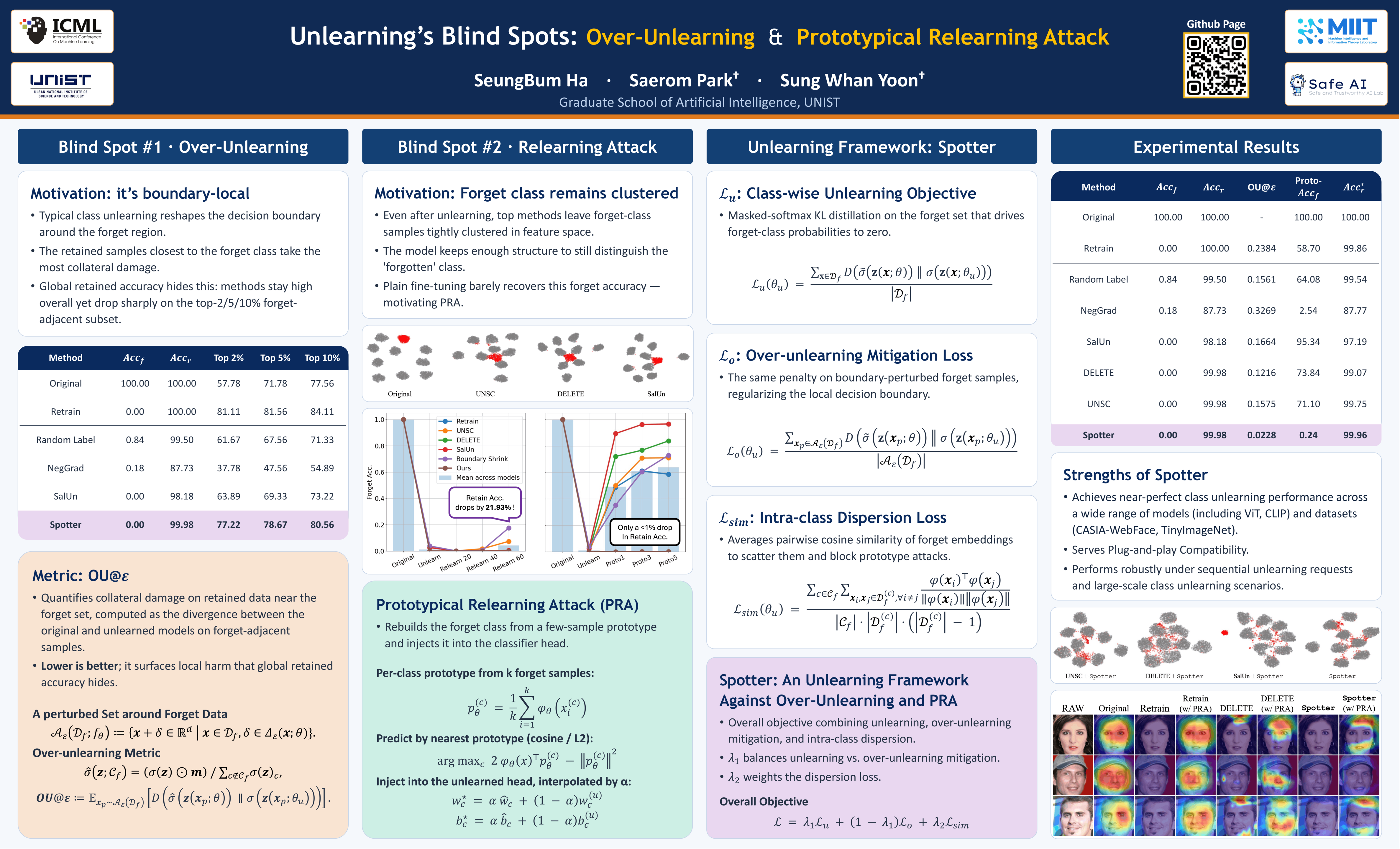
When an AI model learns from data that later needs to be removed, for example, a person's face from a facial recognition system, retraining the model from scratch is extremely costly. "Machine unlearning" offers a faster alternative by selectively erasing specific knowledge from a trained model. However, existing unlearning methods have two hidden weaknesses that have gone unnoticed. First, they often erase too much, accidentally degrading the model's performance on data that was supposed to stay intact, especially data that is similar to what was erased. Second, even after unlearning, the model's internal representations subtly retain enough structure that an attacker can recover the erased information using just a handful of images, which we call a Prototypical Relearning Attack. We addressed both problems with a new unlearning framework called Spotter. It uses two targeted techniques: one that protects data near the erased class from collateral damage, and another that scrambles the internal feature structure of the erased class so it can no longer be reconstructed by an attacker. Our results show that Spotter reliably fixes both blind spots across a range of datasets and model types, making machine unlearning more trustworthy for real-world privacy applications.