
M+Adam: Low-Precision Training via Additive–Multiplicative Optimization
Abstract
Lay Summary
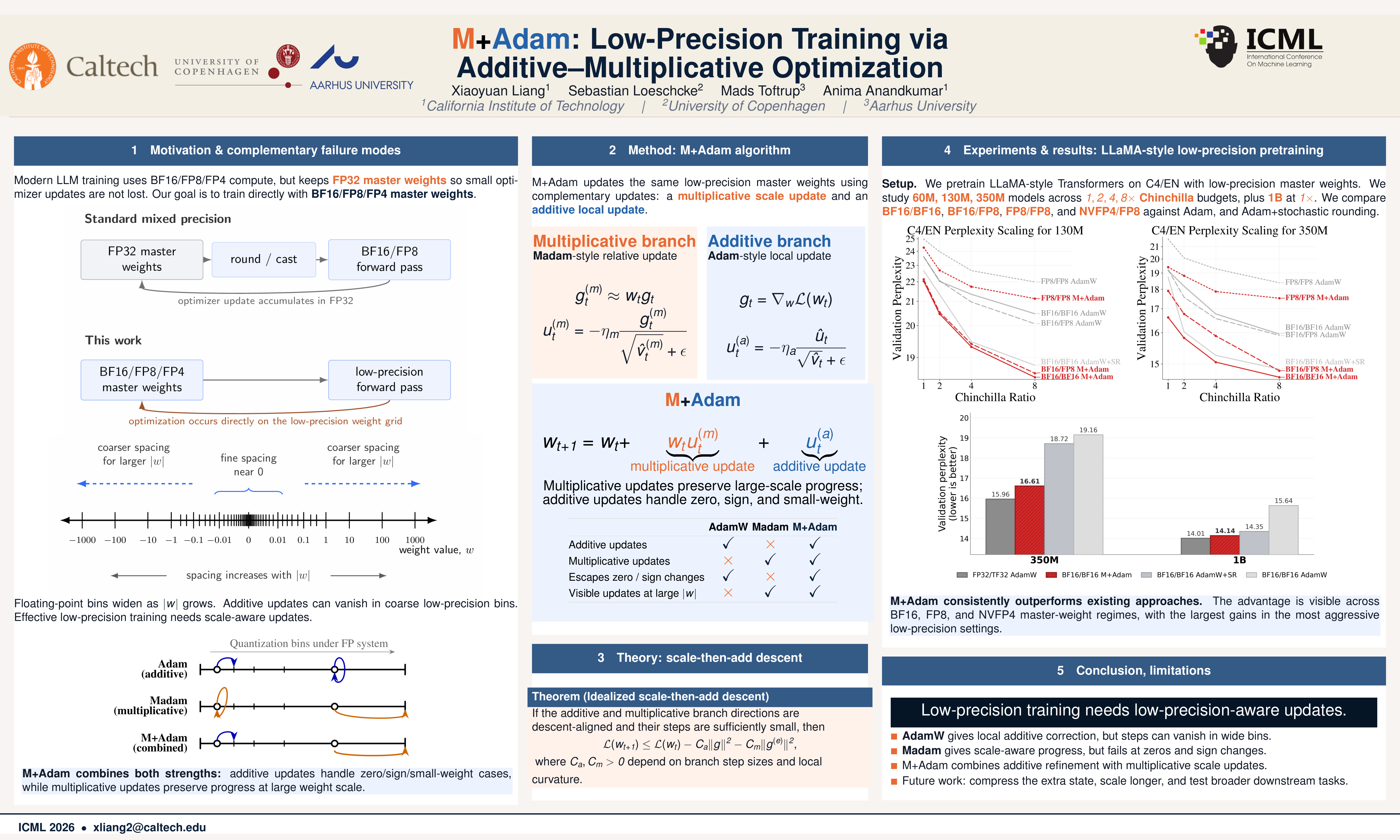
Training large AI models is expensive since it requires large amounts of memory, computation, and energy. One way to cut costs is to store and update model weights using fewer bits. However, this can make training unreliable: when the weights are too coarse, many small updates become zero after rounding, so the model stops improving and progress is stalled. This paper introduces M+Adam, a new training method designed to make training more reliable in such scenarios. The key idea is to combine two kinds of updates. One kind adds or subtracts small adjustments, which works well for small numbers, while the other kind makes relative or percentage-based changes, which work well when the values are large. By using both together, M+Adam avoids the weaknesses of either approach alone. Experiments on language model training show that M+Adam improves training quality across several model sizes and increasingly fewer bits to represent model weights. These results suggest that better training rules can help make large AI models cheaper and more stable to train without relying on expensive storage of model weights.