
Fair Decisions from Calibrated Scores: Achieving Optimal Classification While Satisfying Sufficiency
Abstract
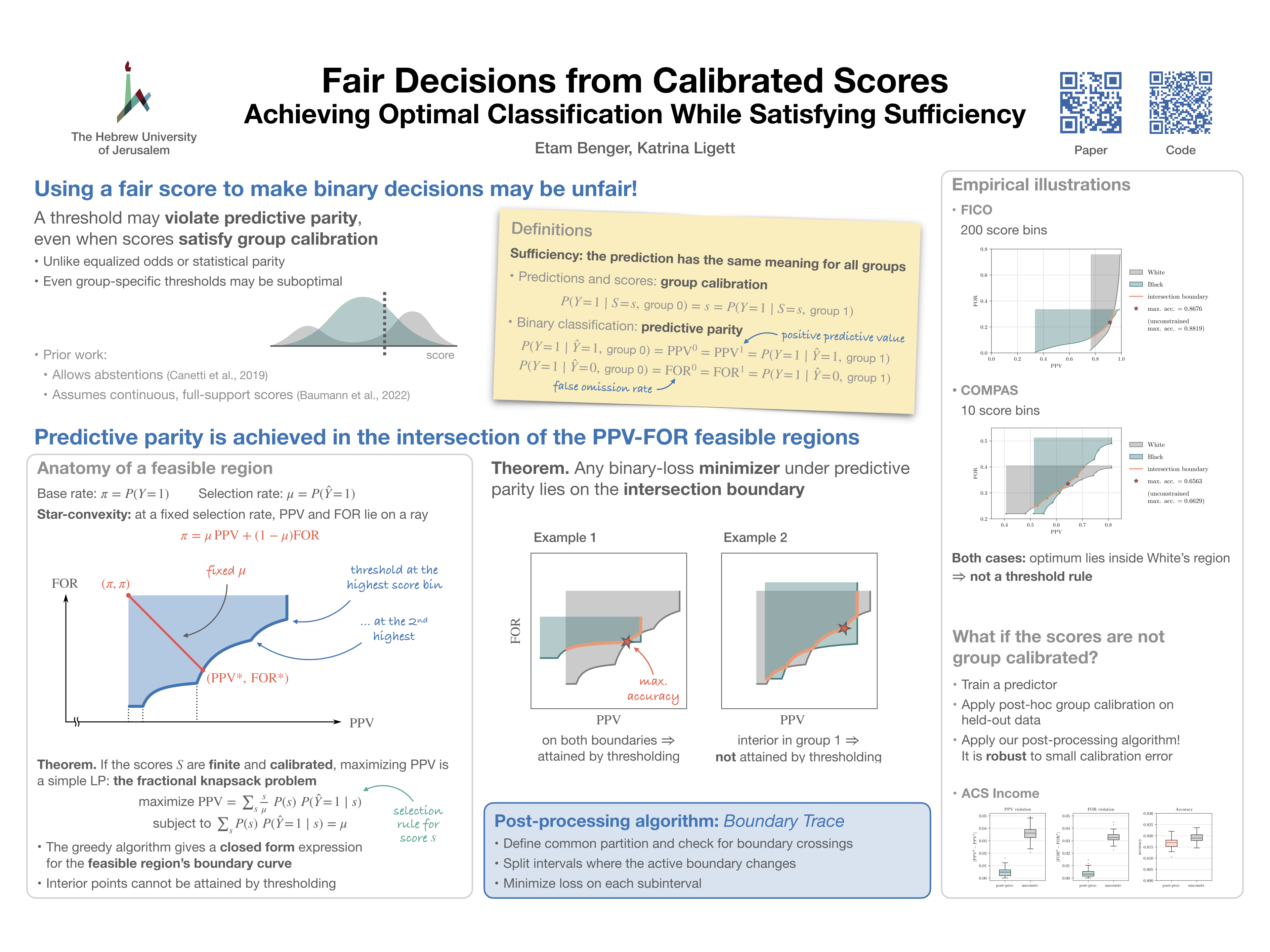
Binary classification based on predicted probabilities (scores) is a fundamental task in supervised machine learning. While thresholding scores is Bayes-optimal in the unconstrained setting, using a single threshold generally violates statistical group fairness constraints. Under independence (statistical parity) and separation (equalized odds), such thresholding suffices when the scores already satisfy the corresponding criterion. However, this does not extend to sufficiency: even perfectly group-calibrated scores---including true class probabilities---violate predictive parity after thresholding. In this work, we present an exact solution for optimal binary (randomized) classification under sufficiency, assuming finite sets of group-calibrated scores. We provide a geometric characterization of the feasible pairs of positive predictive value (PPV) and false omission rate (FOR) achievable by such classifiers, and use it to derive a simple post-processing algorithm that attains the optimal classifier using only group-calibrated scores and group membership. Finally, since sufficiency and separation are generally incompatible, we identify the classifier that minimizes deviation from separation subject to sufficiency, and show that it can also be obtained by our algorithm, often achieving performance comparable to the optimum.
Lay Summary
Machine learning systems often make decisions by first assigning people or cases a risk score, such as the estimated probability of loan repayment, recidivism, or success in some task, and then turning that score into a yes/no decision. A common fairness requirement is that, among people who receive the same decision, the meaning of that decision should be the same across demographic groups. For example, among people approved for a loan, the fraction who repay should be similar across groups, and the same should hold among people who are rejected. Even if the original scores satisfy this fairness requirement perfectly, simply applying a threshold to make binary decisions can break it. This paper studies how to convert calibrated scores into binary decisions while preserving this form of fairness. We give an exact method for finding the most accurate fair decision rule when the scores take finitely many values, as is common in practice. The method uses only the scores and group membership, and does not require retraining the original prediction model. We also show how the same framework can be used to compare different fair decision rules, including ones that reduce another common type of unfairness. Experiments on credit scores, COMPAS recidivism scores, and income prediction illustrate the method and show that it can achieve fairness with only a small loss in accuracy.