
Functional building blocks of neural networks: from network motifs to collective dynamics
Abstract
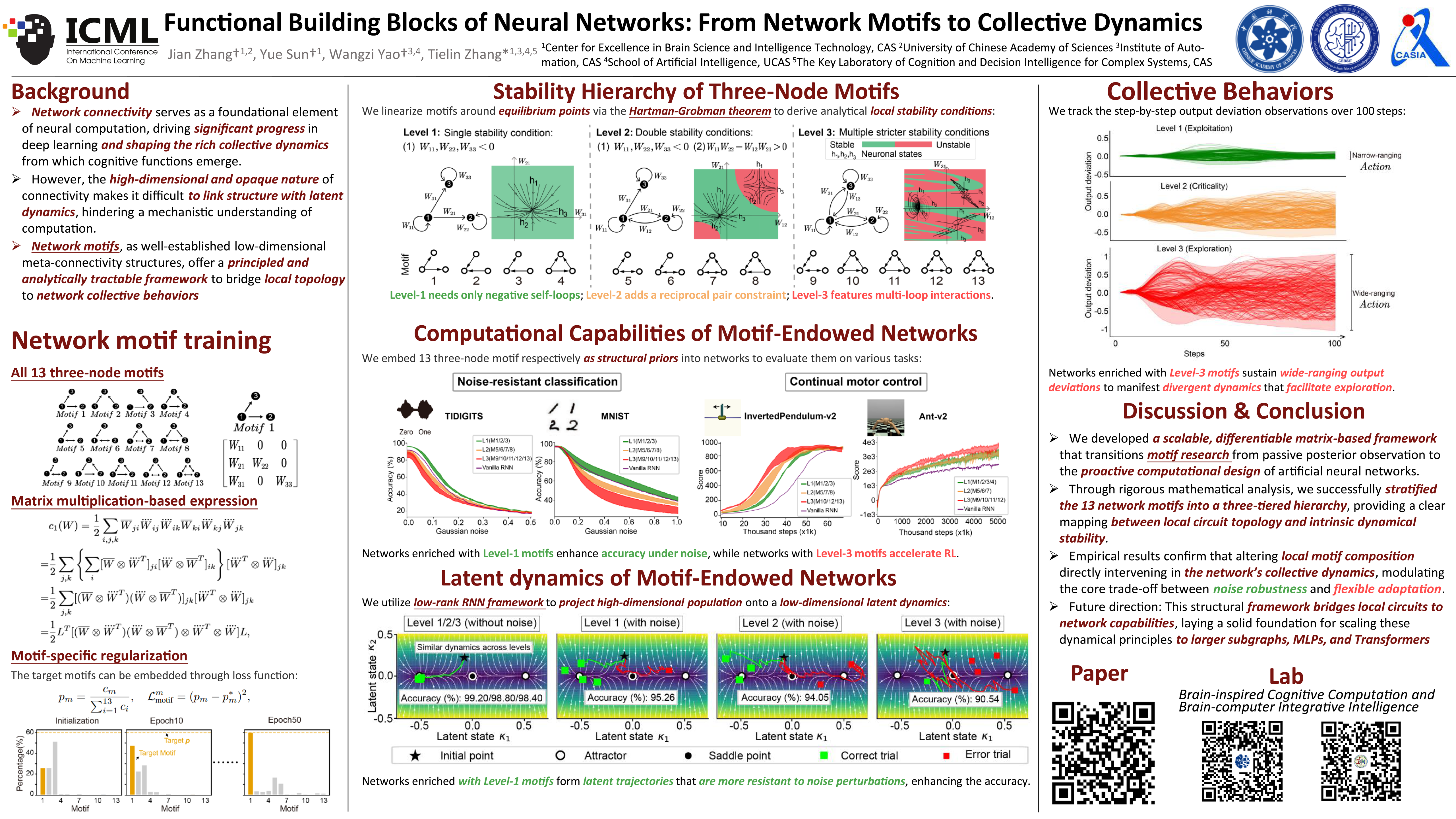
The advancement of artificial neural networks (ANNs) has been driven by diverse and well-established architectural designs, especially in connectivity. Biological neural networks, which exhibit a rich variety of neurodynamic circuits, offer a valuable source of inspiration for developing novel ANN models. In this study, we analyze the meta-connectivity structure and introduce a network motif-based approach, in which 13 distinct motifs are modeled as functional building blocks. These motifs represent low-dimensional, fundamental components of larger network architectures. Through rigorous theoretical analysis, we classify these motifs into a three‑layer hierarchical classification of their dynamical regimes and demonstrate that their hierarchical proportions critically shape collective neural dynamics. Furthermore, by embedding motif distributions into recurrent neural networks (RNNs), we show that these motifs can selectively enhance either network robustness or flexibility. Collectively, our findings provide a theoretical framework—supported by extensive experiments—for understanding how specific network motifs influence the computational properties of artificial intelligence systems via their underlying dynamics. This motif-driven approach offers significant potential for analyzing and modulating neural dynamics in ANNs.
Lay Summary
Network connectivity serves as a foundational element of artificial neural networks. In this study, we examined small, repeating connection patterns called “motifs”. Specifically, we analyzed 13 distinct three-node motifs and grouped them into three levels based on the mathematical stability of their dynamics. We found that changing the proportion of these different motifs directly alters how a network performs: Networks with a higher proportion of highly stable motifs are better at filtering out background noise and external interference. This makes them more robust for categorization tasks, such as recognizing images or spoken words. Networks with a higher proportion of less stable, more complex motifs remain more sensitive to environment. This sensitivity allows networks to adapt more quickly, which improves its performance in trial-and-error tasks like learning continuous action control. In short, our research shows that adjusting the basic connection patterns in neural networks is a practical way to tune the system for either stability or adaptability, depending on the specific requirements of the task.