
DNA: Uncovering Universal Latent Forgery Knowledge
Abstract
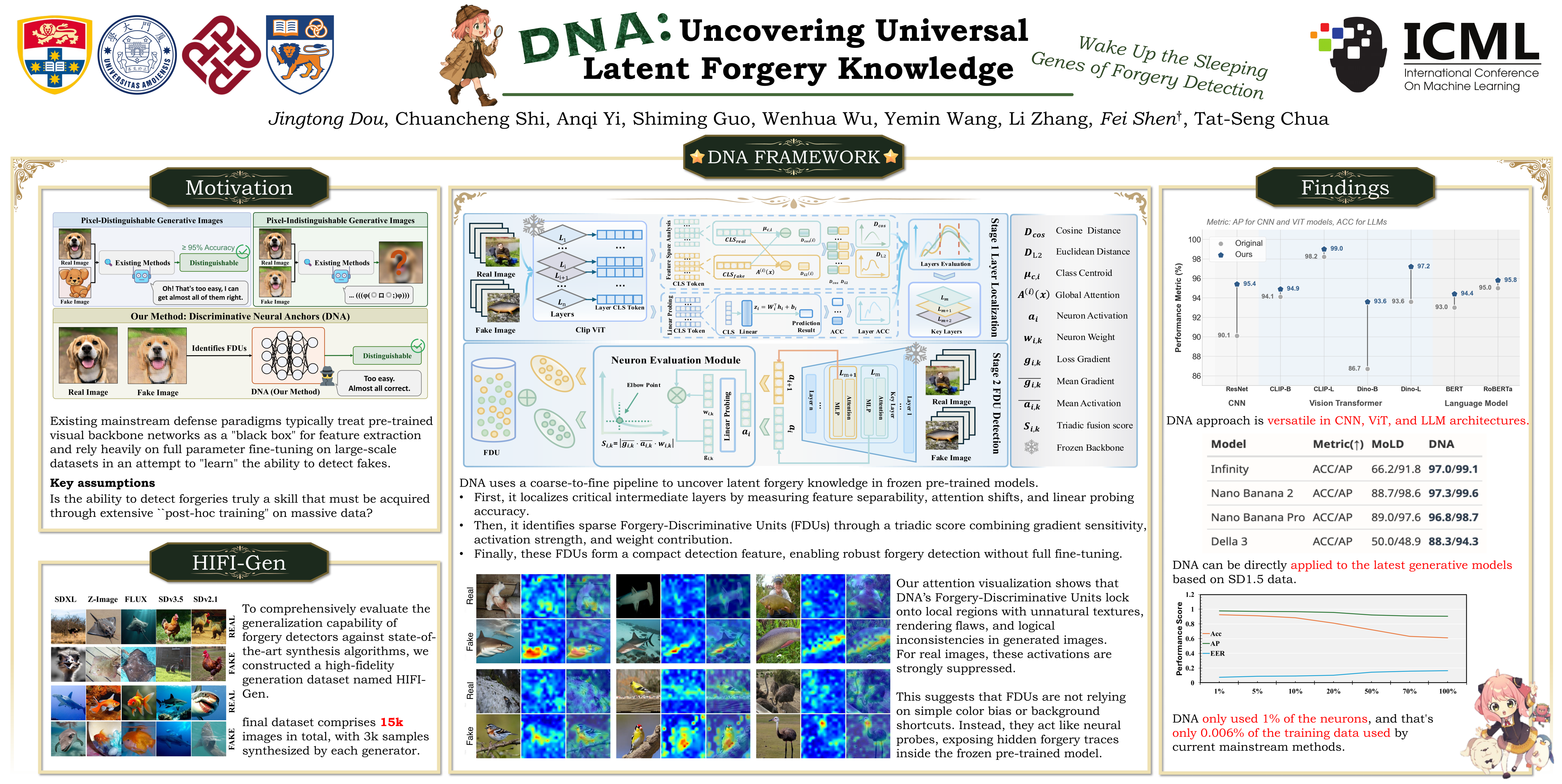
As generative AI achieves hyper-realism, superficial artifact detection has become obsolete. While prevailing methods rely on resource-intensive fine-tuning of black-box backbones, we propose that forgery detection capability is already encoded within pre-trained models rather than requiring end-to-end retraining. To elicit this intrinsic capability, we propose the discriminative neural anchors (DNA) framework, which employs a coarse-to-fine excavation mechanism. First, by analyzing feature decoupling and attention distribution shifts, we pinpoint critical intermediate layers where the focus of the model logically transitions from global semantics to local anomalies. Subsequently, we introduce a triadic fusion scoring metric paired with a curvature-truncation strategy to strip away semantic redundancy, precisely isolating the forgery-discriminative units (FDUs) inherently imprinted with sensitivity to forgery traces. Moreover, we introduce HIFI-Gen, a high-fidelity synthetic benchmark built upon the very latest models, to address the lag in existing datasets. Experiments demonstrate that by solely relying on these anchors, DNA achieves superior detection performance even under few-shot conditions. Furthermore, it exhibits remarkable robustness across diverse architectures and against unseen generative models, validating that waking up latent neurons is more effective than extensive fine-tuning.
Lay Summary
This paper, “DNA: Uncovering Universal Latent Forgery Knowledge,” focuses on a timely problem: AI-generated images are becoming so realistic that traditional detection methods are starting to fail. Earlier fake images often contained visible artifacts, strange textures, or frequency-level traces. But newer diffusion, DiT, and flow-matching models can produce images that are much harder to distinguish from real ones. The paper’s central idea is that the ability to detect AI-generated images may already exist inside large pretrained vision models. Instead of training a new detector from scratch, the authors try to uncover hidden “forgery knowledge” that is already embedded in these models. The proposed method is called DNA, short for Discriminative Neural Anchors. The metaphor is clear: even when AI-generated images look realistic on the surface, they may still carry a kind of hidden “synthetic fingerprint” in the model’s internal representation. DNA aims to identify the specific neurons that are sensitive to these forgery signals. The paper calls these neurons FDUs, or Forgery-Discriminative Units. This is different from many existing detection methods. A common approach is to use models like CLIP or ViT as feature extractors, then train a classifier on top. DNA instead asks a deeper question: what if pretrained models have already learned enough about natural image structure to notice when something is subtly “off”? In that case, the key is not to retrain the whole model, but to find the internal units that already respond to fake-image patterns. A simple analogy is this: traditional methods try to train a new forensic expert, while DNA searches inside an existing model for the “hidden investigators” that already know how to spot forged images. The method follows a coarse-to-fine process. First, it looks across different layers of the model to find where real and fake images begin to separate in representation space. Then, within those important layers, it selects neurons based on factors such as activation patterns, gradient sensitivity, and contribution to the final decision. These selected neurons become compact evidence for detecting AI-generated content. The paper also introduces a new benchmark called HIFI-Gen, designed to test detection on high-quality modern generated images. This matters because many older benchmarks rely on outdated generators, while real-world risks increasingly come from newer models such as SDXL, SDv3.5, FLUX, and other high-fidelity systems. The reported results suggest that DNA generalizes well across multiple datasets and generator families. In particular, it performs strongly not only on known benchmarks, but also on newer high-quality generated images. This supports the paper’s broader claim: there may be universal forgery-related signals inside pretrained vision models. The larger significance of this work is methodological. It suggests that AI safety and media forensics may not always require adding more external supervision or training ever-larger detectors. Sometimes, useful capabilities may already be latent inside foundation models. The challenge is to locate, interpret, and activate them. Of course, this is still a research-stage proposal. Real-world images are often compressed, cropped, filtered, reposted, or edited, which can make detection much harder. More independent testing is needed before we can know how robust DNA is in messy online environments. In one sentence: DNA argues that pretrained vision models already contain hidden knowledge for detecting AI-generated images; the key is to find the neurons that carry that knowledge and use them as reliable forensic anchors.